University of Exeter, UK.
Br J Soc Psychol. 2020 Oct;59(4):965-991. doi: 10.1111/bjso.12372. Epub 2020 Feb 24.
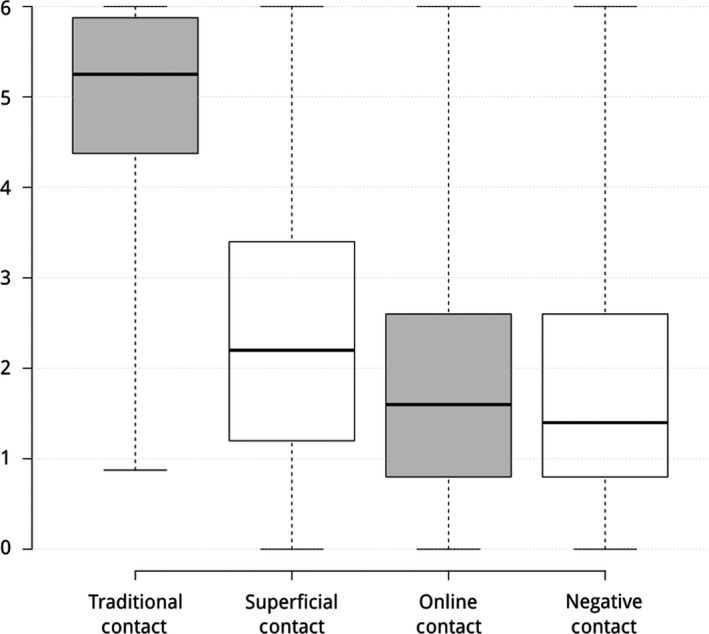
Intergroup contact encompasses a wide range of contact situations. Yet, how 'contact' is conceptualized by those involved has rarely been examined. We argue that understanding the range of subjective definitions of contact is important for intergroup contact measurement and wider impact work. In Study 1, 17 participants completed a 3-day diary and a semi-structured interview about their experiences of contact with other nationalities. We examined the threshold at which encounters are subjectively defined as intergroup contact. Results showed that subjective definitions of intergroup contact were disparate and diverse, particularly when contact was fleeting or online. In Study 2, we asked a British sample (N = 498) to rate the extent to which 67 different contact scenarios with non-British people represented 'intergroup contact'. Findings show that contact situations which diverge from positive, verbal, face-to-face encounters, such as negative contact or online contact, were less likely to be understood as contact, with strong variation in ratings. The extent to which situations were seen as contact was positively correlated with the amount of self-reported intergroup contact. Together, these findings demonstrate the need to recognize and account for the variability in subjective definitions of contact, which ultimately shape self-reports of intergroup contact.
群体间接触包含了广泛的接触情境。然而,很少有研究关注到参与者对“接触”的概念化理解。我们认为,理解接触的主观定义范围对于群体间接触的测量和更广泛的影响工作非常重要。在研究 1 中,17 名参与者完成了为期 3 天的日记和半结构化访谈,记录他们与其他国籍人士的接触经历。我们考察了将遭遇主观定义为群体间接触的门槛。结果表明,群体间接触的主观定义是多样且不同的,尤其是当接触是短暂的或在线上进行时。在研究 2 中,我们要求英国样本(N=498)评估 67 种不同的与非英国人的接触场景在多大程度上代表“群体间接触”。研究结果表明,与积极、口头、面对面的接触不同的接触情况,如负面接触或在线接触,不太可能被理解为接触,而对这些情况的评估差异很大。情境被视为接触的程度与自我报告的群体间接触的数量呈正相关。总的来说,这些发现表明需要认识到和考虑到接触的主观定义的可变性,这最终会影响到对群体间接触的自我报告。