Instituto de Parasitología y Biomedicina López-Neyra (IPBLN-CSIC), Av. Conocimiento 17, Armilla, 18016 Granada, Spain.
Int J Mol Sci. 2020 Feb 21;21(4):1479. doi: 10.3390/ijms21041479.
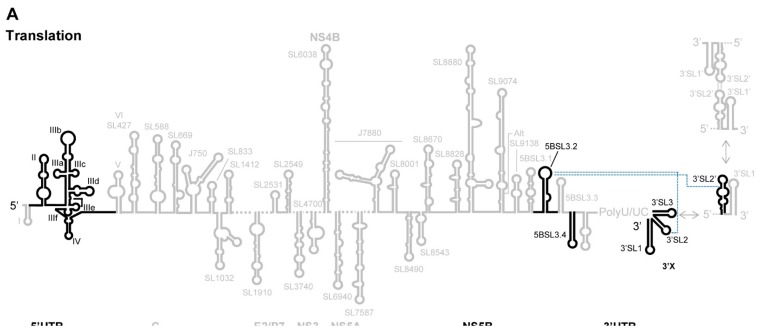
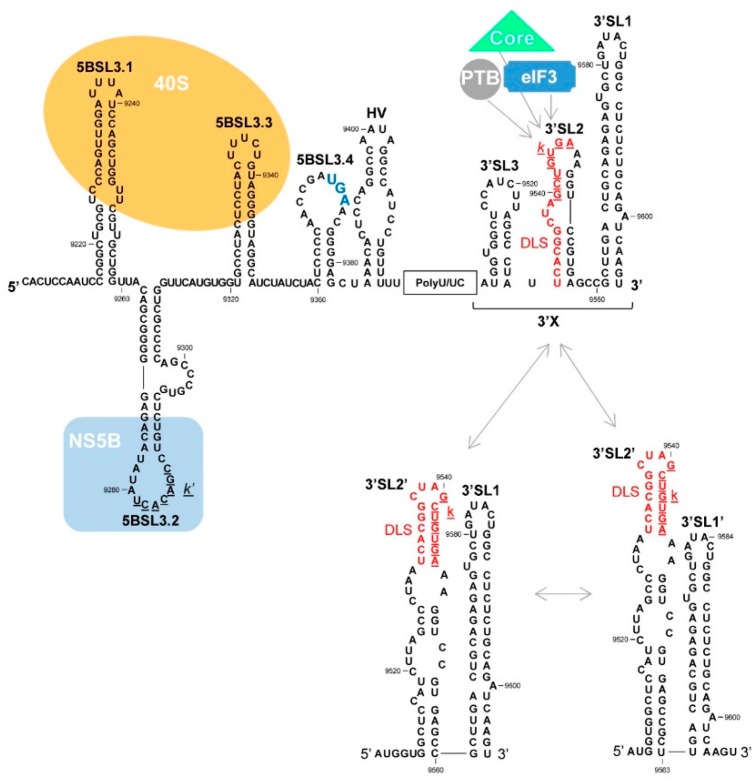
RNA virus genomes are multifunctional entities endowed with conserved structural elements that control translation, replication and encapsidation, among other processes. The preservation of these structural RNA elements constraints the genomic sequence variability. The hepatitis C virus (HCV) genome is a positive, single-stranded RNA molecule with numerous conserved structural elements that manage different steps during the infection cycle. Their function is ensured by the association of protein factors, but also by the establishment of complex, active, long-range RNA-RNA interaction networks-the so-called HCV RNA interactome. This review describes the RNA genome functions mediated via RNA-RNA contacts, and revisits some canonical ideas regarding the role of functional high-order structures during the HCV infective cycle. By outlining the roles of long-range RNA-RNA interactions from translation to virion budding, and the functional domains involved, this work provides an overview of the HCV genome as a dynamic device that manages the course of viral infection.
RNA 病毒基因组是多功能实体,具有控制翻译、复制和包装等过程的保守结构元件。这些结构 RNA 元件的保留限制了基因组序列的可变性。丙型肝炎病毒 (HCV) 基因组是一种正链、单链 RNA 分子,具有许多保守的结构元件,可管理感染周期中的不同步骤。它们的功能是通过蛋白质因子的结合来保证的,但也通过建立复杂、活跃、长距离的 RNA-RNA 相互作用网络来保证的——所谓的 HCV RNA 相互作用组。这篇综述描述了通过 RNA-RNA 接触介导的 RNA 基因组功能,并重新审视了一些关于功能高阶结构在 HCV 感染周期中作用的经典观点。通过概述从翻译到病毒体出芽的长距离 RNA-RNA 相互作用及其涉及的功能域,这项工作概述了 HCV 基因组作为一种动态装置,可管理病毒感染过程。