Niepmann Michael, Shalamova Lyudmila A, Gerresheim Gesche K, Rossbach Oliver
Medical Faculty, Institute of Biochemistry, Justus Liebig University Giessen, Giessen, Germany.
Faculty of Biology and Chemistry, Institute of Biochemistry, Justus Liebig University Giessen, Giessen, Germany.
Front Microbiol. 2018 Mar 12;9:395. doi: 10.3389/fmicb.2018.00395. eCollection 2018.
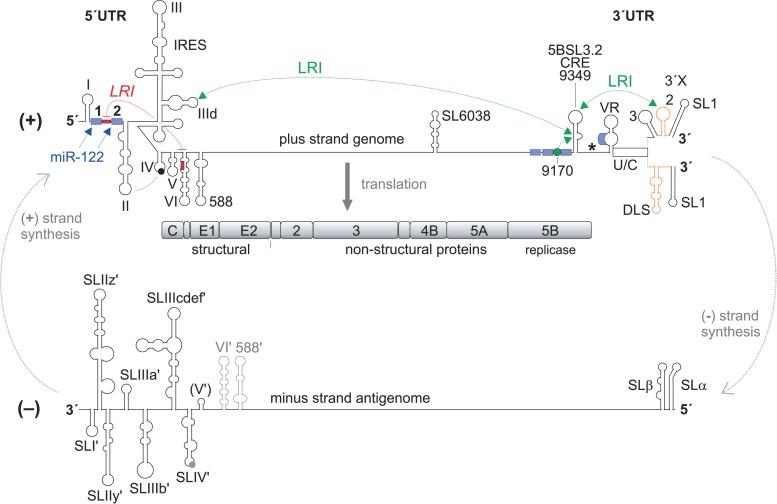
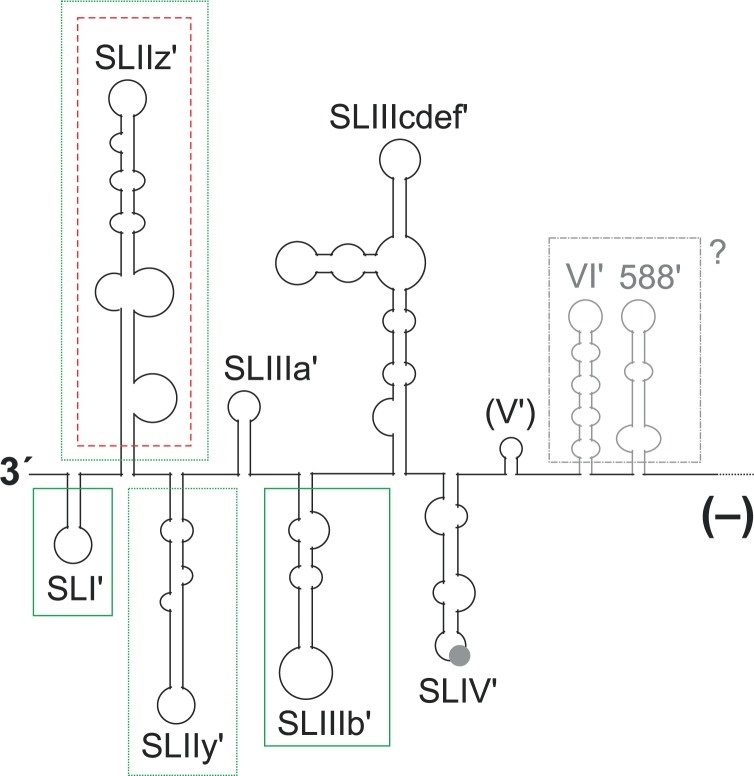
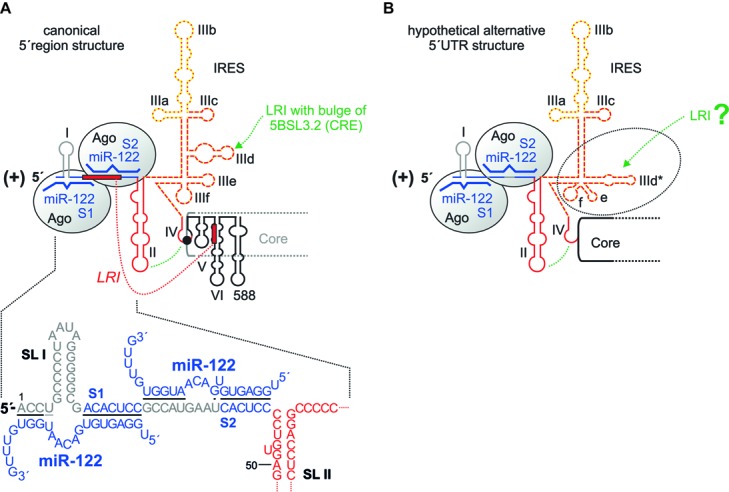
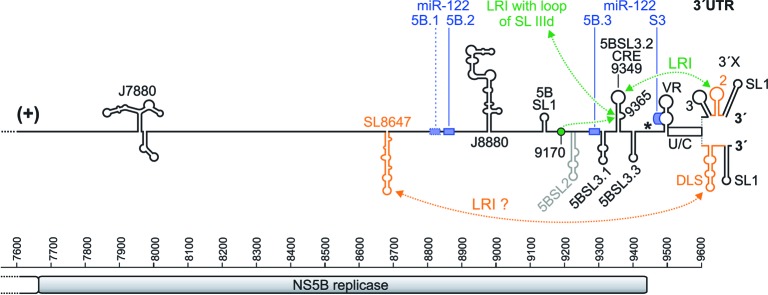
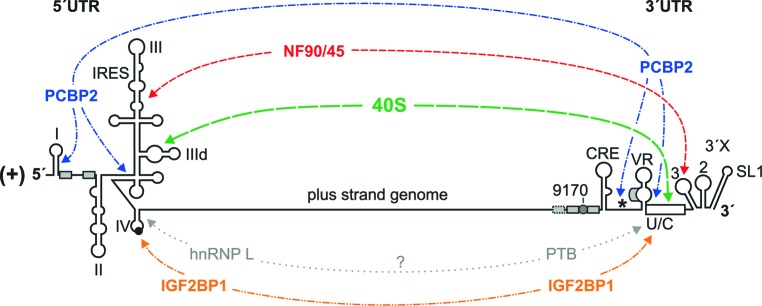
Hepatitis C virus (HCV) preferentially replicates in the human liver and frequently causes chronic infection, often leading to cirrhosis and liver cancer. HCV is an enveloped virus classified in the genus in the family and has a single-stranded RNA genome of positive orientation. The HCV RNA genome is translated and replicated in the cytoplasm. Translation is controlled by the Internal Ribosome Entry Site (IRES) in the 5' untranslated region (5' UTR), while also downstream elements like the -replication element (CRE) in the coding region and the 3' UTR are involved in translation regulation. The -elements controlling replication of the viral RNA genome are located mainly in the 5'- and 3'-UTRs at the genome ends but also in the protein coding region, and in part these signals overlap with the signals controlling RNA translation. Many long-range RNA-RNA interactions (LRIs) are predicted between different regions of the HCV RNA genome, and several such LRIs are actually involved in HCV translation and replication regulation. A number of RNA -elements recruit cellular RNA-binding proteins that are involved in the regulation of HCV translation and replication. In addition, the liver-specific microRNA-122 (miR-122) binds to two target sites at the 5' end of the viral RNA genome as well as to at least three additional target sites in the coding region and the 3' UTR. It is involved in the regulation of HCV RNA stability, translation and replication, thereby largely contributing to the hepatotropism of HCV. However, we are still far from completely understanding all interactions that regulate HCV RNA genome translation, stability, replication and encapsidation. In particular, many conclusions on the function of -elements in HCV replication have been obtained using full-length HCV genomes or near-full-length replicon systems. These include both genome ends, making it difficult to decide if a -element in question acts on HCV replication when physically present in the plus strand genome or in the minus strand antigenome. Therefore, it may be required to use reduced systems that selectively focus on the analysis of HCV minus strand initiation and/or plus strand initiation.
丙型肝炎病毒(HCV)主要在人类肝脏中复制,并经常导致慢性感染,常常发展为肝硬化和肝癌。HCV是一种包膜病毒,归类于 科的 属,具有正向单链RNA基因组。HCV RNA基因组在细胞质中进行翻译和复制。翻译由5'非翻译区(5'UTR)中的内部核糖体进入位点(IRES)控制,同时编码区中的 -复制元件(CRE)和3'UTR等下游元件也参与翻译调控。控制病毒RNA基因组复制的 -元件主要位于基因组末端的5'-和3'-UTR,但也存在于蛋白质编码区,并且这些信号部分与控制RNA翻译的信号重叠。在HCV RNA基因组的不同区域之间预测到许多长程RNA-RNA相互作用(LRI),其中一些LRI实际上参与了HCV的翻译和复制调控。一些RNA -元件招募参与HCV翻译和复制调控的细胞RNA结合蛋白。此外,肝脏特异性微小RNA-122(miR-122)与病毒RNA基因组5'端的两个靶位点以及编码区和3'UTR中的至少三个其他靶位点结合。它参与HCV RNA稳定性、翻译和复制的调控,从而在很大程度上促成了HCV的嗜肝性。然而,我们距离完全理解所有调节HCV RNA基因组翻译、稳定性、复制和衣壳化的相互作用仍有很大差距。特别是,关于HCV复制中 -元件功能的许多结论是使用全长HCV基因组或近全长复制子系统获得的。这些包括基因组两端,这使得难以确定当所讨论的 -元件实际存在于正链基因组或负链反基因组中时是否作用于HCV复制。因此,可能需要使用简化系统,选择性地专注于HCV负链起始和/或正链起始的分析。