Neural Plasticity and Neurorehabilitation Laboratory, Neuroscience Graduate Program, University of Southern California, Los Angeles, CA 90089, USA.
Institute for Creative Technologies, University of Southern California, Playa Vista, CA 90094, USA.
Sensors (Basel). 2020 Feb 22;20(4):1204. doi: 10.3390/s20041204.
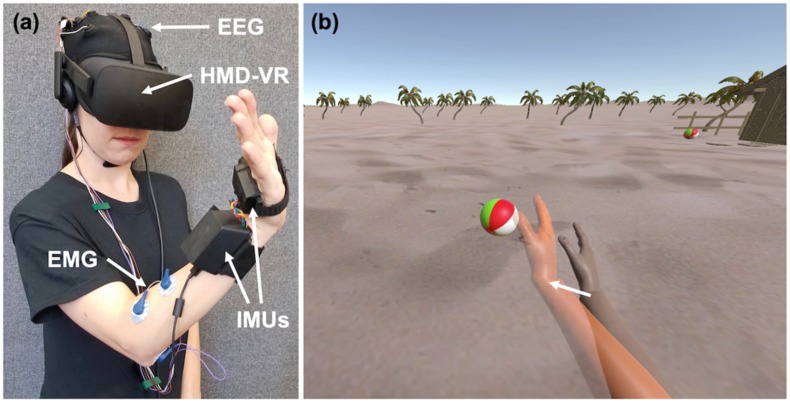
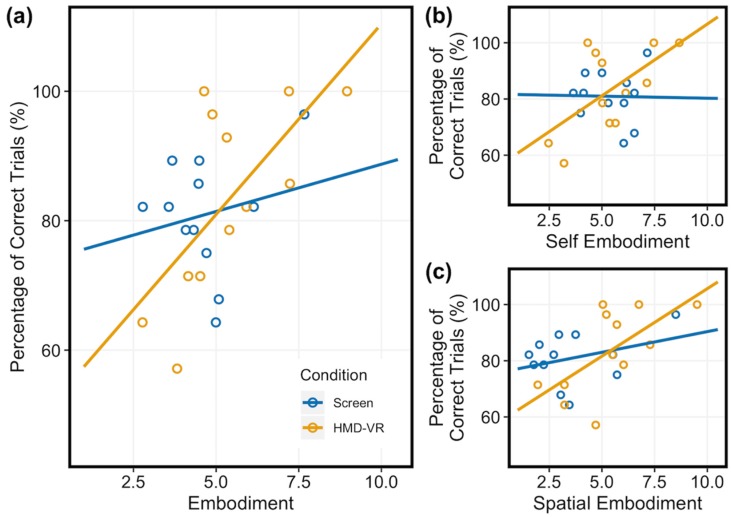
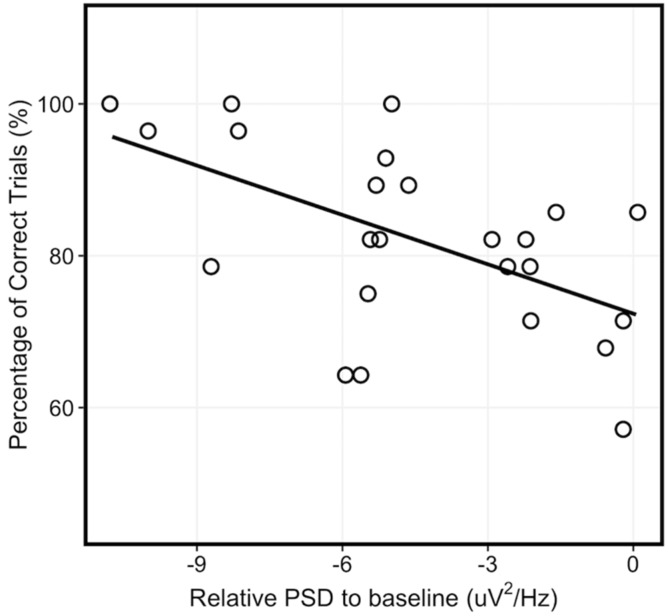
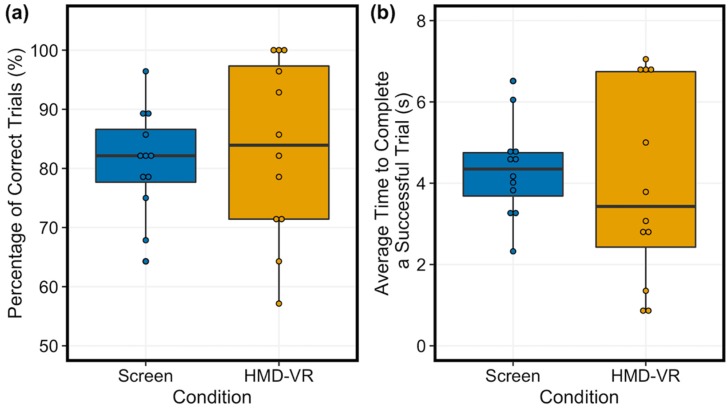
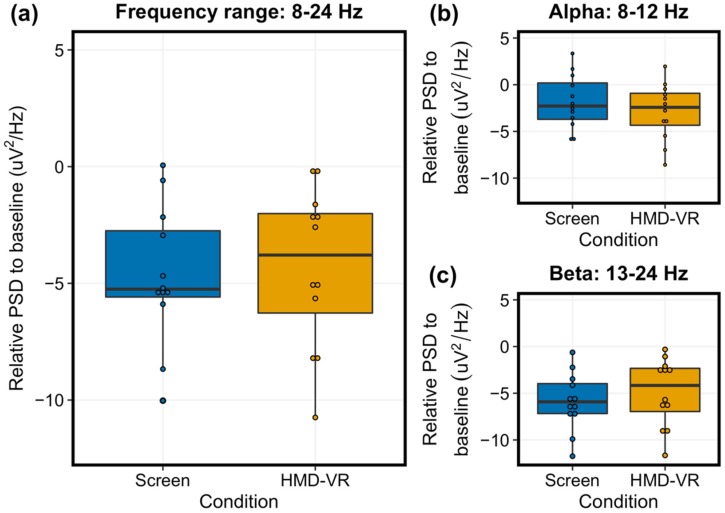
Electroencephalography (EEG)-based brain-computer interfaces (BCIs) for motor rehabilitation aim to "close the loop" between attempted motor commands and sensory feedback by providing supplemental information when individuals successfully achieve specific brain patterns. Existing EEG-based BCIs use various displays to provide feedback, ranging from displays considered more immersive (e.g., head-mounted display virtual reality (HMD-VR)) to displays considered less immersive (e.g., computer screens). However, it is not clear whether more immersive displays improve neurofeedback performance and whether there are individual performance differences in HMD-VR versus screen-based neurofeedback. In this pilot study, we compared neurofeedback performance in HMD-VR versus a computer screen in 12 healthy individuals and examined whether individual differences on two measures (i.e., presence, embodiment) were related to neurofeedback performance in either environment. We found that, while participants' performance on the BCI was similar between display conditions, the participants' reported levels of embodiment were significantly different. Specifically, participants experienced higher levels of embodiment in HMD-VR compared to a computer screen. We further found that reported levels of embodiment positively correlated with neurofeedback performance only in HMD-VR. Overall, these preliminary results suggest that embodiment may relate to better performance on EEG-based BCIs and that HMD-VR may increase embodiment compared to computer screens.
基于脑电图的脑机接口(BCI)旨在为运动康复“闭环”,当个体成功实现特定的脑模式时,通过提供补充信息来提供感觉反馈。现有的基于脑电图的 BCI 使用各种显示器来提供反馈,从被认为更具沉浸感的显示器(例如,头戴式显示器虚拟现实(HMD-VR))到被认为不那么具有沉浸感的显示器(例如,计算机屏幕)。然而,目前尚不清楚更具沉浸感的显示器是否能提高神经反馈的性能,以及在 HMD-VR 与基于屏幕的神经反馈之间是否存在个体表现的差异。在这项初步研究中,我们比较了 12 名健康个体在 HMD-VR 与计算机屏幕上的神经反馈性能,并检查了两个衡量标准(即存在感、体现感)上的个体差异是否与两种环境中的神经反馈性能相关。我们发现,虽然参与者在 BCI 上的表现两种显示条件下相似,但参与者报告的体现感水平存在显著差异。具体来说,参与者在 HMD-VR 中的体现感要高于计算机屏幕。我们还发现,仅在 HMD-VR 中,报告的体现感水平与神经反馈性能呈正相关。总的来说,这些初步结果表明,体现感可能与基于脑电图的 BCI 上更好的表现相关,并且 HMD-VR 可能比计算机屏幕更能增强体现感。