Che Long, Xu Mengmeng, Gao Kaiguo, Wang Li, Yang Xuefen, Wen Xiaolu, Xiao Hao, Jiang Zongyong
1State Key Laboratory of Livestock and Poultry Breeding; Key Laboratory of Animal Nutrition and Feed Science in South China, Ministry of Agriculture; Guangdong Public Laboratory of Animal Breeding and Nutrition; Guangdong Key Laboratory of Animal Breeding and Nutrition, Institute of Animal Science, Guangdong Academy of Agricultural Sciences, No.1 Dafeng Street, Wushan Rd, Tianhe District, Guangzhou, 510640 Guangdong China.
2College of Animal Science and Technology, Henan University of Animal Husbandry and Economy, Zhengzhou, 450046 Henan China.
J Anim Sci Biotechnol. 2020 Feb 19;11:15. doi: 10.1186/s40104-019-0420-z. eCollection 2020.
Mammary gland development during late gestation in gilts is a major factor that alters the composition of colostrum and growth performance of piglets. Plasma valine is taken up and metabolized extensively by the mammary gland; however, the effects of valine on mammary gland development during late gestation are still unclear. Thirty primiparous gilts were divided into three treatment groups ( = 10) and received one of the three diets starting on day 75 of gestation until the day of farrowing. The total dietary valine to lysine ratio of the three diets was 0.63 (LV), 0.73 (MV), and 0.93 (HV), respectively.
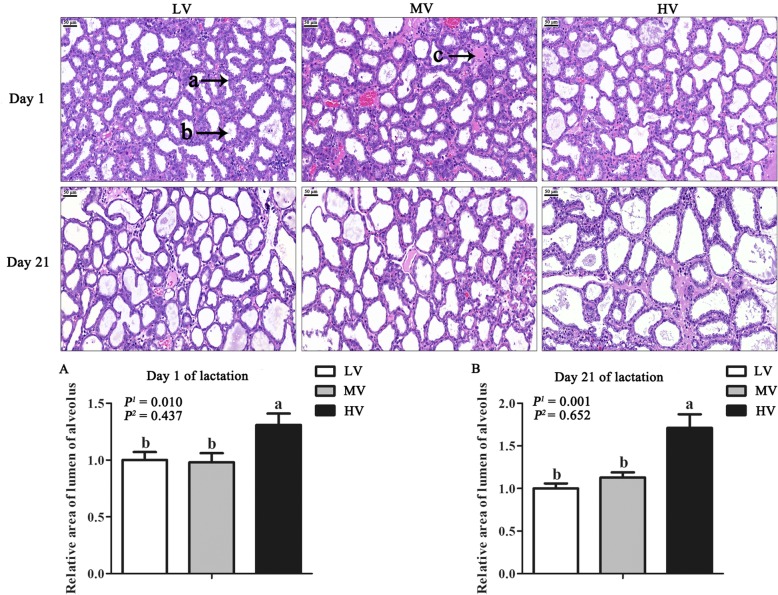
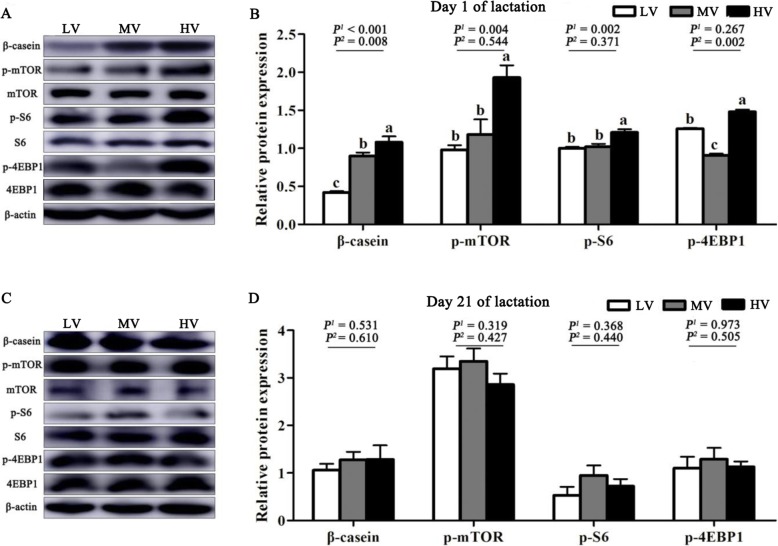
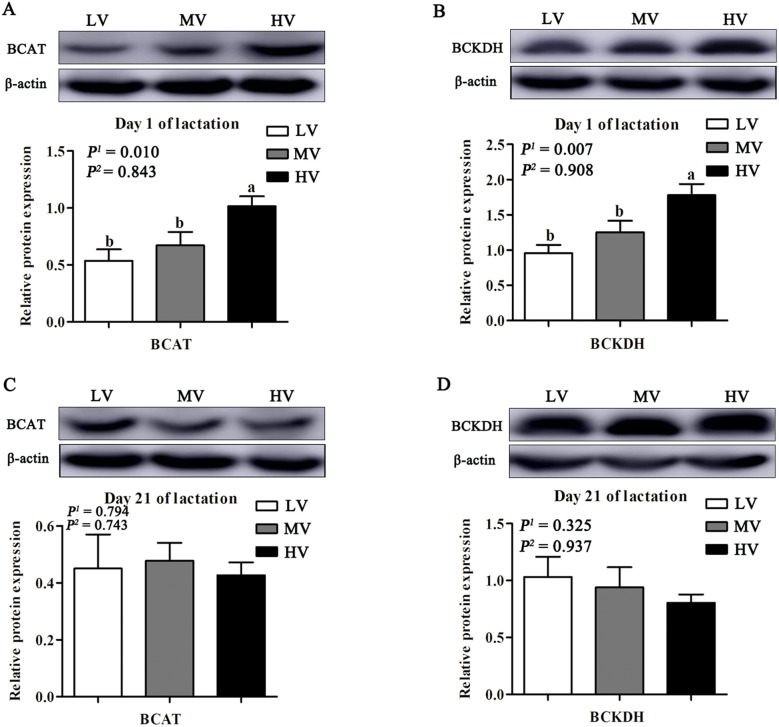
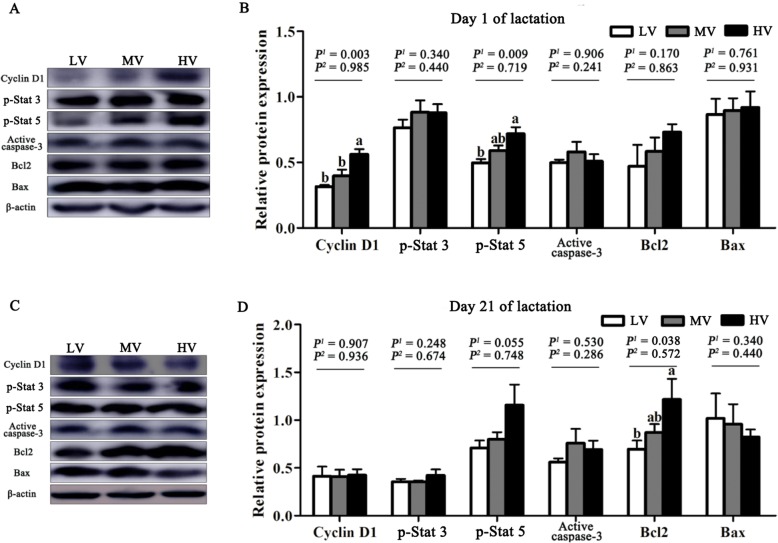
Dietary valine supplementation during late gestation did not affect ( > 0.05) the litter size and weight at farrowing; however, the piglet weight and average daily gain at weaning were linearly increased ( < 0.05) as the dietary valine increased. The highest piglet weight at weaning was observed when the gilts were provided the HV diet. Dietary valine supplementation linearly elevated ( < 0.05) protein, fat and solids-not-fat and some free amino acids content in colostrum. The concentration of prolactin in plasma of gilts was linearly increased in response to valine supplementation at days 1 and 10 of lactation ( < 0.05). Furthermore, with increasing dietary valine allowance, a linear increase ( < 0.05) was observed in the area of the lumen of alveolus and the content of DNA, RNA, and total protein in the mammary tissues at day 1 of lactation. Moreover, the protein expression of cyclin D1, p-mTOR, p-S6, and p-4EBP1 was also linearly increased ( < 0.05) in the mammary tissue at day 1 of lactation. However, no difference ( > 0.05) was observed in the indices related to mammary development and the mTOR signaling pathway at day 21 of lactation.
The results revealed that increasing the total dietary valine to lysine ratio to 0.93 during late gestation significantly enhances the piglet weight and average daily gain at weaning probably due to improved development of mammary gland.
妊娠后期后备母猪乳腺的发育是影响初乳成分和仔猪生长性能的主要因素。乳腺会大量摄取和代谢血浆中的缬氨酸;然而,缬氨酸对妊娠后期乳腺发育的影响仍不清楚。将30头初产后备母猪分为三个处理组(每组n = 10),从妊娠第75天开始直至分娩当天,分别给予三种日粮中的一种。三种日粮中总缬氨酸与赖氨酸的比例分别为0.63(低缬氨酸组,LV)、0.73(中缬氨酸组,MV)和0.93(高缬氨酸组,HV)。
妊娠后期补充日粮缬氨酸对产仔数和出生体重无影响(P > 0.05);然而,随着日粮缬氨酸含量的增加,断奶时仔猪体重和平均日增重呈线性增加(P < 0.05)。给后备母猪提供HV日粮时,断奶仔猪体重最高。日粮补充缬氨酸可使初乳中的蛋白质、脂肪、非脂固形物和一些游离氨基酸含量呈线性升高(P < 0.05)。在泌乳第1天和第10天,随着缬氨酸补充量的增加,后备母猪血浆中催乳素浓度呈线性增加(P < 0.05)。此外,随着日粮缬氨酸摄入量的增加,泌乳第1天乳腺组织中腺泡腔面积以及DNA、RNA和总蛋白含量呈线性增加(P < 0.05)。而且,泌乳第1天乳腺组织中细胞周期蛋白D1、磷酸化mTOR、磷酸化S6和磷酸化4EBP1的蛋白表达也呈线性增加(P < 0.05)。然而,在泌乳第21天,与乳腺发育和mTOR信号通路相关的指标未观察到差异(P > 0.05)。
结果表明,妊娠后期将日粮总缬氨酸与赖氨酸比例提高到0.93可显著提高断奶仔猪体重和平均日增重,这可能是由于乳腺发育得到改善。