OGEDA SA, a wholly owned subsidiary of Astellas Pharma SA, Belgium.
Altus Research, Lake Worth, FL.
Menopause. 2020 Apr;27(4):382-392. doi: 10.1097/GME.0000000000001510.
Menopausal vasomotor symptoms (VMS) may result from altered thermoregulatory control in brain regions innervated by neurokinin 3 receptor-expressing neurons. This phase 2b study evaluated seven dosing regimens of fezolinetant, a selective neurokinin 3 receptor antagonist, as a nonhormone approach for the treatment of VMS.
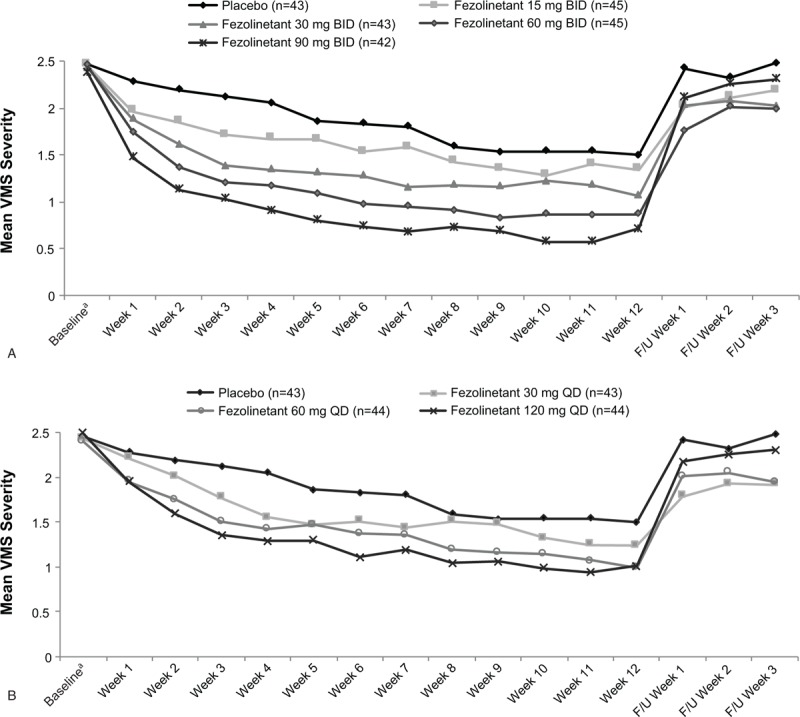
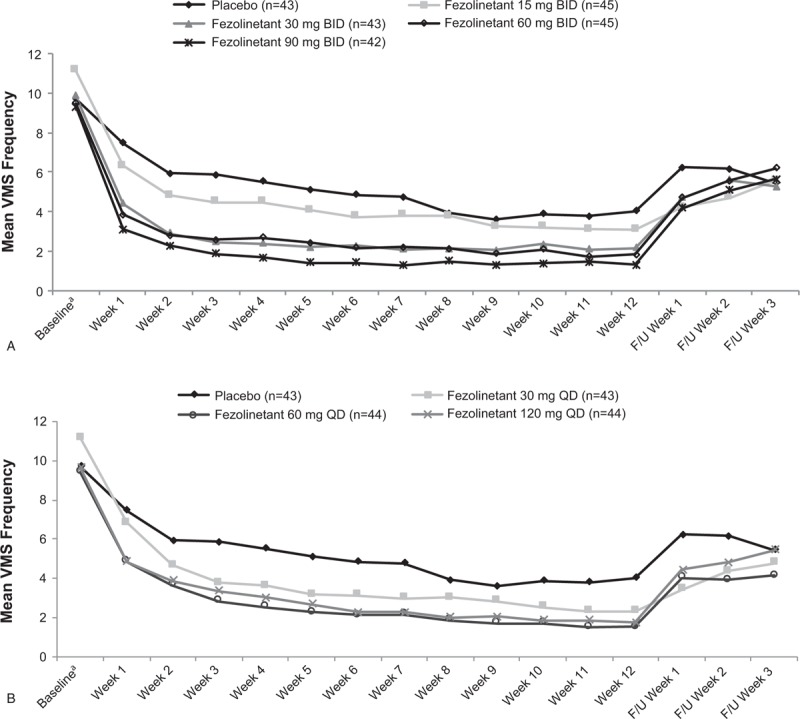
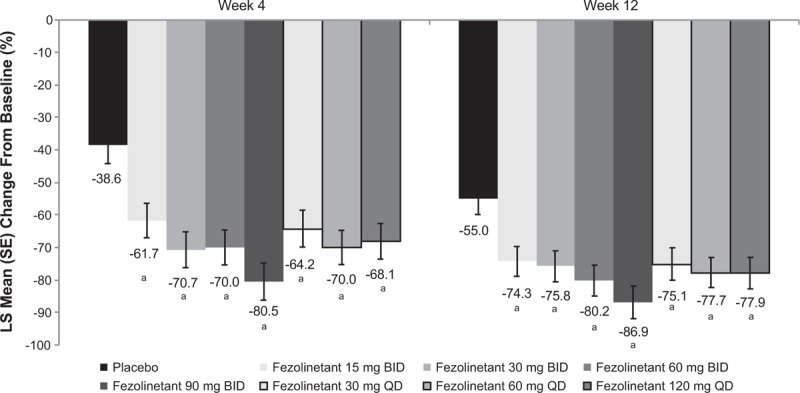
Menopausal women aged >40-65 years with moderate/severe VMS (≥50 episodes/wk) were randomized (double-blind) to fezolinetant 15, 30, 60, 90 mg BID or 30, 60, 120 mg QD, or placebo for 12 weeks. Primary outcomes were reduction in moderate/severe VMS frequency and severity ([number of moderate VMS × 2] + [number of severe VMS × 3]/total daily moderate/severe VMS) at weeks 4 and 12. Response (≥50% reduction in moderate/severe VMS frequency) was a key secondary outcome.
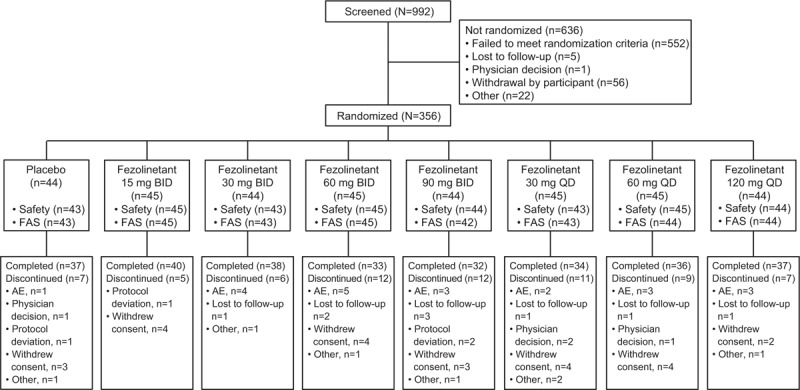
Of 352 treated participants, 287 completed the study. Fezolinetant reduced moderate/severe VMS frequency by -1.9 to -3.5/day at week 4 and -1.8 to -2.6/day at week 12 (all P < 0.05 vs placebo). Mean difference from placebo in VMS severity score was -0.4 to -1 at week 4 (all doses P < 0.05) and -0.2 to -0.6 at week 12 (P < 0.05 for 60 and 90 mg BID and 60 mg QD). Response (50% reduction) relative to placebo was achieved by 81.4% to 94.7% versus 58.5% of participants at end of treatment (all doses P < 0.05). Treatment-emergent adverse events were largely mild/moderate; no serious treatment-related treatment-emergent adverse events occurred.
Fezolinetant is a well-tolerated, effective nonhormone therapy that rapidly reduces moderate/severe menopausal VMS. : Video Summary:http://links.lww.com/MENO/A572; video script available at http://links.lww.com/MENO/A573.
绝经期血管舒缩症状(VMS)可能是由神经激肽 3 受体表达神经元支配的脑区体温调节控制改变引起的。这项 2b 期研究评估了 fezolinetant(一种选择性神经激肽 3 受体拮抗剂)的七种给药方案,作为治疗 VMS 的非激素方法。
年龄>40-65 岁、有中度/重度 VMS(≥50 次/周)的绝经后妇女按双盲法随机分为 fezolinetant 15、30、60、90mg BID 或 30、60、120mg QD,或安慰剂治疗 12 周。主要终点是治疗 4 周和 12 周时中度/重度 VMS 频率和严重程度的降低(中度 VMS 次数×2+重度 VMS 次数×3/每日中度/重度 VMS 总次数)。(中度 VMS 频率降低≥50%)是关键次要终点。
在 352 名接受治疗的参与者中,287 名完成了研究。治疗 4 周时,fezolinetant 使中度/重度 VMS 频率降低-1.9 至-3.5/天,治疗 12 周时降低-1.8 至-2.6/天(所有 P<0.05 与安慰剂相比)。治疗 4 周时,VMS 严重程度评分与安慰剂相比平均差值为-0.4 至-1(所有剂量 P<0.05),治疗 12 周时为-0.2 至-0.6(60 和 90mg BID 及 60mg QD 时 P<0.05)。与安慰剂相比,治疗结束时,有 81.4%至 94.7%的参与者达到了 50%的缓解率(所有剂量 P<0.05)。治疗中出现的不良事件大多为轻度/中度;无严重与治疗相关的治疗中出现的不良事件。
fezolinetant 是一种耐受性良好且有效的非激素治疗药物,可迅速减轻绝经后妇女的中度/重度血管舒缩症状。