Laboratory of Molecular Biology and Biochemistry, Institute of Molecular Medicine, Sechenov First Moscow State Medical University, 119048 Moscow, Russia.
Laboratory of Postgenomic Technologies, Izmerov Research Institute of Occupational Health, 105275 Moscow, Russia.
Viruses. 2020 Feb 23;12(2):247. doi: 10.3390/v12020247.
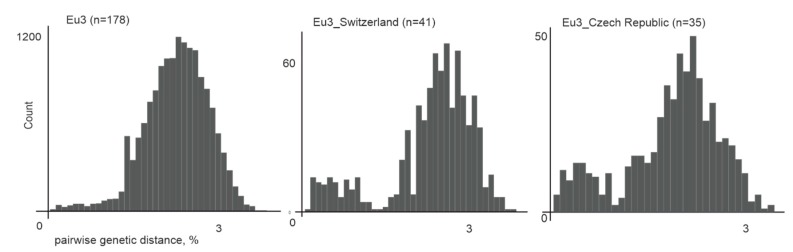
Tick-borne encephalitis (TBE) is one of the most important viral zoonosis transmitted by the bite of infected ticks. In this study, all tick-borne encephalitis virus (TBEV) E gene sequences available in GenBank as of June 2019 with known date of isolation ( = 551) were analyzed. Simulation studies showed that a sample bias could significantly affect earlier studies, because small TBEV datasets ( = 50) produced non-overlapping intervals for evolutionary rate estimates. An apparent lack of a temporal signal in TBEV, in general, was found, precluding molecular clock analysis of all TBEV subtypes in one dataset. Within all subtypes and most of the smaller groups in these subtypes, there was evidence of many medium- and long-distance virus transfers. These multiple random events may play a key role in the virus spreading. For some groups, virus diversity within one territory was similar to diversity over the whole geographic range. This is best exemplified by the virus diversity observed in Switzerland or Czech Republic. These two countries yielded most of the known European subtype Eu3 subgroup sequences, and the diversity of viruses found within each of these small countries is comparable to that of the whole Eu3 subgroup, which is prevalent all over Central and Eastern Europe. Most of the deep tree nodes within all three established TBEV subtypes dated less than 300 years back. This could be explained by the recent emergence of most of the known TBEV diversity. Results of bioinformatics analysis presented here, together with multiple field findings, suggest that TBEV may be regarded as an emerging disease.
蜱传脑炎(TBE)是由感染蜱叮咬传播的最重要的病毒性人畜共患病之一。在本研究中,分析了截至 2019 年 6 月 GenBank 中所有已知分离日期(=551)的蜱传脑炎病毒(TBEV)E 基因序列。模拟研究表明,样本偏差可能会显著影响早期研究,因为小的 TBEV 数据集(=50)产生的进化率估计值没有重叠区间。一般来说,TBEV 中明显缺乏时间信号,因此无法在一个数据集内对所有 TBEV 亚型进行分子钟分析。在所有亚型及其大多数较小的亚型组中,有证据表明存在许多中长距离的病毒转移。这些多次随机事件可能在病毒传播中发挥关键作用。对于某些组,一个地区内的病毒多样性与整个地理范围的多样性相似。瑞士或捷克共和国的病毒多样性就是最好的例证。这两个国家产生了大多数已知的欧洲亚型 Eu3 亚组序列,而这些小国家中发现的病毒多样性与整个流行于中欧和东欧的 Eu3 亚组的多样性相当。所有三个已建立的 TBEV 亚型中的大多数深树节点的时间都不到 300 年。这可以解释为大多数已知的 TBEV 多样性是最近出现的。这里提出的生物信息学分析结果,以及多个实地调查结果表明,TBE 可能被视为一种新兴疾病。