Tubtimsri Sukannika, Limmatvapirat Chutima, Limsirichaikul Siripan, Akkaramongkolporn Prasert, Inoue Yutaka, Limmatvapirat Sontaya
Faculty of Pharmaceutical Science, Burapha University, Thailand.
Department of Pharmaceutical Technology, Faculty of Pharmacy, Silpakorn University, 6 Rachamankra Road, Ampur Mueng, Nakhon Pathom 73000, Thailand.
Asian J Pharm Sci. 2018 Sep;13(5):425-437. doi: 10.1016/j.ajps.2018.02.003. Epub 2018 Mar 16.
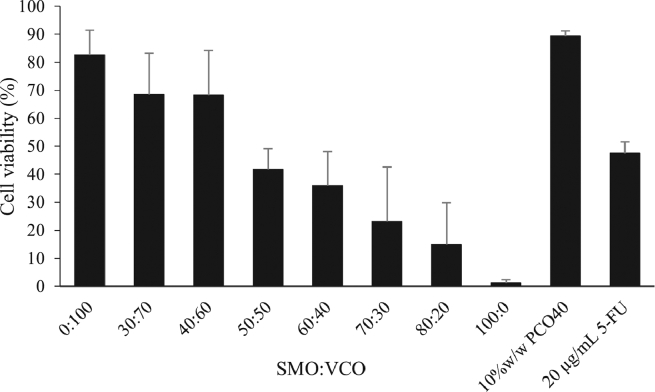
Spearmint oil (SMO), a commonly used essential oil for oral care products, possesses various interesting functions, especially for anticancer property. However, the application of SMO for cancer treatment is limited due to water insoluble. In the present study, nanoemulsions, which have been widely accepted as dosage forms for poorly water-soluble drugs, were selected as candidate carriers for SMO to inhibit oral cancer cell. The nanoemulsions were fabricated using phase inversion temperature method. The factors affecting formation and properties of nanoemulsions including type and amount of surfactants, oil loading and ratio of SMO to virgin coconut oil (VCO) were investigated. Among the surfactants used, the nanoemulsions containing polyoxyethylene castor oil derivatives (KolliphorEL; PCO35, CremophorRH40; PCO40, EumulginCO60; PCO60) and polyoxyethylene sorbitan fatty acid esters (PSF80) showed 100% creaming after temperature cycling test indicating excellent physical stability while those containing PCO40 demonstrated more transparency and better physical stability. With an increasing amount of PCO40, the droplet size tended to decrease and was in the nano-size range (<1000 nm) after increasing to more than 5% (w/w). SMO-VCO loading also influenced on the droplet size. At 5% (w/w) PCO40, the maximum SMO-VCO loading of 25% (w/w) to attain nanoemulsions was observed. Moreover, the composition of oils had an impact on size of emulsions. The transparent nanoemulsions were only prepared in the range of SMO-VCO from 40:60 to 80:20, suggesting the optimum ratio of SMO to surfactant and the composition of oils were the critical factors for formation of nanoemulsions. NMR study disclosed that the interaction between PCO40 with both VCO and SMO should be a possible stabilization mechanism. Furthermore, the SMO-VCO nanoemulsions exhibited significant cytotoxic effect against oral carcinoma (KON) cell line using MTT assay. The finding, therefore, revealed the good feasibility of SMO-VCO nanoemulsions as novel carriers for treating of oral cancer.
留兰香油(SMO)是口腔护理产品中常用的一种香精油,具有多种有趣的功能,尤其是其抗癌特性。然而,由于其水不溶性,SMO在癌症治疗中的应用受到限制。在本研究中,纳米乳剂作为水溶性差的药物的剂型已被广泛接受,被选为SMO抑制口腔癌细胞的候选载体。纳米乳剂采用相转变温度法制备。研究了影响纳米乳剂形成和性质的因素,包括表面活性剂的类型和用量、油相负载量以及SMO与初榨椰子油(VCO)的比例。在所使用的表面活性剂中,含有聚氧乙烯蓖麻油衍生物(聚氧乙烯蓖麻油;PCO35、聚氧乙烯氢化蓖麻油40;PCO40、优麦林CO60;PCO60)和聚氧乙烯山梨醇酐脂肪酸酯(PSF80)的纳米乳剂在温度循环试验后出现100%的乳析现象,表明其具有优异的物理稳定性,而含有PCO40的纳米乳剂表现出更高的透明度和更好的物理稳定性。随着PCO40用量的增加,液滴尺寸趋于减小,当增加到超过5%(w/w)时,液滴尺寸处于纳米尺寸范围(<1000 nm)。SMO-VCO负载量也会影响液滴尺寸。在5%(w/w)的PCO40用量下,观察到达到纳米乳剂的最大SMO-VCO负载量为25%(w/w)。此外,油相组成对乳剂尺寸有影响。透明纳米乳剂仅在SMO-VCO比例为40:60至80:20的范围内制备成功,这表明SMO与表面活性剂的最佳比例以及油相组成是形成纳米乳剂的关键因素。核磁共振研究表明,PCO40与VCO和SMO之间的相互作用可能是一种稳定机制。此外,使用MTT法检测发现SMO-VCO纳米乳剂对口腔癌细胞系(KON)具有显著的细胞毒性作用。因此,该研究结果表明SMO-VCO纳米乳剂作为治疗口腔癌的新型载体具有良好的可行性。