Su Juan, Wu Fubing, Xia Hongping, Wu Yafeng, Liu Songqin
Jiangsu Engineering Laboratory of Smart Carbon-Rich Materials and Device , School of Chemistry and Chemical Engineering , Southeast University , Nanjing 211189 , China.
Department of Pathology , School of Basic Medical Sciences , Department of Oncology , The Affiliated Sir Run Run Hospital , State Key Laboratory of Reproductive Medicine , Key Laboratory of Antibody Technique of National Health Commission , Nanjing Medical University , Nanjing 211166 , China.
Chem Sci. 2019 Nov 5;11(1):80-86. doi: 10.1039/c9sc04823e. eCollection 2020 Jan 7.
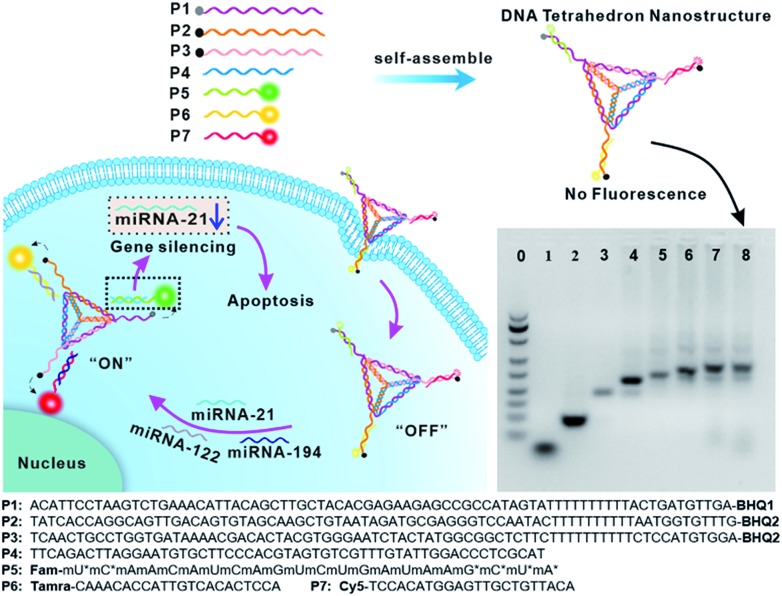
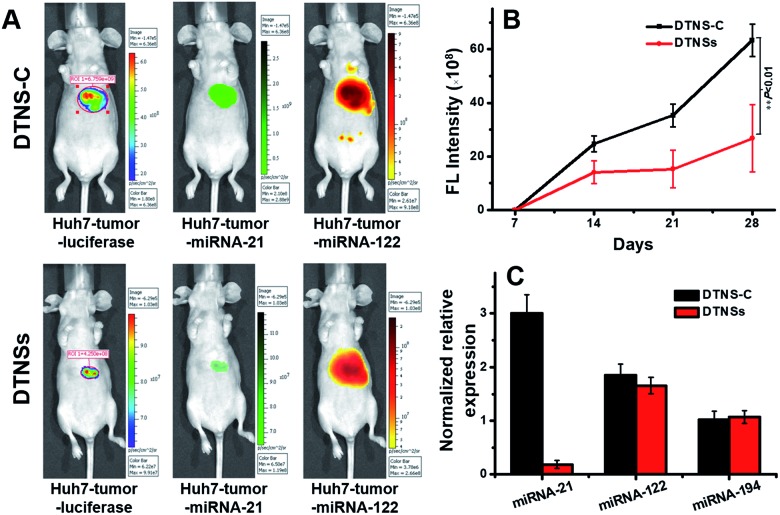
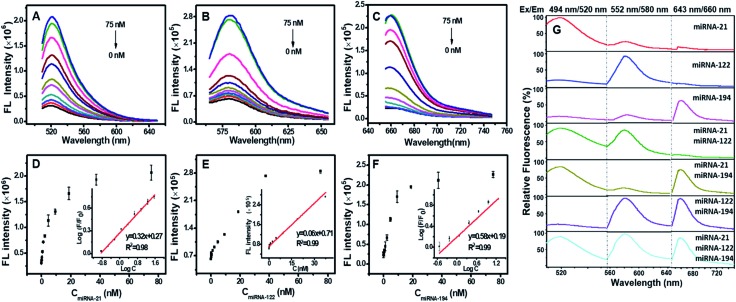
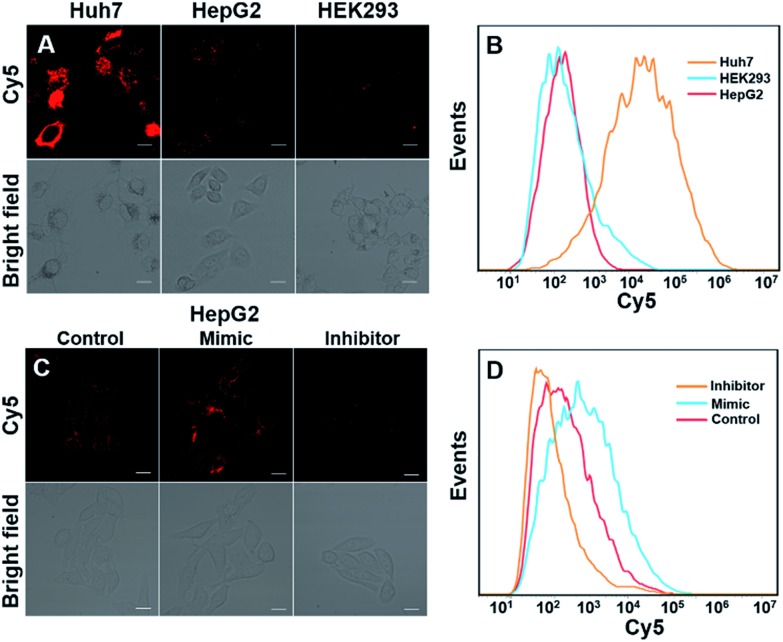
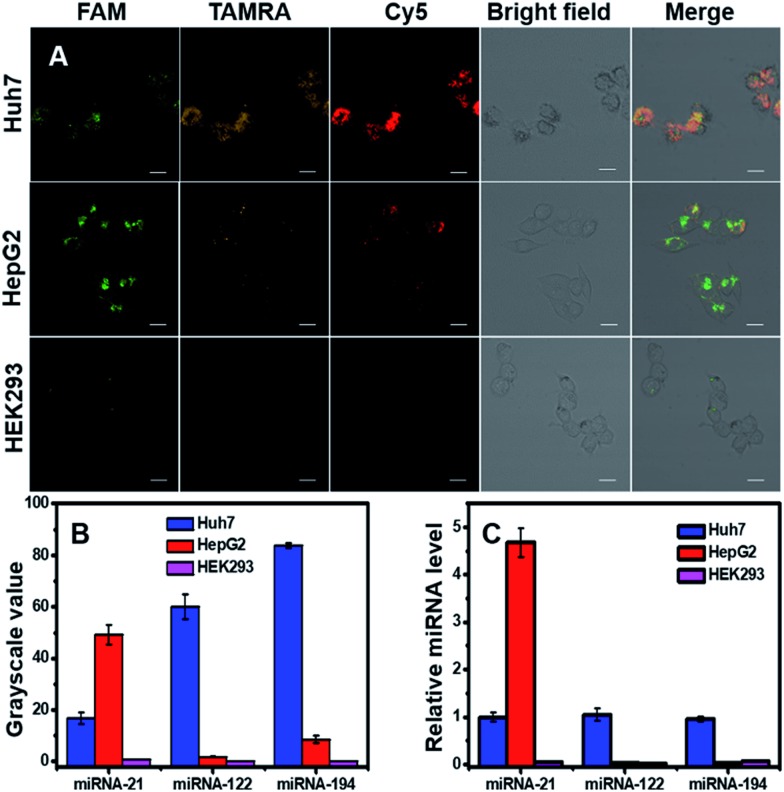
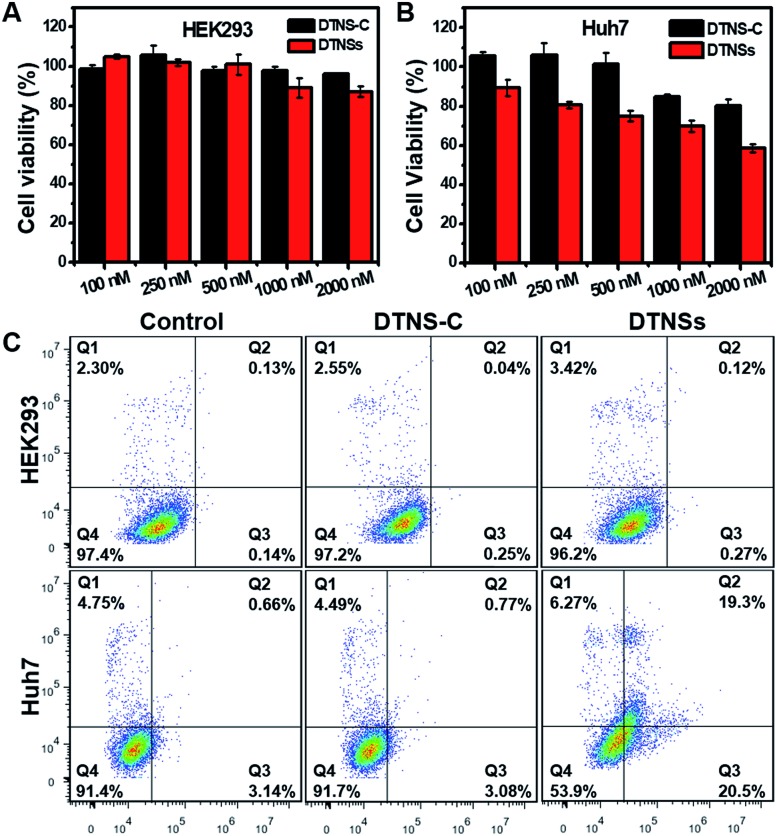
Accurate cancer cell identification and efficient therapy are extremely desirable and challenging in clinics. Here, we reported the first example of DNA tetrahedron nanostructures (DTNSs) to real-time monitor and image three intracellular miRNAs based on the fluorescence "OFF" to "ON" mode, as well as to realize cancer therapy induced by miRNA silencing. DTNSs were self-assembled by seven customized single-stranded nucleic acid chains containing three recognition sequences for target miRNAs. In the three vertexes of DTNSs, fluorophores and quenchers were brought into close proximity, inducing fluorescence quenching. In the presence of target miRNAs, fluorophores and quenchers would be separated, resulting in fluorescence recovery. Owing to the unique tetrahedron-like spatial structure, DTNSs displayed improved resistance to enzymatic digestion and high cellular uptake efficiency, and exhibited the ability to simultaneously monitor three intracellular miRNAs. DTNSs not only effectively distinguished tumor cells from normal cells, but also identified cancer cell subtypes, which avoided false-positive signals and significantly improved the accuracy of cancer diagnosis. Moreover, the DTNSs could also act as an anti-cancer drug; antagomir-21 (one recognition sequence) was detached from DTNSs to silence endogenous miRNA-21 inside cells, which would suppress cancer cell migration and invasion, and finally induce cancer cell apoptosis; the result was demonstrated by experiments and . It is anticipated that the development of smart nanoplatforms will open a door for cancer diagnosis and treatment in clinical systems.
在临床上,准确识别癌细胞并进行有效治疗极具需求但也极具挑战性。在此,我们报道了首例基于荧光“关”到“开”模式实时监测和成像三种细胞内微小RNA(miRNA)的DNA四面体纳米结构(DTNS),并实现了由miRNA沉默诱导的癌症治疗。DTNS由七条定制的单链核酸链自组装而成,这些链包含针对目标miRNA的三个识别序列。在DTNS的三个顶点,荧光团和猝灭剂紧密靠近,导致荧光猝灭。在存在目标miRNA的情况下,荧光团和猝灭剂会分离,从而导致荧光恢复。由于独特的四面体状空间结构,DTNS表现出对酶消化的抗性增强和高细胞摄取效率,并展现出同时监测三种细胞内miRNA的能力。DTNS不仅能有效区分肿瘤细胞和正常细胞,还能识别癌细胞亚型,避免了假阳性信号,显著提高了癌症诊断的准确性。此外,DTNS还可作为抗癌药物;抗miR - 21(一个识别序列)从DTNS上脱离,使细胞内的内源性miRNA - 21沉默,这将抑制癌细胞的迁移和侵袭,并最终诱导癌细胞凋亡;实验 和 证明了这一结果。预计智能纳米平台的发展将为临床系统中的癌症诊断和治疗打开一扇门。