Sriram Renuka, Van Criekinge Mark, DeLos Santos Justin, Ahamed Fayyaz, Qin Hecong, Nolley Rosalie, Santos Romelyn DeLos, Tabatabai Z Laura, Bok Robert A, Keshari Kayvan R, Vigneron Daniel B, Peehl Donna M, Kurhanewicz John
Department of Radiology and Biomedical Imaging, University of California, San Francisco, CA 94158, USA.
Department of Urology, Stanford University, Stanford, CA 94305, USA.
Cancers (Basel). 2020 Feb 26;12(3):537. doi: 10.3390/cancers12030537.
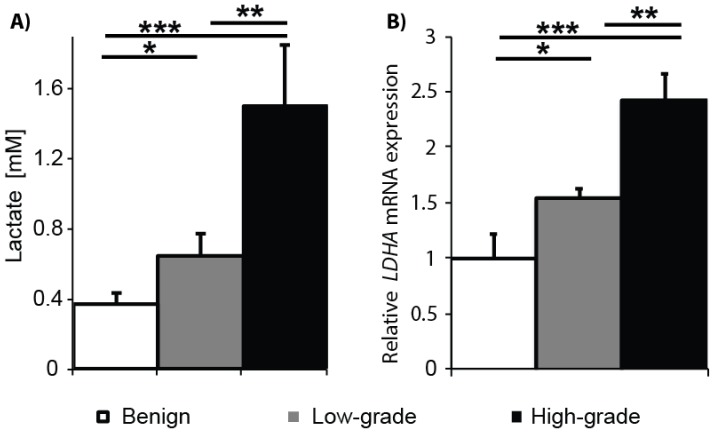
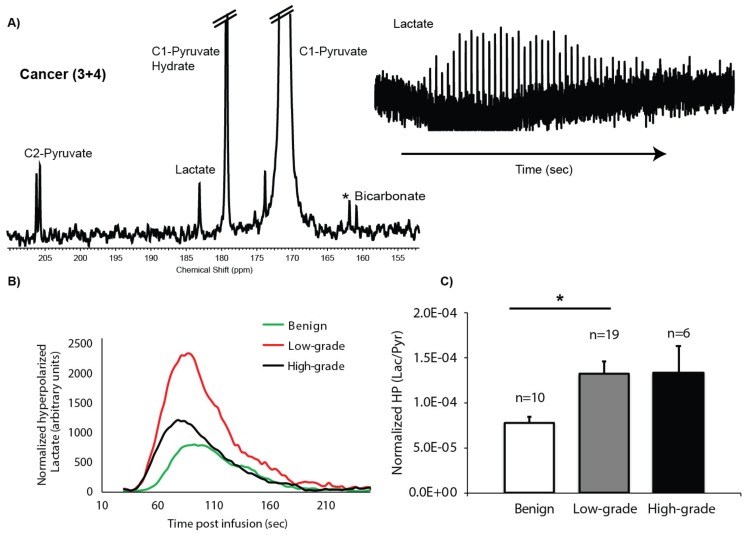
Non-invasive assessment of the biological aggressiveness of prostate cancer (PCa) is needed for men with localized disease. Hyperpolarized (HP) C magnetic resonance (MR) spectroscopy is a powerful approach to image metabolism, specifically the conversion of HP [1-C]pyruvate to [1-C]lactate, catalyzed by lactate dehydrogenase (LDH). Significant increase in tumor lactate was measured in high-grade PCa relative to benign and low-grade cancer, suggesting that HP C MR could distinguish low-risk (Gleason score ≤3 + 4) from high-risk (Gleason score ≥4 + 3) PCa. To test this and the ability of HP C MR to detect these metabolic changes, we cultured prostate tissues in an MR-compatible bioreactor under continuous perfusion. P spectra demonstrated good viability and dynamic HP C-pyruvate MR demonstrated that high-grade PCa had significantly increased lactate efflux compared to low-grade PCa and benign prostate tissue. These metabolic differences are attributed to significantly increased expression and LDH activity, as well as significantly increased monocarboxylate transporter 4 (MCT4) expression in high- versus low- grade PCa. Moreover, lactate efflux, LDH activity, and MCT4 expression were not different between low-grade PCa and benign prostate tissues, indicating that these metabolic alterations are specific for high-grade disease. These distinctive metabolic alterations can be used to differentiate high-grade PCa from low-grade PCa and benign prostate tissues using clinically translatable HP [1-C]pyruvate MR.
对于患有局限性疾病的男性,需要对前列腺癌(PCa)的生物学侵袭性进行非侵入性评估。超极化(HP)碳磁共振(MR)波谱是一种强大的代谢成像方法,特别是通过乳酸脱氢酶(LDH)催化将HP [1-碳]丙酮酸转化为[1-碳]乳酸。相对于良性和低级别癌症,高级别PCa中肿瘤乳酸含量显著增加,这表明HP碳MR可以区分低风险(Gleason评分≤3 + 4)和高风险(Gleason评分≥4 + 3)的PCa。为了验证这一点以及HP碳MR检测这些代谢变化的能力,我们在连续灌注的MR兼容生物反应器中培养前列腺组织。磷谱显示良好的活力,动态HP碳-丙酮酸MR显示高级别PCa与低级别PCa和良性前列腺组织相比,乳酸流出显著增加。这些代谢差异归因于高级别与低级别PCa中显著增加的表达和LDH活性,以及显著增加的单羧酸转运蛋白4(MCT4)表达。此外,低级别PCa和良性前列腺组织之间的乳酸流出、LDH活性和MCT4表达没有差异,表明这些代谢改变是高级别疾病所特有的。这些独特的代谢改变可用于通过临床可转化的HP [1-碳]丙酮酸MR区分高级别PCa与低级别PCa和良性前列腺组织。