Wellcome Centre for Human Neuroimaging, UCL, Queen Square, London, WC1N 3AR, United Kingdom.
Department of Clinical and Experimental Epilepsy, UCL, Queen Square Institute of Neurology, London, WC1N 3BG, United Kingdom.
Ann Clin Transl Neurol. 2020 Mar;7(3):397-401. doi: 10.1002/acn3.50995. Epub 2020 Feb 29.
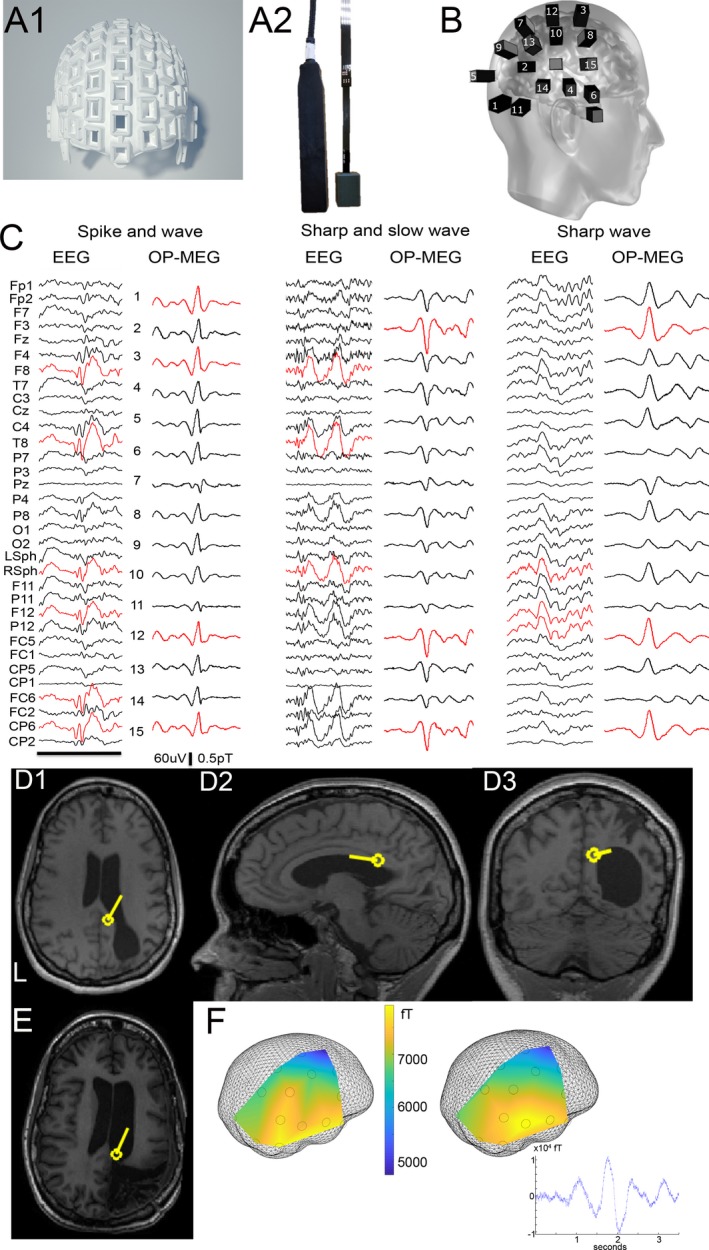
We demonstrate the first use of Optically Pumped Magnetoencephalography (OP-MEG) in an epilepsy patient with unrestricted head movement. Current clinical MEG uses a traditional SQUID system, where sensors are cryogenically cooled and housed in a helmet in which the patient's head is fixed. Here, we use a different type of sensor (OPM), which operates at room temperature and can be placed directly on the patient's scalp, permitting free head movement. We performed OP-MEG recording in a patient with refractory focal epilepsy. OP-MEG-identified analogous interictal activity to scalp EEG, and source localized this activity to an appropriate brain region.
我们展示了在一名头部可自由活动的癫痫患者中应用光泵磁共振脑磁图(OP-MEG)的首例结果。目前临床应用的 MEG 使用传统超导量子干涉仪(SQUID)系统,其传感器需要经致冷达到低温并安装在头盔中以固定患者头部。在这里,我们使用了一种不同类型的传感器(OPM),它在室温下工作,可以直接放置在患者头皮上,从而实现头部的自由活动。我们对一名耐药性局灶性癫痫患者进行了 OP-MEG 记录。OP-MEG 识别出与头皮 EEG 类似的发作间期活动,并通过源定位将该活动定位于适当的脑区。