Ioanas Horea-Ioan, Marks Markus, Garin Clément M, Dhenain Marc, Yanik Mehmet Fatih, Rudin Markus
Institute for Biomedical Engineering, ETH and University of Zurich, Zurich, Switzerland.
Institute of Neuroinformatics, ETH and University of Zurich, Zurich, Switzerland.
Front Neuroinform. 2020 Feb 11;14:5. doi: 10.3389/fninf.2020.00005. eCollection 2020.
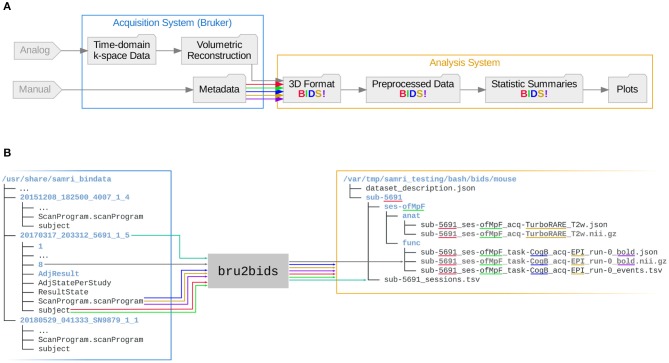
Large-scale research integration is contingent on seamless access to data in standardized formats. Standards enable researchers to understand external experiment structures, pool results, and apply homogeneous preprocessing and analysis workflows. Particularly, they facilitate these features without the need for numerous potentially confounding compatibility add-ons. In small animal magnetic resonance imaging, an overwhelming proportion of data is acquired via the ParaVision software of the Bruker Corporation. The original data structure is predominantly transparent, but fundamentally incompatible with modern pipelines. Additionally, it sources metadata from free-field operator input, which diverges strongly between laboratories and researchers. In this article we present an open-source workflow which automatically converts and reposits data from the ParaVision structure into the widely supported and openly documented Brain Imaging Data Structure (BIDS). Complementing this workflow we also present operator guidelines for appropriate ParaVision data input, and a programmatic walk-through detailing how preexisting scans with uninterpretable metadata records can easily be made compliant after the acquisition.
大规模研究整合取决于能否无缝访问标准化格式的数据。标准使研究人员能够理解外部实验结构、汇总结果,并应用统一的预处理和分析工作流程。特别是,它们无需众多可能造成混淆的兼容性插件就能实现这些功能。在小动物磁共振成像中,绝大多数数据是通过布鲁克公司的ParaVision软件采集的。原始数据结构主要是透明的,但与现代工作流程根本不兼容。此外,它从自由场操作员输入中获取元数据,而不同实验室和研究人员之间的元数据差异很大。在本文中,我们提出了一个开源工作流程,该流程可自动将数据从ParaVision结构转换并重新存储为广泛支持且有公开文档记录的脑成像数据结构(BIDS)。作为此工作流程的补充,我们还提供了关于适当的ParaVision数据输入的操作员指南,以及一个编程演练,详细说明了如何在采集后轻松使具有无法解释的元数据记录的现有扫描符合要求。