Dong Jingsi, Li Bingjie, Lin Dan, Lu Dan, Liu Chang, Lu Xingbing, Tang Xiaojun, Li Lu, Zhu Daxing, Liu Jiewei, Qiu Xiaoming, Tian Long, Zhou Qinghua
Department of Lung Cancer Center, West China Hospital, Sichuan University, Chengdu, China.
Department of Otorhinolaryngology, Head & Neck Surgery, West China Hospital, Sichuan University, Chengdu, China.
Front Oncol. 2020 Feb 6;10:79. doi: 10.3389/fonc.2020.00079. eCollection 2020.
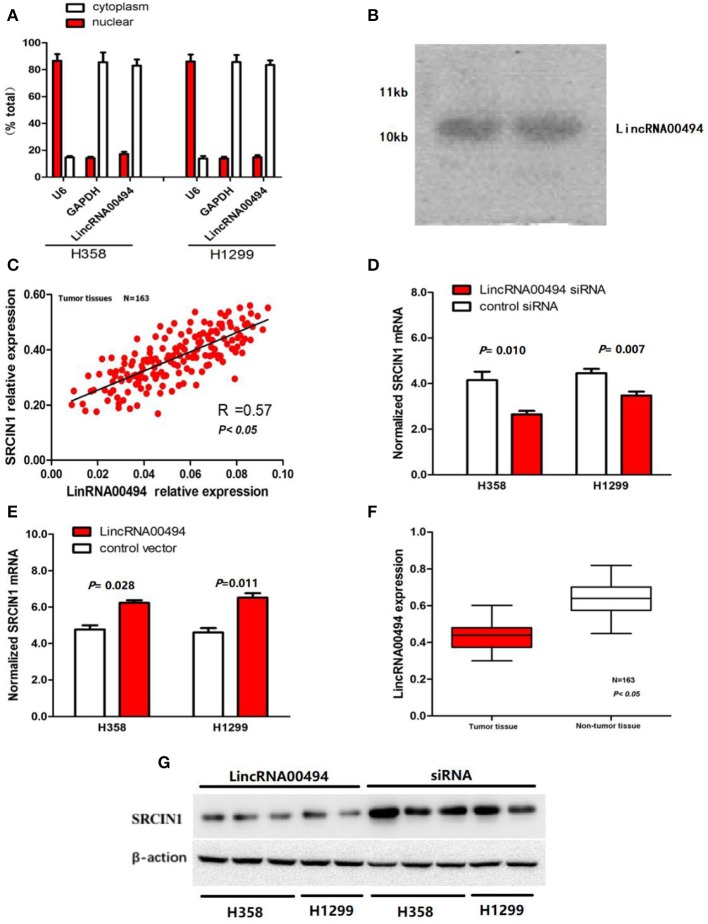
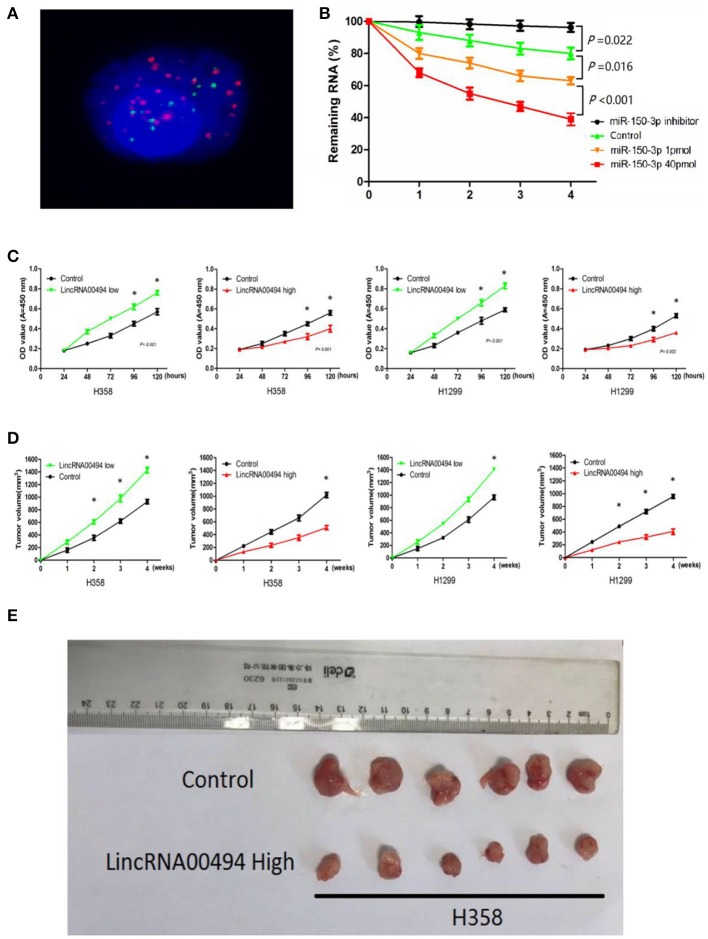
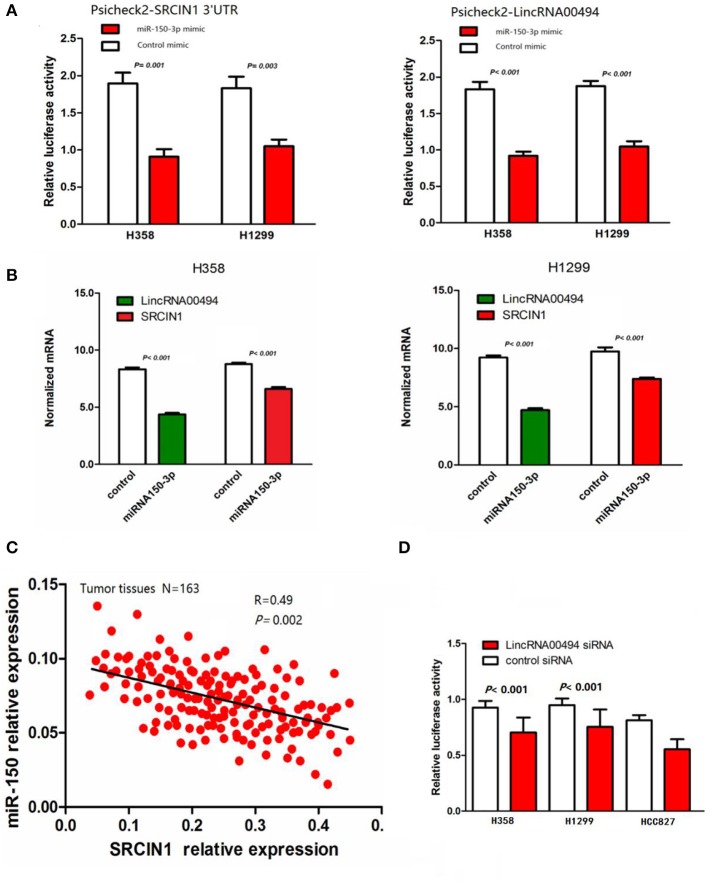
Lung cancer is the most common malignant tumor worldwide. Accumulating results have shown that long non-coding RNAs (lncRNAs) play a key role in tumorigenesis. A total of 163 tumor tissues were collected from non-small cell lung cancer (NSCLC) patients from West China Hospital of Sichuan University. is a novel lncRNA, and its expression and biological effect in NSCLC were reported in this study. NSCLC cell lines were used in this study. is mainly distributed in the cytoplasm. was downregulated in the tumor tissues compared with the adjacent non-tumor tissues. expression was positively correlated with SRCIN1 expression ( = 0.57, < 0.05). Silencing of in the cell lines substantially decreased SRCIN1 expression at the mRNA and protein levels, whereas overexpression of enhanced the SRCIN1 levels. miR-150-3p significantly decreased the luciferase signals of and SRCIN1 reporters. After transfection with miR-150-3p mimics and miR-150-3p inhibitor, overexpression of decreased the proliferation of the H358 (36%) and H1299 (29%) cell lines compared with that of the control cells, as shown by CCK-8 assays, whereas silencing promoted the proliferation of the H358 (47%) and H1299 (35%) cells. Tumor growth from LincRNA00494-overexpressing xenografts was significantly decreased; additionally, LincRNA00494 silencing substantially increased tumor growth compared with that of the control cells. Functional experiments revealed that inhibited NSCLC cell proliferation, which might be related to the suppression of SRCIN1, a tumor suppressor gene, by acting as a decoy for miR-150-3p. The data showed that might have antineoplastic effects during NSCLC tumorigenesis through its role as a ceRNA.
肺癌是全球最常见的恶性肿瘤。越来越多的研究结果表明,长链非编码RNA(lncRNAs)在肿瘤发生中起关键作用。本研究从四川大学华西医院收集了163例非小细胞肺癌(NSCLC)患者的肿瘤组织。LincRNA00494是一种新型lncRNA,本研究报道了其在NSCLC中的表达及生物学效应。本研究使用了NSCLC细胞系。LincRNA00494主要分布在细胞质中。与相邻的非肿瘤组织相比,肿瘤组织中LincRNA00494表达下调。LincRNA00494表达与SRCIN1表达呈正相关(r = 0.57,P < 0.05)。在细胞系中沉默LincRNA00494可显著降低SRCIN1在mRNA和蛋白水平的表达,而LincRNA00494过表达则提高SRCIN1水平。miR-150-3p显著降低LincRNA00494和SRCIN1报告基因的荧光素酶信号。用miR-150-3p模拟物和miR-150-3p抑制剂转染后,如CCK-8检测所示,LincRNA00494过表达与对照细胞相比降低了H358(36%)和H1299(29%)细胞系的增殖,而沉默LincRNA00494则促进了H358(47%)和H1299(35%)细胞的增殖。过表达LincRNA00494的异种移植瘤的肿瘤生长显著降低;此外,与对照细胞相比,沉默LincRNA00494显著增加肿瘤生长。功能实验表明,LincRNA00494抑制NSCLC细胞增殖,这可能与通过作为miR-150-3p的诱饵抑制肿瘤抑制基因SRCIN1有关。数据表明,LincRNA00494可能通过其作为ceRNA的作用在NSCLC肿瘤发生过程中发挥抗肿瘤作用。