Wong Jin Xiang, Gonzalez-Miro Majela, Sutherland-Smith Andrew J, Rehm Bernd H A
School of Fundamental Sciences, Massey University, Palmerston North, New Zealand.
MacDiarmid Institute for Advanced Materials and Nanotechnology, Victoria University of Wellington, Wellington, New Zealand.
Front Bioeng Biotechnol. 2020 Feb 6;8:44. doi: 10.3389/fbioe.2020.00044. eCollection 2020.
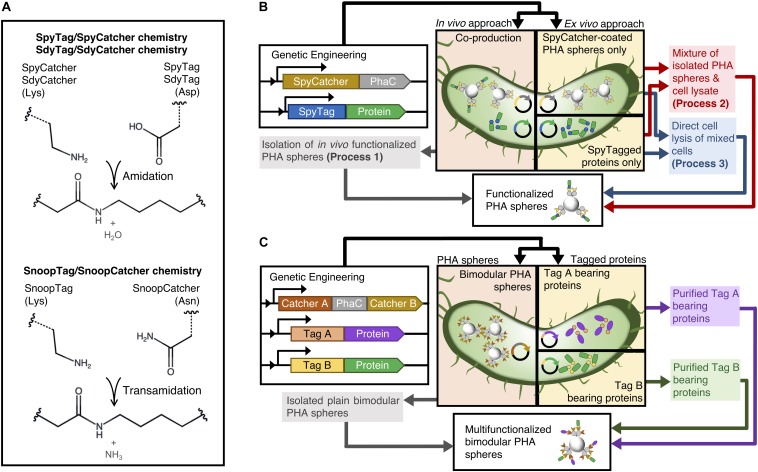
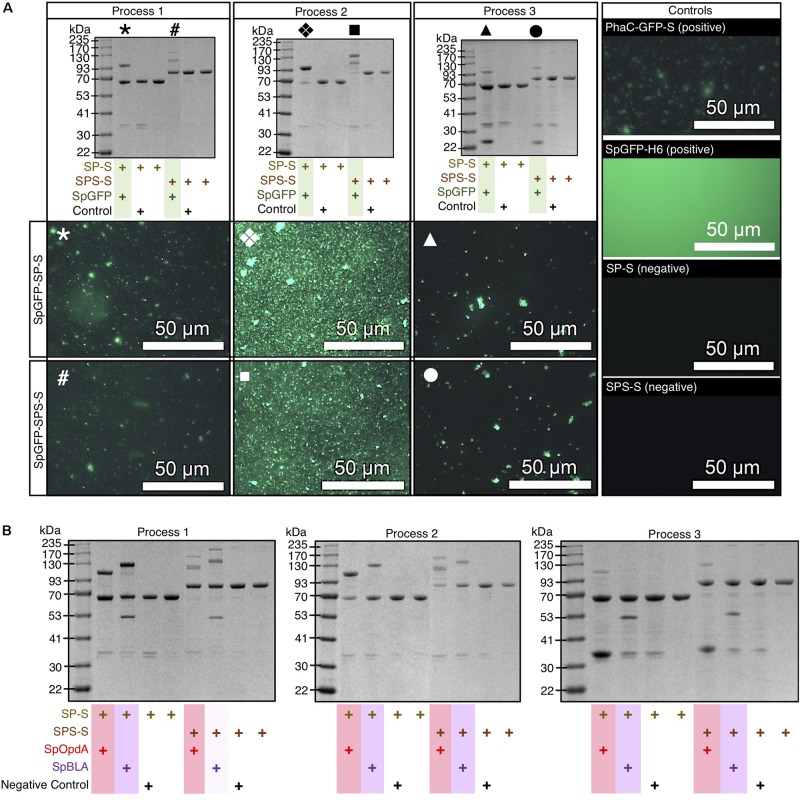
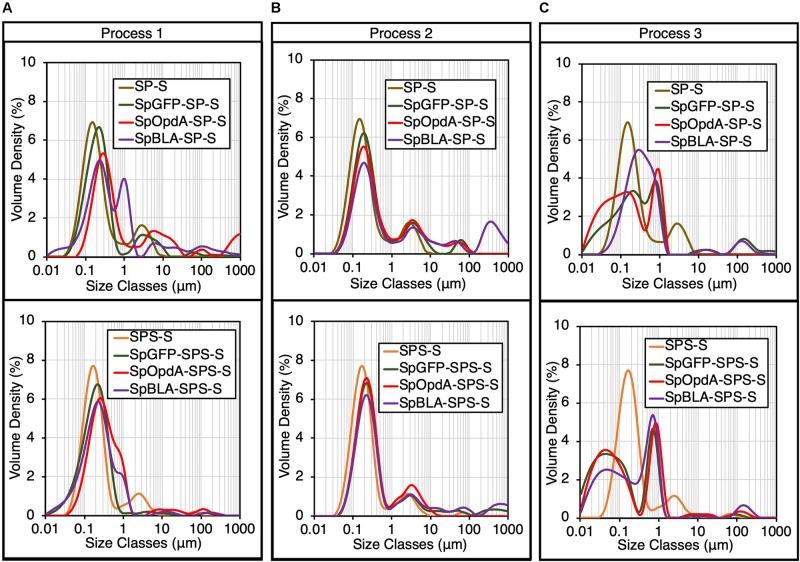
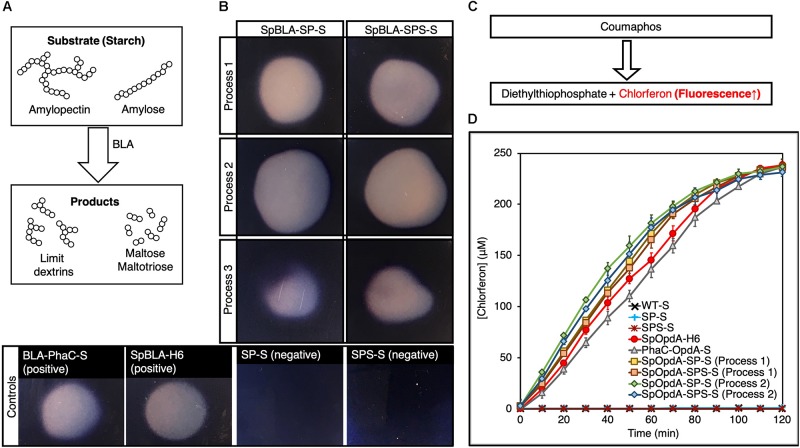
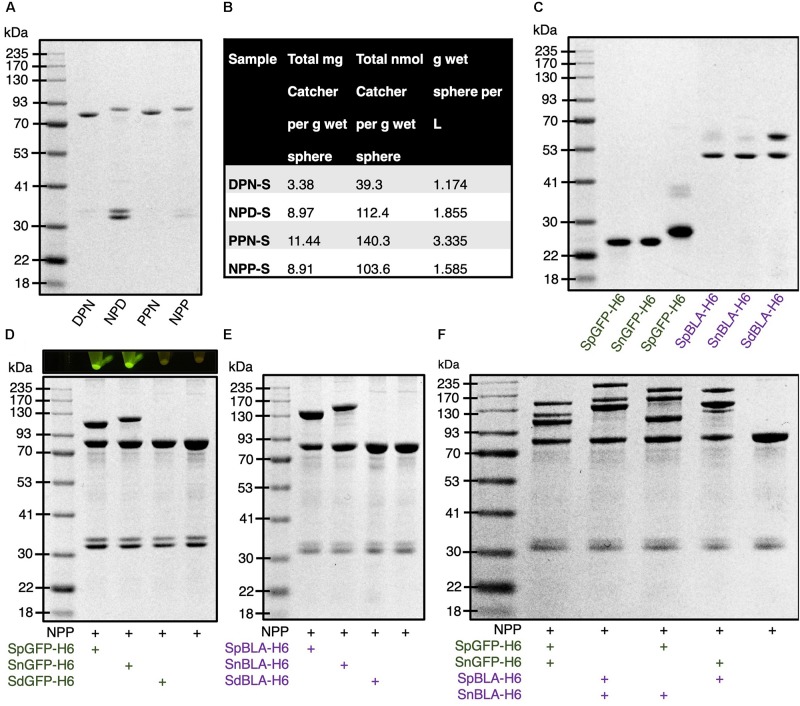
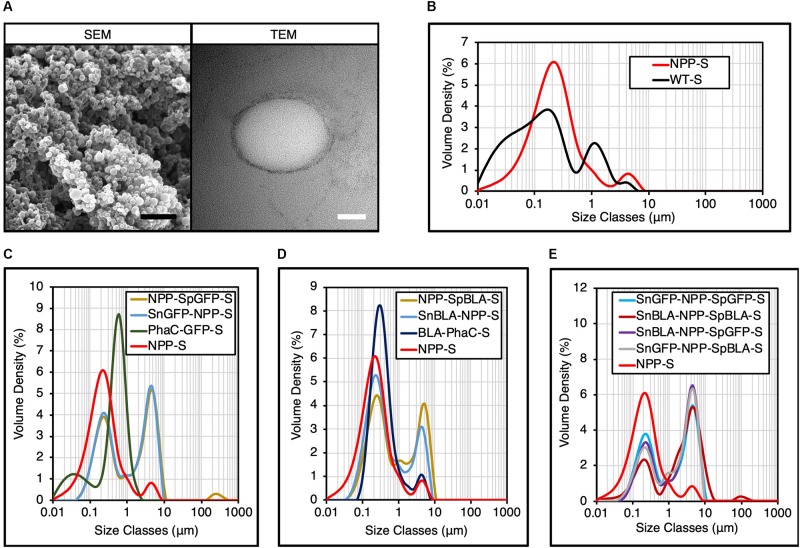
Bioengineered polyhydroxyalkanoate (PHA) spheres assembled in engineered bacteria are showing promising potential in protein immobilization for high-value applications. Here, we have designed innovative streamlined approaches to add functional proteins from complex mixtures (e.g., without prior purification) to bioengineered PHA spheres directly harnessing the specificity of the SpyTag/SpyCatcher mediated protein ligation. was engineered to assemble PHA spheres displaying the SpyCatcher domain while simultaneously producing a SpyTagged target protein, which was specifically ligated to the PHA spheres. To further demonstrate the specificity of this ligation reaction, we incubated isolated SpyCatcher-coated PHA spheres with cell lysates containing SpyTagged target protein, which also resulted in specific ligation mediating surface functionalization. An even cruder approach was used by lysing a mixture of cells, either producing PHA spheres or target protein, which resulted in specific surface functionalization suggesting that ligation between the SpyCatcher-coated PHA spheres and the SpyTagged target proteins is highly specific. To expand the design space of this general modular approach toward programmable multifunctionalization, e.g., one-pot construction of immobilized multienzyme cascade systems on PHA spheres, we designed various recombinant bimodular PHA spheres utilizing alternative Tag/Catcher pairs (e.g., SnoopTag/SnoopCatcher and SdyTag/SdyCatcher systems). One of our bimodular PHA spheres resulted in simultaneous multifunctionalization of plain PHA spheres in one-step with two differently tagged proteins under and reaction conditions while remaining functional. Our bimodular PHA spheres also showed high orthogonality with the non-target peptide tag and exhibited decent robustness against repeated freeze-thaw treatment. We demonstrated the utility of these approaches by using a fluorescent protein, a monomeric amylase, and a dimeric organophosphate hydrolase as target proteins. We established a versatile toolbox for dynamic functionalization of PHA spheres for biomedical and industrial applications.
在工程细菌中组装的生物工程聚羟基脂肪酸酯(PHA)球体在用于高价值应用的蛋白质固定方面显示出有前景的潜力。在此,我们设计了创新的简化方法,可直接利用SpyTag/SpyCatcher介导的蛋白质连接的特异性,将复杂混合物中的功能蛋白(例如,无需事先纯化)添加到生物工程PHA球体中。对工程菌进行改造,使其组装展示SpyCatcher结构域的PHA球体,同时产生带有SpyTag的靶蛋白,该靶蛋白可特异性连接到PHA球体上。为了进一步证明这种连接反应的特异性,我们将分离的包被有SpyCatcher的PHA球体与含有带有SpyTag的靶蛋白的细胞裂解物一起孵育,这也导致了介导表面功能化的特异性连接。我们采用了一种更粗糙的方法,即裂解产生PHA球体或靶蛋白的细胞混合物,这导致了特异性表面功能化,表明包被有SpyCatcher的PHA球体与带有SpyTag的靶蛋白之间的连接具有高度特异性。为了将这种通用模块化方法的设计空间扩展到可编程的多功能化,例如在PHA球体上一锅法构建固定化多酶级联系统,我们利用替代的标签/捕获器对(例如,SnoopTag/SnoopCatcher和SdyTag/SdyCatcher系统)设计了各种重组双模块PHA球体。我们的一种双模块PHA球体在温和反应条件下,能使普通PHA球体一步同时被两种不同标记的蛋白进行多功能化,且仍保持功能。我们的双模块PHA球体还与非靶肽标签表现出高正交性,并且对反复冻融处理具有良好的耐受性。我们通过使用荧光蛋白、单体淀粉酶和二聚体有机磷酸酯水解酶作为靶蛋白,证明了这些方法的实用性。我们建立了一个用于PHA球体动态功能化的通用工具箱,用于生物医学和工业应用。