Chung Sook Hyun, Mollhoff Iris Natalie, Nguyen Uyen, Nguyen Amy, Stucka Natalie, Tieu Eric, Manna Suman, Meleppat Ratheesh Kumar, Zhang Pengfei, Nguyen Emerald Lovece, Fong Jared, Zawadzki Robert, Yiu Glenn
Department of Ophthalmology & Vision Science, University of California, Davis, Davis, CA, USA.
Mol Ther Methods Clin Dev. 2020 Jan 23;17:409-417. doi: 10.1016/j.omtm.2020.01.006. eCollection 2020 Jun 12.
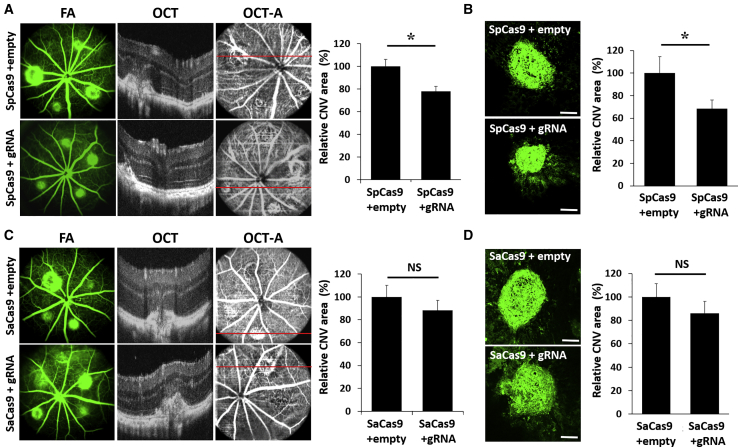
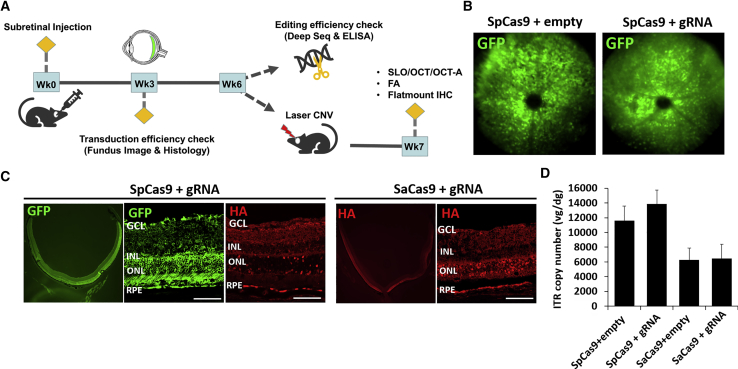
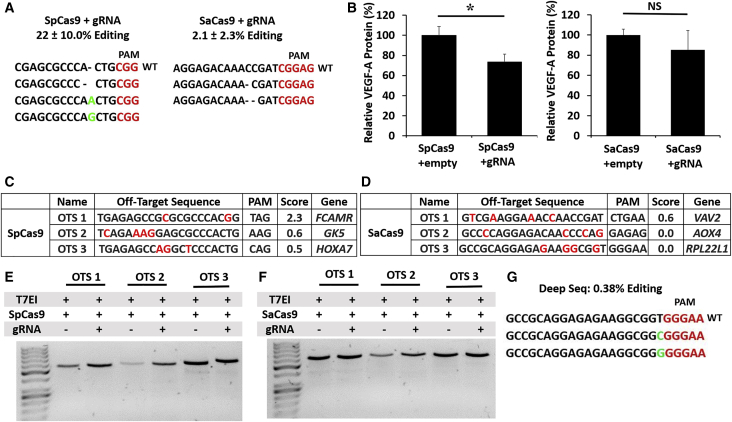
Frequent injections of anti-vascular endothelial growth factor (anti-VEGF) agents are a clinical burden for patients with neovascular age-related macular degeneration (AMD). Genomic disruption of using adeno-associated viral (AAV) delivery of clustered regularly interspaced short palindromic repeats (CRISPR)-Cas9 has the potential to permanently suppress aberrant angiogenesis, but the factors that determine the optimal efficacy are unknown. Here, we investigate two widely used Cas9 endonucleases, SpCas9 and SaCas9, and evaluate the relative contribution of AAV-delivery efficiency and genome-editing rates to determine the mechanisms that drive successful CRISPR-based suppression of VEGF-A, using a mouse model of laser-induced choroidal neovascularization (CNV). We found that SpCas9 demonstrated higher genome-editing rates, greater VEGF reduction, and more effective CNV suppression than SaCas9, despite similar AAV transduction efficiency between a dual-vector approach for SpCas9 and single-vector system for SaCas9 to deliver the Cas9 orthologs and single guide RNAs (gRNAs). Our results suggest that successful VEGF knockdown using AAV-mediated CRISPR systems may be determined more by the efficiency of genome editing rather than viral transduction and that SpCas9 may be more effective than SaCas9 as a potential therapeutic strategy for CRISPR-based treatment of CNV in neovascular AMD.
频繁注射抗血管内皮生长因子(anti-VEGF)药物对新生血管性年龄相关性黄斑变性(AMD)患者来说是一项临床负担。利用腺相关病毒(AAV)递送成簇规律间隔短回文重复序列(CRISPR)-Cas9进行基因组破坏有可能永久抑制异常血管生成,但决定最佳疗效的因素尚不清楚。在这里,我们研究了两种广泛使用的Cas9核酸内切酶SpCas9和SaCas9,并评估AAV递送效率和基因组编辑率的相对贡献,以确定基于CRISPR成功抑制VEGF-A的机制,使用激光诱导脉络膜新生血管(CNV)的小鼠模型。我们发现,尽管用于SpCas9的双载体方法和用于SaCas9的单载体系统在递送Cas9直系同源物和单向导RNA(gRNA)时AAV转导效率相似,但SpCas9比SaCas9表现出更高的基因组编辑率、更大的VEGF降低和更有效的CNV抑制。我们的结果表明,使用AAV介导的CRISPR系统成功敲低VEGF可能更多地取决于基因组编辑效率而非病毒转导,并且作为基于CRISPR治疗新生血管性AMD中CNV的潜在治疗策略,SpCas9可能比SaCas9更有效。