Corral-Acero Jorge, Margara Francesca, Marciniak Maciej, Rodero Cristobal, Loncaric Filip, Feng Yingjing, Gilbert Andrew, Fernandes Joao F, Bukhari Hassaan A, Wajdan Ali, Martinez Manuel Villegas, Santos Mariana Sousa, Shamohammdi Mehrdad, Luo Hongxing, Westphal Philip, Leeson Paul, DiAchille Paolo, Gurev Viatcheslav, Mayr Manuel, Geris Liesbet, Pathmanathan Pras, Morrison Tina, Cornelussen Richard, Prinzen Frits, Delhaas Tammo, Doltra Ada, Sitges Marta, Vigmond Edward J, Zacur Ernesto, Grau Vicente, Rodriguez Blanca, Remme Espen W, Niederer Steven, Mortier Peter, McLeod Kristin, Potse Mark, Pueyo Esther, Bueno-Orovio Alfonso, Lamata Pablo
Department of Engineering Science, University of Oxford, Oxford, UK.
Department of Computer Science, British Heart Foundation Centre of Research Excellence, University of Oxford, Oxford, UK.
Eur Heart J. 2020 Dec 21;41(48):4556-4564. doi: 10.1093/eurheartj/ehaa159.
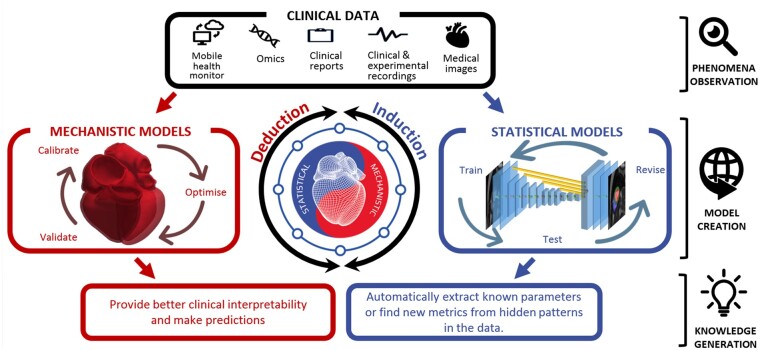
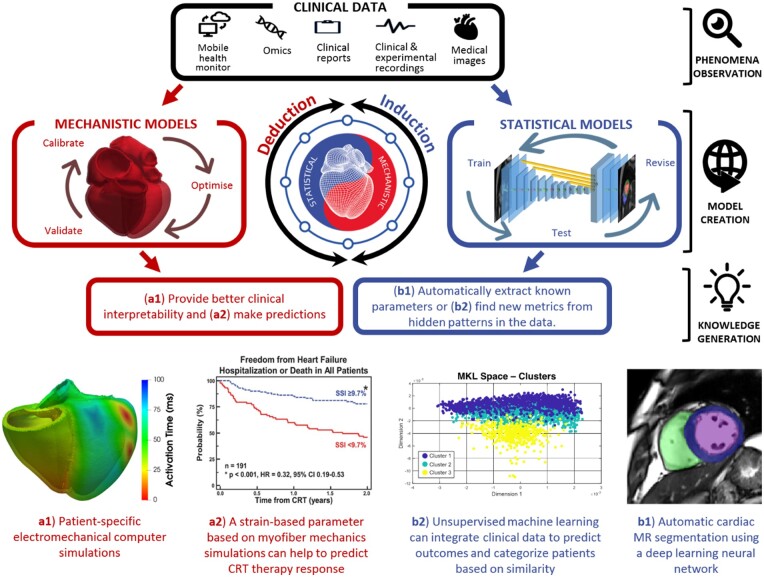
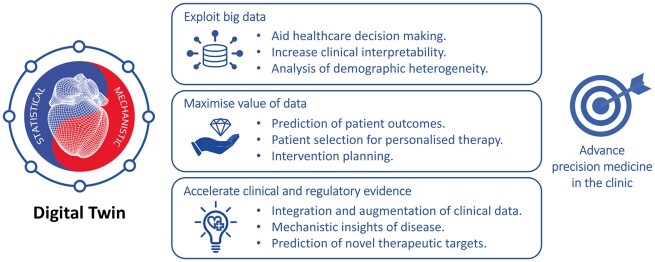
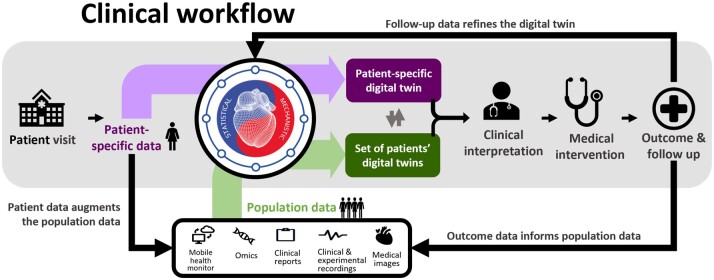
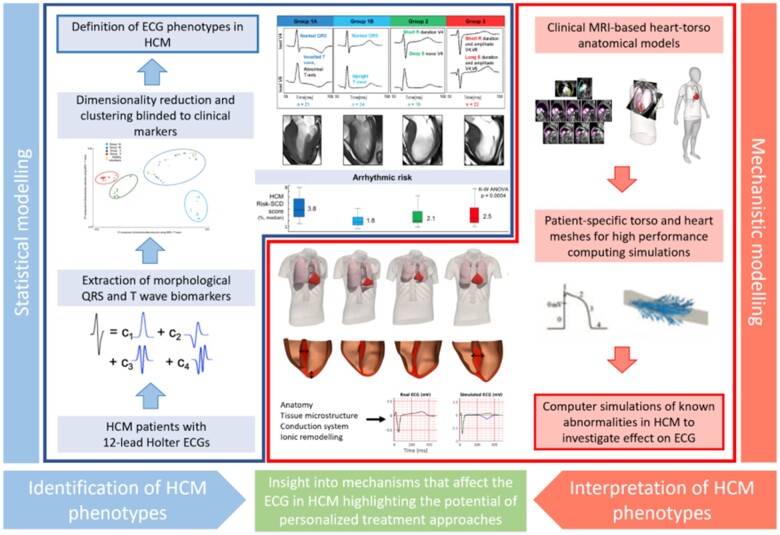
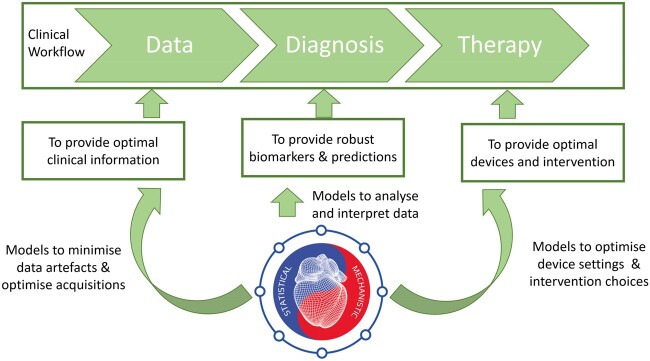
Providing therapies tailored to each patient is the vision of precision medicine, enabled by the increasing ability to capture extensive data about individual patients. In this position paper, we argue that the second enabling pillar towards this vision is the increasing power of computers and algorithms to learn, reason, and build the 'digital twin' of a patient. Computational models are boosting the capacity to draw diagnosis and prognosis, and future treatments will be tailored not only to current health status and data, but also to an accurate projection of the pathways to restore health by model predictions. The early steps of the digital twin in the area of cardiovascular medicine are reviewed in this article, together with a discussion of the challenges and opportunities ahead. We emphasize the synergies between mechanistic and statistical models in accelerating cardiovascular research and enabling the vision of precision medicine.
提供针对每位患者的个性化治疗是精准医学的愿景,而收集个体患者大量数据的能力不断增强使得这一愿景得以实现。在本立场文件中,我们认为实现这一愿景的第二个关键支柱是计算机和算法学习、推理以及构建患者“数字孪生”的能力不断提升。计算模型正在提高做出诊断和预后判断的能力,未来的治疗不仅将根据当前的健康状况和数据进行定制,还将依据模型预测对恢复健康的途径进行准确预测。本文回顾了心血管医学领域数字孪生的早期进展,并讨论了未来面临的挑战和机遇。我们强调机械模型和统计模型在加速心血管研究以及实现精准医学愿景方面的协同作用。