Dramé Ousmane, Leclair Daniel, Parmley E Jane, Deckert Anne, Ouattara Blaise, Daignault Danielle, Ravel André
Food Safety Science Directorate, Canadian Food Inspection Agency, Ottawa, Canada.
Groupe de recherche en épidémiologie des zoonoses et santé publique, Faculty of Veterinary Medicine, University of Montreal, Saint-Hyacinthe, Quebec, Canada.
Foodborne Pathog Dis. 2020 Aug;17(8):512-520. doi: 10.1089/fpd.2019.2752. Epub 2020 Mar 4.
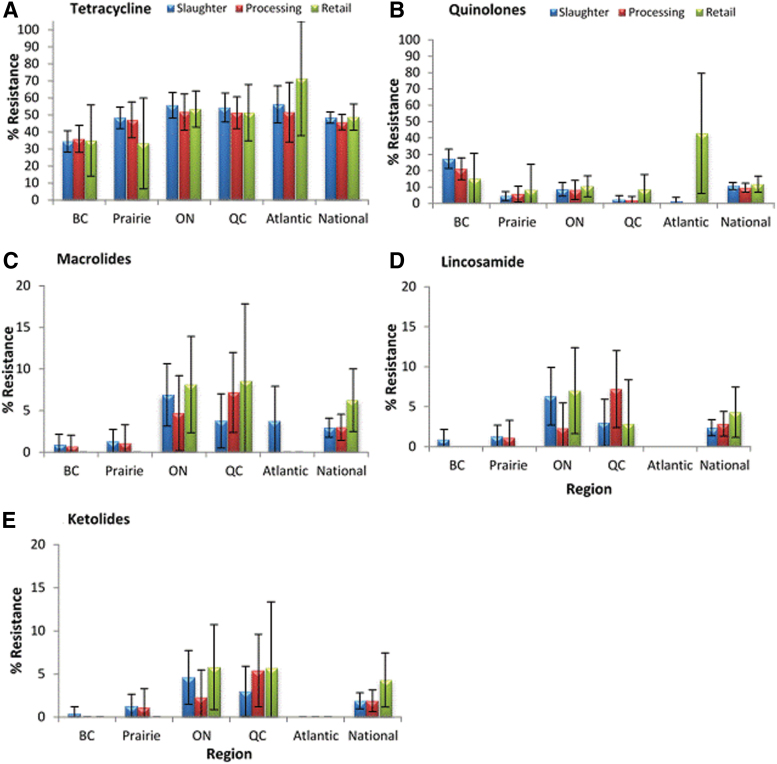
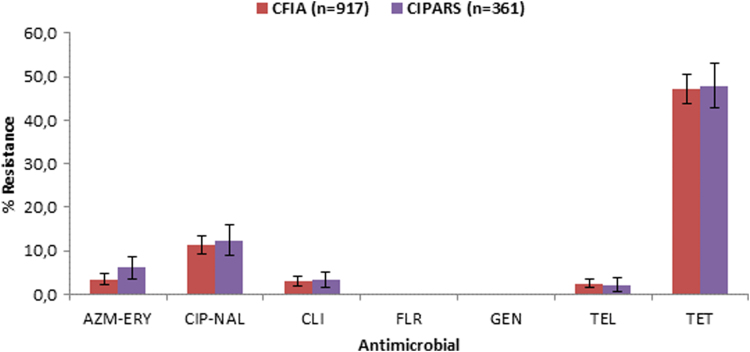
Antimicrobial resistance (AMR) is a major public health threat worldwide. The main objective of this study was to compare AMR in from broiler chickens raised on Canadian farms and their products in different geographical regions of Canada. To do this, antimicrobial susceptibility results from isolates of recovered from a national microbiological baseline study conducted in federally registered establishments and in the retail marketplace were analyzed. Among 1460 isolates tested, 774 (53%) were resistant to at least one antimicrobial, with a predominance of three profiles: tetracycline (39%), quinolone-tetracycline (6.6%), and quinolones only (3.5%). The results showed no significant difference in the frequency of resistant profiles ( ≥ 0.05) among the isolates originating from different points in the food processing chain at slaughterhouses and in retail establishments. This suggests that AMR observed in isolates from raw chicken at retail originated further upstream in the system. A difference in the frequency of certain resistance profiles was observed between the regions of Canada. For instance, in British Columbia, there was more resistance to quinolones, while in Ontario and Quebec, isolates were more resistant to tetracyclines, macrolides, ketolides, and lincosamides. Comparison of AMR data from this study with those from the Canadian Integrated Program for Antimicrobial Resistance Surveillance (CIPARS) did not show any significant difference and provides evidence that CIPARS produces nationally representative resistance results.
抗菌药物耐药性(AMR)是全球主要的公共卫生威胁。本研究的主要目的是比较加拿大不同地理区域农场饲养的肉鸡及其产品中的AMR情况。为此,分析了从联邦注册机构和零售市场进行的全国微生物基线研究中分离出的菌株的抗菌药物敏感性结果。在测试的1460株菌株中,774株(53%)对至少一种抗菌药物耐药,主要有三种耐药谱:四环素(39%)、喹诺酮 - 四环素(6.6%)和仅对喹诺酮耐药(3.5%)。结果表明,来自屠宰场和零售机构食品加工链不同环节的菌株中,耐药谱的频率没有显著差异(≥0.05)。这表明在零售的生鸡肉分离株中观察到的AMR在系统中起源于更上游。在加拿大不同地区观察到某些耐药谱频率存在差异。例如,在不列颠哥伦比亚省,对喹诺酮的耐药性更高,而在安大略省和魁北克省,分离株对四环素、大环内酯类、酮内酯类和林可酰胺类更耐药。将本研究的AMR数据与加拿大抗菌药物耐药性监测综合项目(CIPARS)的数据进行比较,未发现任何显著差异,这证明CIPARS产生了具有全国代表性的耐药性结果。