Interdepartmental Neuroscience Program, Yale University, New Haven, Connecticut, United States of America.
Department of Comparative Medicine, Yale University, New Haven, Connecticut, United States of America.
PLoS One. 2020 Mar 4;15(3):e0228782. doi: 10.1371/journal.pone.0228782. eCollection 2020.
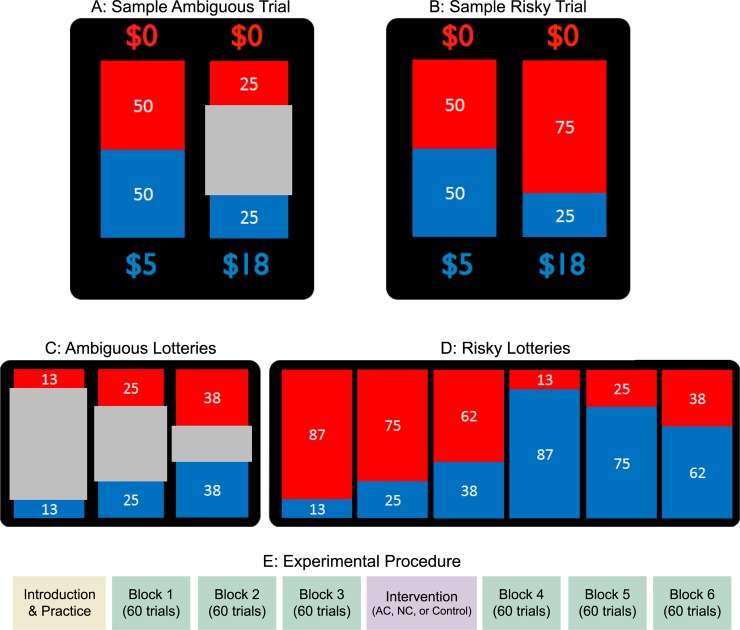
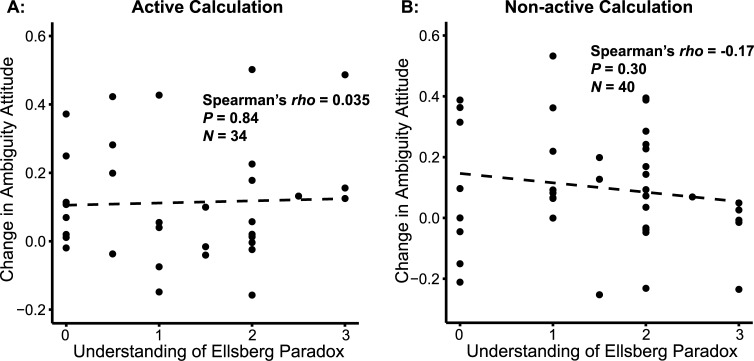
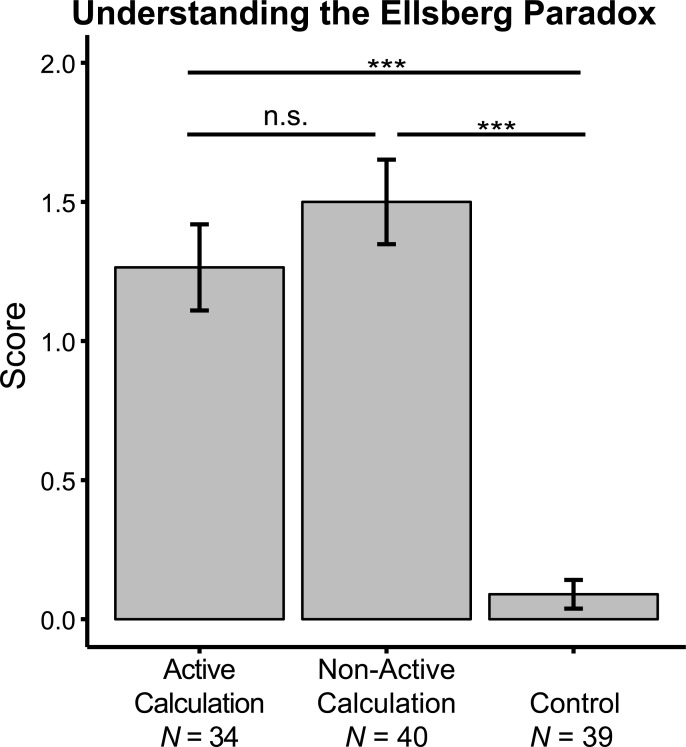
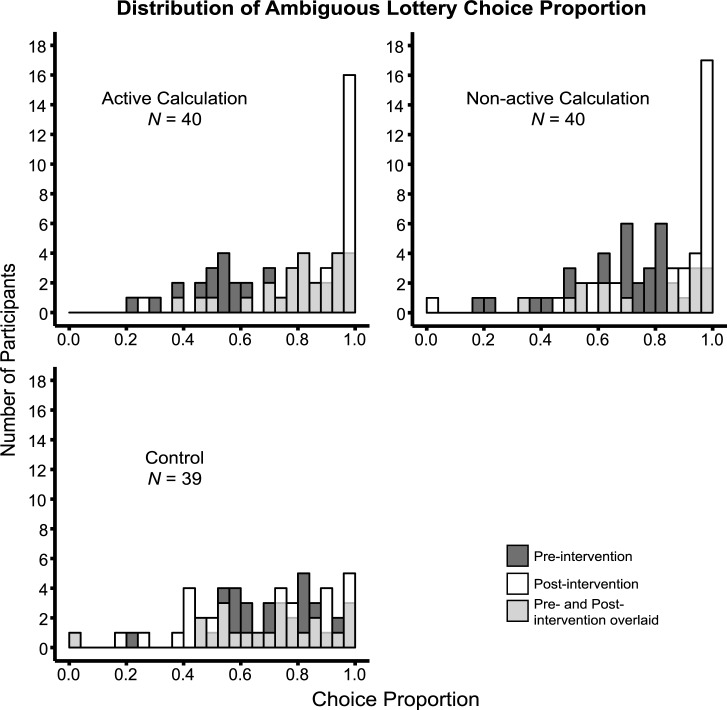
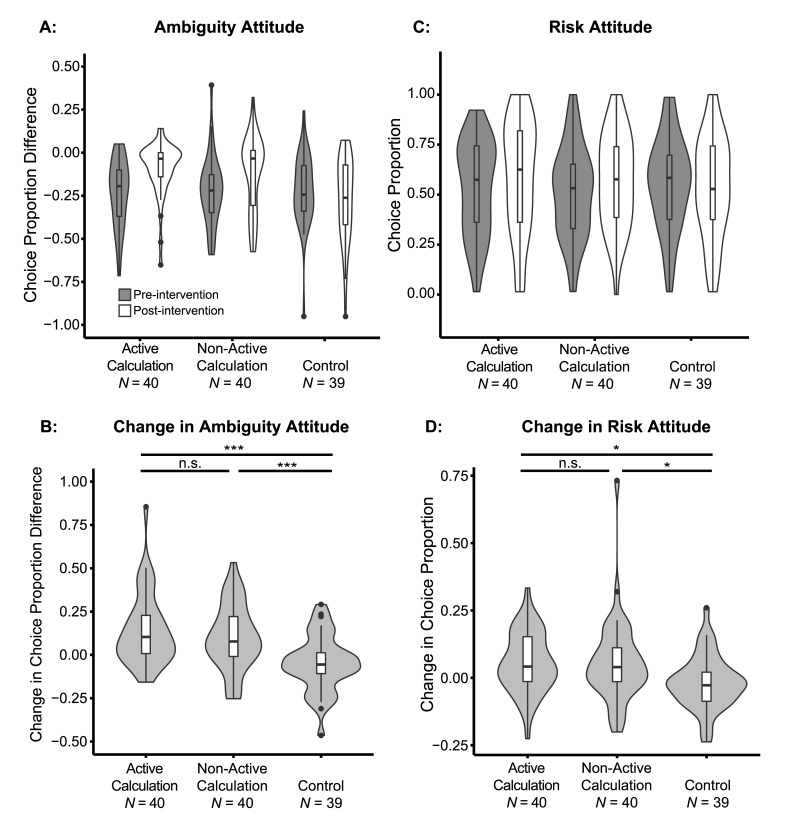
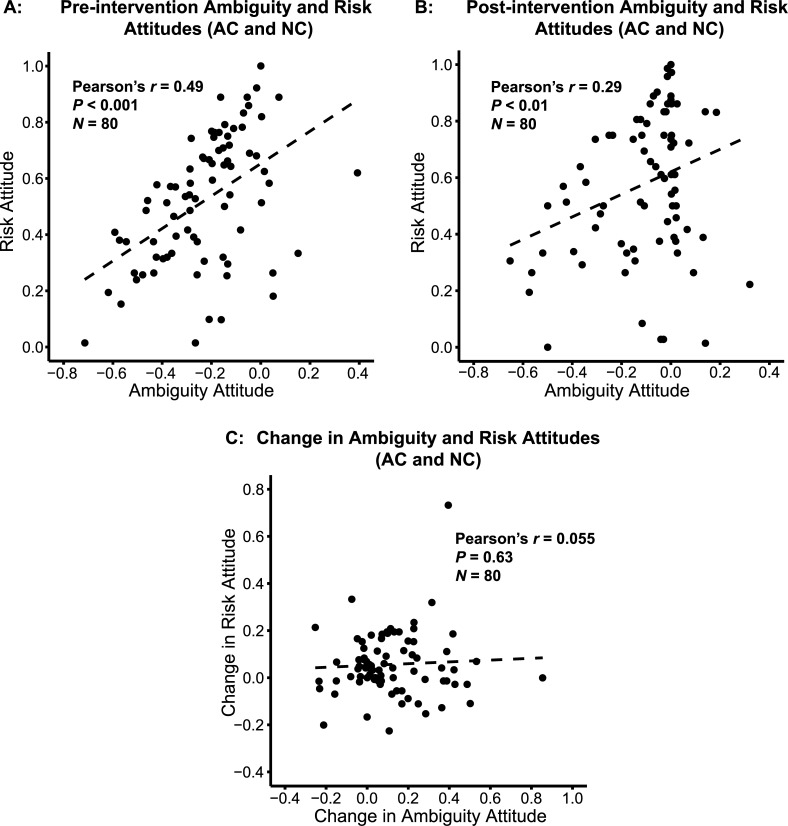
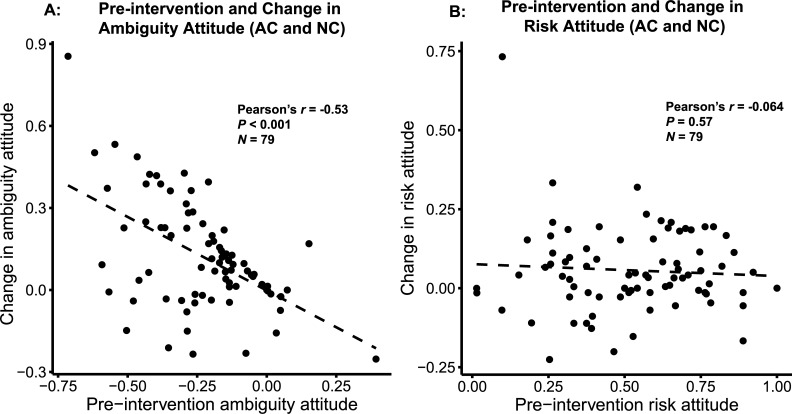
Ambiguity aversion-the tendency to avoid options whose outcome probabilities are unknown-is a ubiquitous phenomenon. While in some cases ambiguity aversion is an adaptive strategy, in many situations it leads to suboptimal decisions, as illustrated by the famous Ellsberg Paradox. Behavioral interventions for reducing ambiguity aversion should therefore be of substantial practical value. Here we test a simple intervention, aimed at reducing ambiguity aversion in an experimental design, where aversion to ambiguity leads to reduced earnings. Participants made a series of choices between a reference lottery with a 50% chance of winning $5, and another lottery, which offered more money, but whose outcome probability was either lower than 50% (risky lottery) or not fully known (ambiguous lottery). Similar to previous studies, participants exhibited both risk and ambiguity aversion in their choices. They then went through one of three interventions. Two groups of participants learned about the Ellsberg Paradox and their own suboptimal choices, either by actively calculating the objective winning probability of the ambiguous lotteries, or by observing these calculations. A control group learned about base-rate neglect, which was irrelevant to the task. Following the intervention, participants again made a series of choices under risk and ambiguity. Participants who learned about the Ellsberg Paradox were more tolerant of ambiguity, yet ambiguity aversion was not completely abolished. At the same time, these participants also exhibited reduced aversion to risk, suggesting inappropriate generalization of learning to an irrelevant decision domain. Our results highlight the challenge for behavioral interventions: generating a strong, yet specific, behavioral change.
回避模糊性——即回避结果概率未知的选项的倾向——是一种普遍存在的现象。虽然在某些情况下,回避模糊性是一种适应性策略,但在许多情况下,它会导致次优决策,正如著名的埃尔斯伯格悖论所表明的那样。因此,减少回避模糊性的行为干预应该具有重要的实际价值。在这里,我们测试了一种简单的干预措施,旨在减少实验设计中的回避模糊性,在这种设计中,回避模糊性会导致收益减少。参与者在一个参考彩票和另一个彩票之间进行一系列选择,参考彩票有 50%的机会赢得 5 美元,而另一个彩票提供更多的钱,但结果概率低于 50%(风险彩票)或不完全知道(模糊彩票)。与之前的研究类似,参与者在他们的选择中表现出了风险和模糊性的回避。然后,他们经历了三种干预措施中的一种。两组参与者通过主动计算模糊彩票的客观获胜概率,或者通过观察这些计算,了解了埃尔斯伯格悖论和他们自己的次优选择。对照组了解了基本比率忽视,这与任务无关。干预措施之后,参与者再次在风险和模糊性下进行一系列选择。了解埃尔斯伯格悖论的参与者对模糊性的容忍度更高,但回避模糊性并没有完全消除。同时,这些参与者也表现出对风险的回避减少,这表明学习对不相关决策领域的不适当推广。我们的结果强调了行为干预的挑战:产生强烈但具体的行为改变。