Gong Huimin, Zhao Changhui, Niu Gaoqiang, Zhang Wei, Wang Fei
School of Microelectronics, Southern University of Science and Technology, Shenzhen 518055, China.
Department of Electrical and Electronic Engineering, Southern University of Science and Technology, Shenzhen 518055, China.
Research (Wash D C). 2020 Feb 13;2020:2196063. doi: 10.34133/2020/2196063. eCollection 2020.
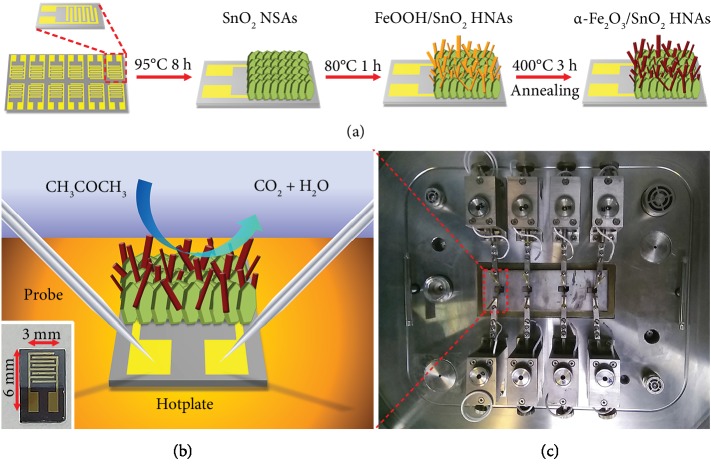
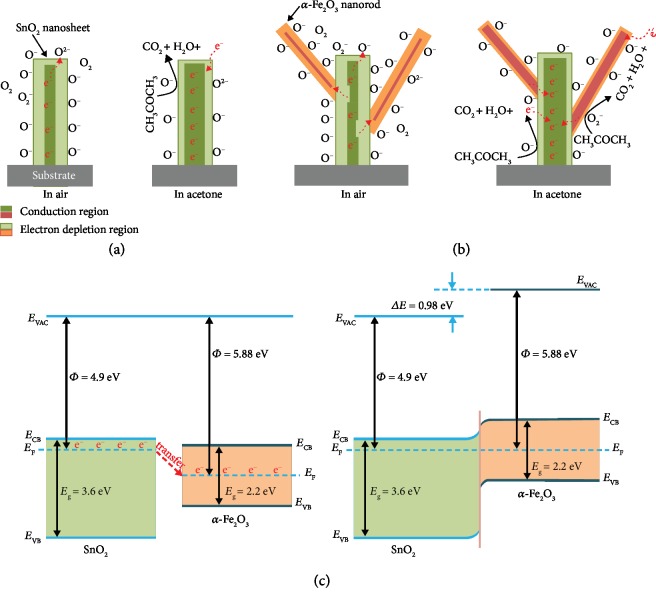
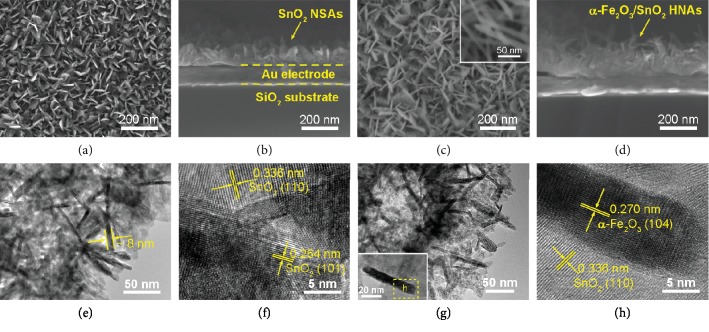
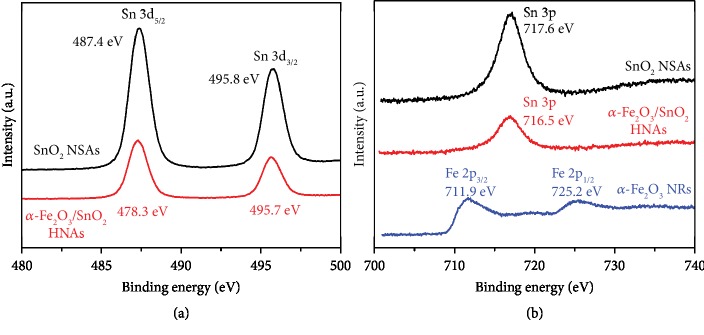
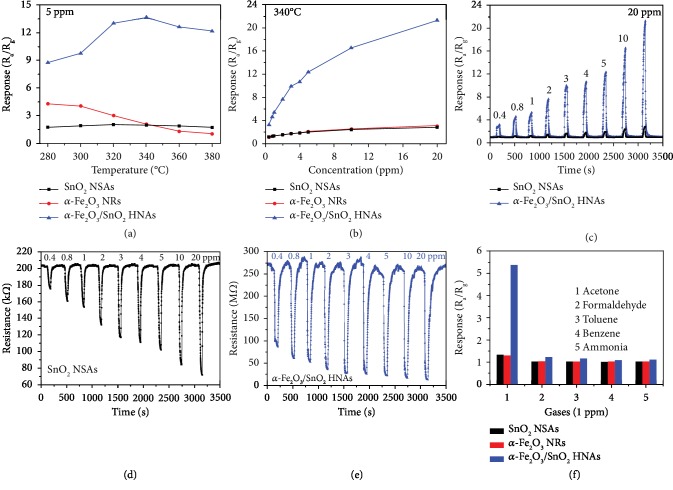
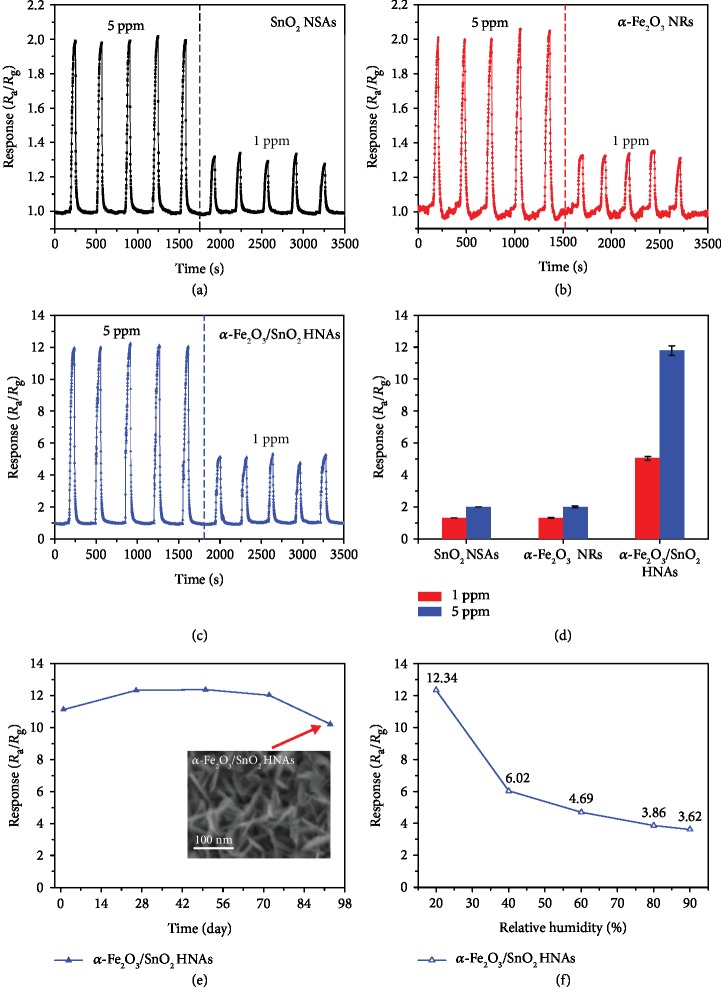
Exhaled acetone is one of the representative biomarkers for the noninvasive diagnosis of type-1 diabetes. In this work, we have applied a facile two-step chemical bath deposition method for acetone sensors based on -FeO/SnO hybrid nanoarrays (HNAs), where one-dimensional (1D) FeOOH nanorods are in situ grown on the prefabricated 2D SnO nanosheets for on-chip construction of 1D/2D HNAs. After annealing in air, ultrafine -FeO nanorods are homogenously distributed on the surface of SnO nanosheet arrays (NSAs). Gas sensing results show that the -FeO/SnO HNAs exhibit a greatly enhanced response to acetone (3.25 at 0.4 ppm) at a sub-ppm level compared with those based on pure SnO NSAs (1.16 at 0.4 ppm) and pure -FeO nanorods (1.03 at 0.4 ppm), at an operating temperature of 340°C. The enhanced acetone sensing performance may be attributed to the formation of -FeO-SnO n-n heterostructure with 1D/2D hybrid architectures. Moreover, the -FeO/SnO HNAs also possess good reproducibility and selectivity toward acetone vapor, suggesting its potential application in breath acetone analysis.
呼出丙酮是1型糖尿病无创诊断的代表性生物标志物之一。在本工作中,我们基于-FeO/SnO混合纳米阵列(HNAs)应用一种简便的两步化学浴沉积法制备丙酮传感器,其中一维(1D)FeOOH纳米棒原位生长在预制的二维SnO纳米片上,用于在芯片上构建一维/二维HNAs。在空气中退火后,超细的-FeO纳米棒均匀分布在SnO纳米片阵列(NSAs)表面。气敏结果表明,在340°C的工作温度下,与基于纯SnO NSAs(0.4 ppm时为1.16)和纯-FeO纳米棒(0.4 ppm时为1.03)的传感器相比,-FeO/SnO HNAs在亚ppm水平对丙酮表现出极大增强的响应(0.4 ppm时为3.25)。增强的丙酮传感性能可能归因于具有一维/二维混合结构的-FeO-SnO n-n异质结构的形成。此外,-FeO/SnO HNAs对丙酮蒸汽还具有良好的重现性和选择性,表明其在呼气丙酮分析中的潜在应用。