Global Influenza Programme, Infectious Hazards Management, WHO Emergency Programme, WHO, Geneva, Switzerland.
Influenza Division, National Center for Immunization and Respiratory Diseases, Centers for Disease Control and Prevention, Atlanta, Georgia, USA.
Rev Med Virol. 2020 May;30(3):e2099. doi: 10.1002/rmv.2099. Epub 2020 Mar 5.
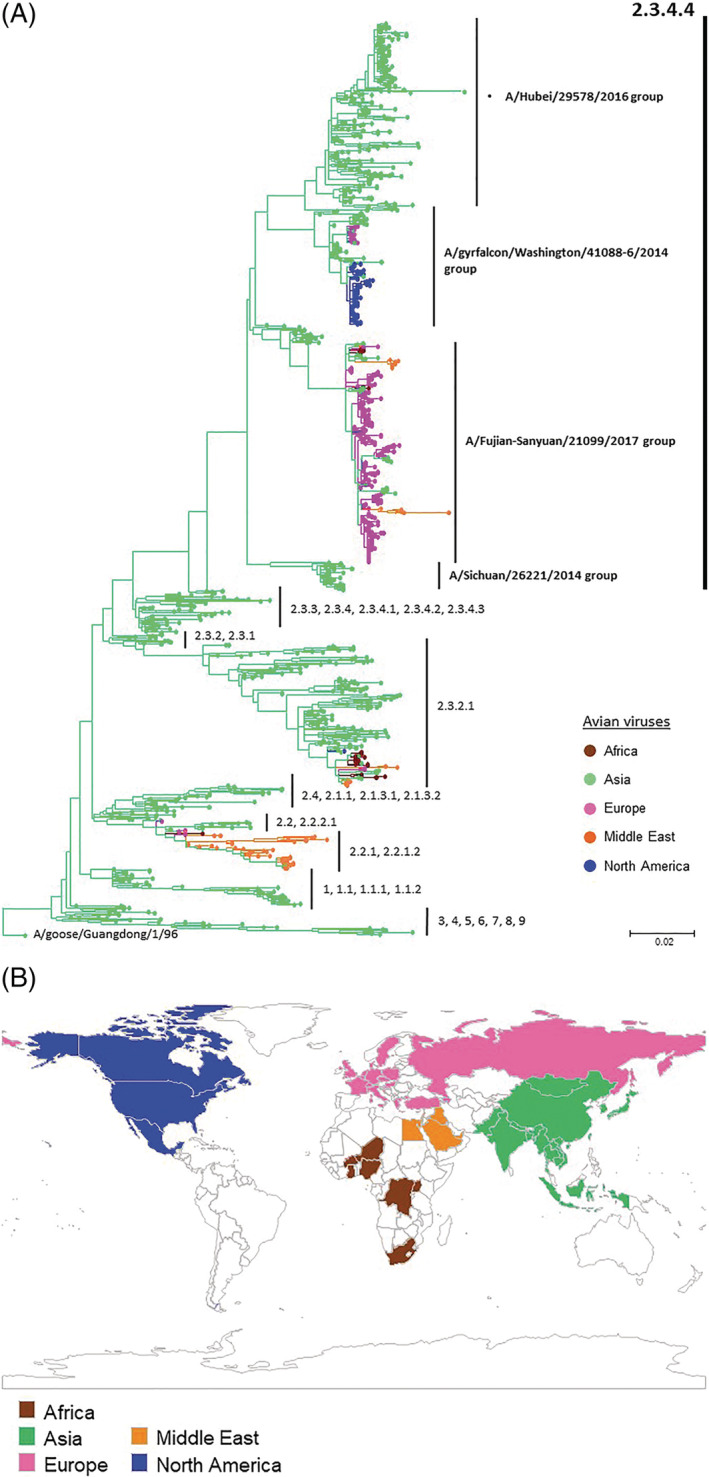
The panzootic caused by A/goose/Guangdong/1/96-lineage highly pathogenic avian influenza (HPAI) A(H5) viruses has occurred in multiple waves since 1996. From 2013 onwards, clade 2.3.4.4 viruses of subtypes A(H5N2), A(H5N6), and A(H5N8) emerged to cause panzootic waves of unprecedented magnitude among avian species accompanied by severe losses to the poultry industry around the world. Clade 2.3.4.4 A(H5) viruses have expanded in distinct geographical and evolutionary pathways likely via long distance migratory bird dispersal onto several continents and by poultry trade among neighboring countries. Coupled with regional circulation, the viruses have evolved further by reassorting with local viruses. As of February 2019, there have been 23 cases of humans infected with clade 2.3.4.4 H5N6 viruses, 16 (70%) of which had fatal outcomes. To date, no HPAI A(H5) virus has caused sustainable human-to-human transmission. However, due to the lack of population immunity in humans and ongoing evolution of the virus, there is a continuing risk that clade 2.3.4.4 A(H5) viruses could cause an influenza pandemic if the ability to transmit efficiently among humans was gained. Therefore, multisectoral collaborations among the animal, environmental, and public health sectors are essential to conduct risk assessments and develop countermeasures to prevent disease and to control spread. In this article, we describe an assessment of the likelihood of clade 2.3.4.4 A(H5) viruses gaining human-to-human transmissibility and impact on human health should such human-to-human transmission occur. This structured analysis assessed properties of the virus, attributes of the human population, and ecology and epidemiology of these viruses in animal hosts.
自 1996 年以来,由 A/goose/Guangdong/1/96 谱系高致病性禽流感(HPAI)A(H5)病毒引起的大流行已经发生了多波。自 2013 年以来,亚型 A(H5N2)、A(H5N6)和 A(H5N8)的 2.3.4.4 分支病毒出现,导致禽类物种中前所未有的大流行波,给全球家禽业造成严重损失。2.3.4.4 分支 A(H5)病毒通过长距离候鸟传播到多个大陆,并通过邻国之间的家禽贸易,在不同的地理和进化途径中扩展。加上区域循环,病毒通过与当地病毒的重配进一步进化。截至 2019 年 2 月,已有 23 例人类感染 2.3.4.4 分支 H5N6 病毒的病例,其中 16 例(70%)为致命病例。迄今为止,没有 HPAI A(H5)病毒导致可持续的人际传播。然而,由于人类缺乏群体免疫力和病毒的持续进化,如果 2.3.4.4 分支 A(H5)病毒获得在人群中有效传播的能力,仍然存在病毒引起流感大流行的持续风险。因此,动物、环境和公共卫生部门之间的多部门合作对于进行风险评估和制定对策以预防疾病和控制传播至关重要。在本文中,我们描述了对 2.3.4.4 分支 A(H5)病毒获得人际传播能力及其对人类健康影响的评估,如果发生人际传播。这种结构化分析评估了病毒的特性、人类群体的属性以及这些病毒在动物宿主中的生态学和流行病学。