Kim Kyoung-Bae, Shin Yun-A
Department of Physical Education, Korea Military Academy, Seoul, Korea.
Department of Prescription and Rehabilitation of Exercise, College of Sport Science, Dankook University, Cheonan, Korea.
J Obes Metab Syndr. 2020 Mar 30;29(1):18-25. doi: 10.7570/jomes20008.
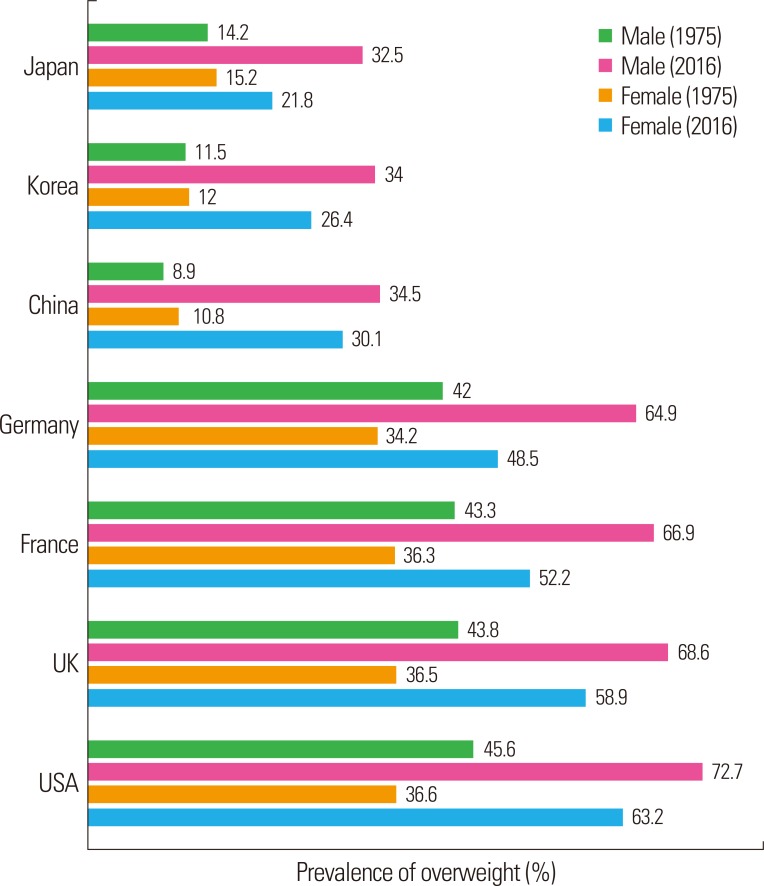
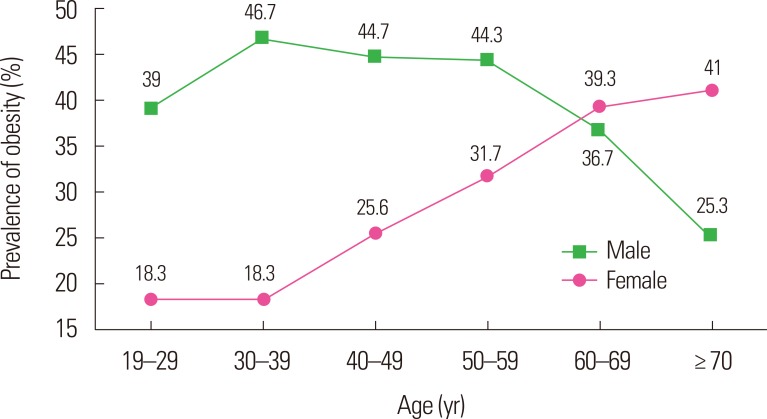
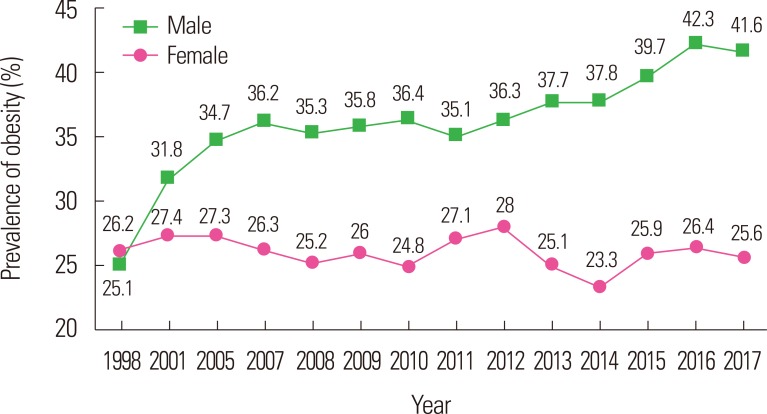
Global average data suggest that the prevalence of obese and overweight males is much higher than that of females in some regions. The gender gap in obese and overweight individuals has deepened in many countries, and the gap is more prominent in overweight than in obesity. In particular, the prevalence of male obesity has continuously increased in the Republic of Korea over the past two decades, whereas the increase in female obesity has slowed and may even have plateaued. The cutoff point for obesity in Korea is a body mass index of ≥25 kg/m, which is equivalent to the international classification of being overweight. Researching obesity in males is not as prevalent as studying obesity in females. Previous studies have rarely considered obesity type (android vs. gynoid), hormones (testosterone, androgen, etc.), awareness of body shape, or special resources such as exercise interventions to improve male weight issues. Adaptations to exercise interventions show individual variability as well as differences between men and women. Therefore, integrated approaches to research should be adopted, including evaluation of socio-demographic and physiological characteristics, to ensure that such interventions are not simply a symptomatic treatment but are actually treating the root cause of the obesity.
全球平均数据表明,在某些地区,肥胖和超重男性的患病率远高于女性。许多国家肥胖和超重人群中的性别差距不断加大,超重方面的差距比肥胖更为显著。特别是在过去二十年里,韩国男性肥胖患病率持续上升,而女性肥胖率的增长则有所放缓,甚至可能已趋于平稳。韩国肥胖的临界值是体重指数≥25千克/平方米,这等同于国际上超重的分类标准。对男性肥胖的研究不如对女性肥胖的研究普遍。以往的研究很少考虑肥胖类型(腹型肥胖与臀型肥胖)、激素(睾酮、雄激素等)、体型认知,或诸如运动干预等改善男性体重问题的特殊资源。对运动干预的适应性表现出个体差异以及男女之间的差异。因此,应采用综合研究方法,包括评估社会人口学和生理特征,以确保此类干预措施不仅仅是对症治疗,而是真正针对肥胖的根本原因进行治疗。