Department of Biology, University of Pennsylvania, Philadelphia, PA 19104, USA.
Metallomics. 2020 Apr 1;12(4):572-591. doi: 10.1039/c9mt00314b. Epub 2020 Mar 9.
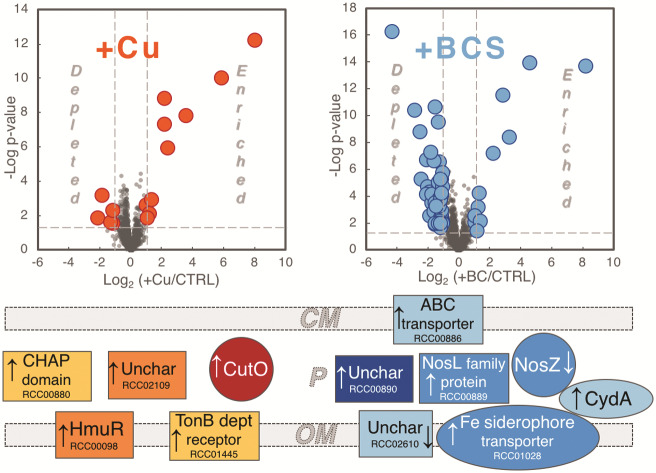
Copper (Cu) is an essential, but toxic, micronutrient for living organisms and cells have developed sophisticated response mechanisms towards both the lack and the excess of Cu in their environments. In this study, we achieved a global view of Cu-responsive changes in the prokaryotic model organism Rhodobacter capsulatus using label-free quantitative differential proteomics. Semi-aerobically grown cells under heterotrophic conditions in minimal medium (∼0.3 μM Cu) were compared with cells supplemented with either 5 μM Cu or with 5 mM of the Cu-chelator bathocuproine sulfonate. Mass spectrometry based bottom-up proteomics of unfractionated cell lysates identified 2430 of the 3632 putative proteins encoded by the genome, producing a robust proteome dataset for R. capsulatus. Use of biological and technical replicates for each growth condition yielded high reproducibility and reliable quantification for 1926 of the identified proteins. Comparison of cells grown under Cu-excess or Cu-depleted conditions to those grown under minimal Cu-sufficient conditions revealed that 75 proteins exhibited statistically significant (p < 0.05) abundance changes, ranging from 2- to 300-fold. A subset of the highly Cu-responsive proteins was orthogonally probed using molecular genetics, validating that several of them were indeed involved in cellular Cu homeostasis.
铜(Cu)是生物体必需的,但也是有毒的微量元素,细胞已经发展出了复杂的应对机制,以适应其环境中 Cu 的缺乏和过量。在这项研究中,我们使用无标记定量差异蛋白质组学方法,对原核模式生物荚膜红细菌(Rhodobacter capsulatus)中对 Cu 响应的变化进行了全面的观察。将在最小培养基中(约 0.3 μM Cu)进行半需氧异养生长的细胞与用 5 μM Cu 或 5 mM 的 Cu 螯合剂 bathocuproine sulfonate 进行补充的细胞进行了比较。基于质谱的未分级细胞裂解物的自上而下蛋白质组学鉴定了 3632 个假定蛋白中的 2430 个,为荚膜红细菌产生了一个强大的蛋白质组数据集。每个生长条件的生物学和技术重复使用为 1926 个鉴定的蛋白提供了高重复性和可靠的定量。将在 Cu 过量或 Cu 缺乏条件下生长的细胞与在最小 Cu 充足条件下生长的细胞进行比较,发现 75 个蛋白的丰度发生了统计学上显著(p < 0.05)的变化,范围从 2 到 300 倍。使用分子遗传学对一组高度 Cu 响应的蛋白进行了正交探测,验证了其中一些蛋白确实参与了细胞 Cu 稳态。