• 文献检索
  • 文档翻译
  • 深度研究
  • 学术资讯
  • Suppr Zotero 插件Zotero 插件
  • 邀请有礼
  • 套餐&价格
  • 历史记录
应用&插件
Suppr Zotero 插件Zotero 插件浏览器插件Mac 客户端Windows 客户端微信小程序
定价
高级版会员购买积分包购买API积分包
服务
文献检索文档翻译深度研究API 文档MCP 服务
关于我们
关于 Suppr公司介绍联系我们用户协议隐私条款
关注我们

Suppr 超能文献

核心技术专利:CN118964589B侵权必究
粤ICP备2023148730 号-1Suppr @ 2026

文献检索

告别复杂PubMed语法,用中文像聊天一样搜索,搜遍4000万医学文献。AI智能推荐,让科研检索更轻松。

立即免费搜索

文件翻译

保留排版,准确专业,支持PDF/Word/PPT等文件格式,支持 12+语言互译。

免费翻译文档

深度研究

AI帮你快速写综述,25分钟生成高质量综述,智能提取关键信息,辅助科研写作。

立即免费体验

进食频率降低与西班牙裔大学新生内脏脂肪组织增加、体脂增加和体重指数升高有关。

Decreased eating frequency linked to increased visceral adipose tissue, body fat, and BMI in Hispanic college freshmen.

作者信息

House Benjamin T, Shearrer Grace E, Boisseau Jessica B, Bray Molly S, Davis Jaimie N

机构信息

Department of Nutritional Sciences, University of Texas (BTH, GES, JBB, MSB, JND), 103 W 24th St, Austin, TX 78712 USA.

出版信息

BMC Nutr. 2018 Mar 6;4:10. doi: 10.1186/s40795-018-0217-z. eCollection 2018.

DOI:10.1186/s40795-018-0217-z
PMID:32153874
原文链接:https://pmc.ncbi.nlm.nih.gov/articles/PMC7050920/
Abstract

BACKGROUND

To investigate the relationship between eating frequency and specific adiposity markers in a potentially high-risk and understudied population of Hispanic college freshmen.

METHODS

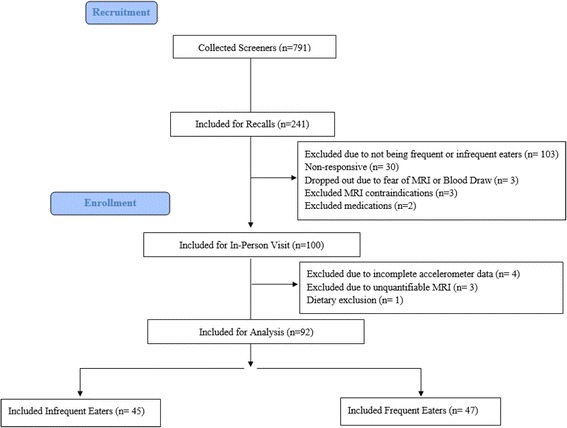
This study included 92 Hispanic college freshmen (18-19 y). The following cross-sectional data were collected: height, weight, waist circumference, body mass index (BMI), dietary intake, body composition, physical activity, hepatic fat, visceral adipose tissue (VAT), and subcutaneous adipose tissue (SAT).

RESULTS

Infrequent eaters ate 44% less often (2.5 ± 0.2 vs. 4.5 ± 0.8,  ≤ 0.01) and consumed 27% more calories per EO ( ≤ 0.01), while consuming 21% less kcals per day ( ≤ 0.01) compared to frequent eaters. Infrequent eaters had 8% higher BMIs (24.8 ± 4.4 vs. 22.9 ± 3.2 kg/m) ( = 0.02) 60% higher BMI z-scores (0.5 ± 1.0 vs. 0.2 ± 1.0,  = 0.03) 21% higher VAT (298.3 ± 153.8 vs. 236.8 ± 78.2 ml,  = 0.03), 26% higher SAT (1150.1 ± 765.4 vs. 855.6 ± 494.6 ml,  = 0.03), and 8% higher total body fat (27.6 ± 10.8 vs. 25.3 ± 8.8%,  = 0.04) compared to frequent eaters while showing no significant difference in physical activity. These findings seem to be driven by females more than males.

CONCLUSIONS

These findings suggest that infrequent eating is related to increased adiposity in Hispanic college freshmen, despite a decreased daily energy intake and no significant differences in physical activity. Yet, more research is needed to understand the underlying mechanisms of these findings, as well as investigate any potential causal relationship between eating frequency and adiposity in Hispanic youth.

摘要

背景

研究西班牙裔大学新生这一潜在高危且研究不足的人群中进食频率与特定肥胖标志物之间的关系。

方法

本研究纳入了92名西班牙裔大学新生(18 - 19岁)。收集了以下横断面数据:身高、体重、腰围、体重指数(BMI)、饮食摄入、身体成分、身体活动、肝脏脂肪、内脏脂肪组织(VAT)和皮下脂肪组织(SAT)。

结果

与频繁进食者相比,不频繁进食者进食频率低44%(2.5 ± 0.2次/天对4.5 ± 0.8次/天,P≤0.01),每次进食摄入的热量多27%(P≤0.01),但每天摄入的千卡热量少21%(P≤0.01)。不频繁进食者的BMI高8%(24.8 ± 4.4对22.9 ± 3.2 kg/m²)(P = 0.02),BMI z评分高60%(0.5 ± 1.0对0.2 ± 1.0,P = 0.03),VAT高21%(298.3 ± 153.8对236.8 ± 78.2 ml,P = 0.03),SAT高26%(1150.1 ± 765.4对855.6 ± 494.6 ml,P = 0.03),全身脂肪高8%(27.6 ± 10.8对25.3 ± 8.8%,P = 0.04),而身体活动无显著差异。这些发现似乎在女性中比在男性中更明显。

结论

这些发现表明,在西班牙裔大学新生中,尽管每日能量摄入减少且身体活动无显著差异,但不频繁进食与肥胖增加有关。然而,需要更多研究来了解这些发现的潜在机制,以及调查西班牙裔青少年进食频率与肥胖之间的任何潜在因果关系。
https://cdn.ncbi.nlm.nih.gov/pmc/blobs/ffa0/7050920/91dbcad3c1ff/40795_2018_217_Fig1_HTML.jpg

相似文献

1
Decreased eating frequency linked to increased visceral adipose tissue, body fat, and BMI in Hispanic college freshmen.进食频率降低与西班牙裔大学新生内脏脂肪组织增加、体脂增加和体重指数升高有关。
BMC Nutr. 2018 Mar 6;4:10. doi: 10.1186/s40795-018-0217-z. eCollection 2018.
2
Meal skipping linked to increased visceral adipose tissue and triglycerides in overweight minority youth.间断性禁食与超重少数族裔青少年内脏脂肪组织和甘油三酯增加有关。
Obesity (Silver Spring). 2014 May;22(5):E77-84. doi: 10.1002/oby.20487. Epub 2013 Dec 2.
3
Increased eating frequency linked to decreased obesity and improved metabolic outcomes.进食频率增加与肥胖减轻及代谢结果改善有关。
Int J Obes (Lond). 2015 Jan;39(1):136-41. doi: 10.1038/ijo.2014.81. Epub 2014 May 20.
4
Diet Quality Is an Indicator of Disease Risk Factors in Hispanic College Freshmen.饮食质量是西班牙裔大学新生疾病风险因素的一个指标。
J Acad Nutr Diet. 2019 May;119(5):760-768. doi: 10.1016/j.jand.2018.12.002. Epub 2019 Feb 22.
5
Visceral adiposity and inflammatory bowel disease.内脏肥胖与炎症性肠病。
Int J Colorectal Dis. 2021 Nov;36(11):2305-2319. doi: 10.1007/s00384-021-03968-w. Epub 2021 Jun 9.
6
CT-derived abdominal adiposity: Distributions and better predictive ability than BMI in a nationwide study of 59,429 adults in China.基于 CT 的腹部肥胖:在中国一项全国性的 59429 例成年人研究中,其分布情况优于 BMI,且预测能力更强。
Metabolism. 2021 Feb;115:154456. doi: 10.1016/j.metabol.2020.154456. Epub 2020 Nov 28.
7
Abdominal fat sub-depots and energy expenditure: Magnetic resonance imaging study.腹部脂肪亚群与能量消耗:磁共振成像研究。
Clin Nutr. 2017 Jun;36(3):804-811. doi: 10.1016/j.clnu.2016.05.009. Epub 2016 May 27.
8
Faster eating rates are associated with higher energy intakes during an ad libitum meal, higher BMI and greater adiposity among 4·5-year-old children: results from the Growing Up in Singapore Towards Healthy Outcomes (GUSTO) cohort.在一顿随意进食的餐食中,进食速度较快与4.5岁儿童更高的能量摄入量、更高的体重指数和更严重的肥胖相关:来自新加坡成长为健康个体(GUSTO)队列研究的结果。
Br J Nutr. 2017 Apr;117(7):1042-1051. doi: 10.1017/S0007114517000848. Epub 2017 May 2.
9
Association of Binge Eating Behavior with Total and Abdominal Adipose Tissue in a Large Sample of Participants Starting a Weight Loss or Maintenance Program.
J Am Coll Nutr. 2018 Nov-Dec;37(8):701-707. doi: 10.1080/07315724.2018.1463184. Epub 2018 Apr 27.
10
Effect of eating frequency on body composition in 9-11-year-old children.饮食频率对9至11岁儿童身体成分的影响。
Int J Sports Med. 2007 Mar;28(3):265-70. doi: 10.1055/s-2006-924349. Epub 2006 Oct 6.

引用本文的文献

1
Snacking Consumption among Adults in the United States: A Scoping Review.美国成年人的零食消费:范围综述。
Nutrients. 2023 Mar 25;15(7):1596. doi: 10.3390/nu15071596.
2
Eating Speed, Eating Frequency, and Their Relationships with Diet Quality, Adiposity, and Metabolic Syndrome, or Its Components.进食速度、进食频率及其与饮食质量、肥胖和代谢综合征或其成分的关系。
Nutrients. 2021 May 15;13(5):1687. doi: 10.3390/nu13051687.

本文引用的文献

1
Endocrine causes of nonalcoholic fatty liver disease.非酒精性脂肪性肝病的内分泌病因
World J Gastroenterol. 2015 Oct 21;21(39):11053-76. doi: 10.3748/wjg.v21.i39.11053.
2
Increased eating frequency linked to decreased obesity and improved metabolic outcomes.进食频率增加与肥胖减轻及代谢结果改善有关。
Int J Obes (Lond). 2015 Jan;39(1):136-41. doi: 10.1038/ijo.2014.81. Epub 2014 May 20.
3
Prevalence of childhood and adult obesity in the United States, 2011-2012.美国儿童和成人肥胖率,2011-2012 年。
JAMA. 2014 Feb 26;311(8):806-14. doi: 10.1001/jama.2014.732.
4
The clustering of diet, physical activity and sedentary behavior in children and adolescents: a review.儿童和青少年的饮食、身体活动及久坐行为聚类分析:综述
Int J Behav Nutr Phys Act. 2014 Jan 22;11:4. doi: 10.1186/1479-5868-11-4.
5
Meal skipping linked to increased visceral adipose tissue and triglycerides in overweight minority youth.间断性禁食与超重少数族裔青少年内脏脂肪组织和甘油三酯增加有关。
Obesity (Silver Spring). 2014 May;22(5):E77-84. doi: 10.1002/oby.20487. Epub 2013 Dec 2.
6
Obesity and body fat classification in the metabolic syndrome: impact on cardiometabolic risk metabotype.代谢综合征中的肥胖和体脂分类:对代谢相关心血管风险表型的影响。
Obesity (Silver Spring). 2013 Jan;21(1):E154-61. doi: 10.1002/oby.20263.
7
Family functioning: associations with weight status, eating behaviors, and physical activity in adolescents.家庭功能:与青少年体重状况、饮食行为和身体活动的关联。
J Adolesc Health. 2013 Mar;52(3):351-7. doi: 10.1016/j.jadohealth.2012.07.006. Epub 2012 Aug 29.
8
Associations between friends' disordered eating and muscle-enhancing behaviors.朋友的饮食失调与肌肉增强行为之间的关联。
Soc Sci Med. 2012 Dec;75(12):2242-9. doi: 10.1016/j.socscimed.2012.08.024. Epub 2012 Sep 1.
9
Associations between eating frequency, adiposity, diet, and activity in 9-10 year old healthy-weight and centrally obese children.9-10 岁健康体重和中心性肥胖儿童的进食频率、肥胖、饮食和活动之间的关系。
Obesity (Silver Spring). 2012 Jul;20(7):1462-8. doi: 10.1038/oby.2012.72. Epub 2012 Mar 22.
10
Prevalence of obesity and trends in body mass index among US children and adolescents, 1999-2010.美国儿童和青少年肥胖率及体重指数趋势,1999-2010 年。
JAMA. 2012 Feb 1;307(5):483-90. doi: 10.1001/jama.2012.40. Epub 2012 Jan 17.