Hopperton Kathryn E, O'Connor Deborah L, Bando Nicole, Conway Aisling M, Ng Dawn V Y, Kiss Alex, Jackson Jacqueline, Ly Linh, Unger Sharon L
Translational Medicine Program, The Hospital for Sick Children, Toronto, Canada.
Department of Nutritional Sciences, University of Toronto, Toronto, Canada.
Curr Dev Nutr. 2019 Nov 12;3(12):nzz129. doi: 10.1093/cdn/nzz129. eCollection 2019 Dec.
Bovine milk-based fortifiers (BMBF) have been standard of care for nutrient fortification of feeds for very low birth weight (VLBW) infants, however, there is increasing use of human milk-based fortifiers (HMBF) in neonatal care despite additional costs and limited supporting data. No randomized clinical trial has followed infants fed these fortifiers after initial hospitalization.
To compare neurodevelopment in infants born weighing <1250 g fed maternal milk with supplemental donor milk and either a HMBF or BMBF.
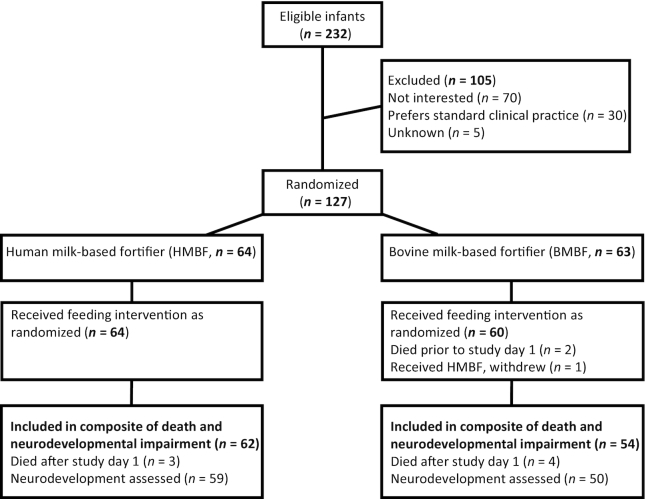
This is a follow-up of a completed pragmatic, triple-blind, parallel group randomized clinical trial conducted in Southern Ontario between August 2014 and March 2016 (NCT02137473) with feeding tolerance as the primary outcome. Infants weighing <1250 g at birth were block randomized by an online third-party service to receive either HMBF ( = 64) or BMBF ( = 63) added to maternal milk with supplemental donor milk during hospitalization. Neurodevelopment was assessed at 18-mo corrected age using the , Third Edition. Follow-up was completed in October 2017.
Of the 127 infants randomized, 109 returned for neurodevelopmental assessment. No statistically significant differences between fortifiers were identified for cognitive composite scores [adjusted mean scores 94.7 in the HMBF group and 95.9 in the BMBF group; fully adjusted mean difference, -1.1 (95% CI: -6.5 to 4.4)], language composite scores [adjusted scores 92.4 in the HMBF group and 93.1 in the BMBF; fully adjusted mean difference, -1.2 (-7.5 to 5.1)], or motor composite scores [adjusted scores 95.6 in the HMBF group and 97.7 in the BMBF; fully adjusted mean difference, -1.1 (-6.3 to 4.2)]. There was no difference in the proportion of participants that died or had neurodevelopmental impairment or disability between groups.
Providing HMBF compared with BMBF does not improve neurodevelopmental scores at 18-mo corrected age in infants born <1250 g otherwise fed a human milk diet. This trial was registered at clinicaltrials.gov as NCT02137473.
基于牛乳的强化剂(BMBF)一直是极低出生体重(VLBW)婴儿喂养营养强化的标准治疗方法,然而,尽管成本增加且支持数据有限,但在新生儿护理中,基于人乳的强化剂(HMBF)的使用却越来越多。尚无随机临床试验对这些强化剂喂养的婴儿在初次住院后的情况进行跟踪。
比较出生体重<1250g的婴儿,在母乳喂养并添加捐赠者母乳的基础上,分别使用HMBF或BMBF后的神经发育情况。
这是对一项已完成的实用性、三盲、平行组随机临床试验的随访,该试验于2014年8月至2016年3月在安大略省南部进行(NCT02137473),以喂养耐受性作为主要结局。出生体重<1250g的婴儿通过在线第三方服务进行区组随机分组,在住院期间接受添加到母乳并补充捐赠者母乳中的HMBF(n = 64)或BMBF(n = 63)。在18个月校正年龄时使用《第三版》评估神经发育情况。随访于2017年10月完成。
在127名随机分组的婴儿中,109名返回进行神经发育评估。在认知综合评分方面,强化剂之间未发现统计学上的显著差异[HMBF组调整后平均评分为94.7,BMBF组为95.9;完全调整后的平均差异为-1.1(95%CI:-6.5至4.4)],语言综合评分[HMBF组调整后评分为92.4,BMBF组为93.1;完全调整后的平均差异为-1.2(-7.5至5.1)],或运动综合评分[HMBF组调整后评分为95.6,BMBF组为97.7;完全调整后的平均差异为-1.1(-6.3至4.2)]。两组之间死亡或有神经发育障碍或残疾的参与者比例没有差异。
对于出生体重<1250g且以人乳饮食喂养的婴儿,与BMBF相比,提供HMBF并不能提高18个月校正年龄时的神经发育评分。该试验在clinicaltrials.gov上注册为NCT02137473。