• 文献检索
  • 文档翻译
  • 深度研究
  • 学术资讯
  • Suppr Zotero 插件Zotero 插件
  • 邀请有礼
  • 套餐&价格
  • 历史记录
应用&插件
Suppr Zotero 插件Zotero 插件浏览器插件Mac 客户端Windows 客户端微信小程序
定价
高级版会员购买积分包购买API积分包
服务
文献检索文档翻译深度研究API 文档MCP 服务
关于我们
关于 Suppr公司介绍联系我们用户协议隐私条款
关注我们

Suppr 超能文献

核心技术专利:CN118964589B侵权必究
粤ICP备2023148730 号-1Suppr @ 2026

文献检索

告别复杂PubMed语法,用中文像聊天一样搜索,搜遍4000万医学文献。AI智能推荐,让科研检索更轻松。

立即免费搜索

文件翻译

保留排版,准确专业,支持PDF/Word/PPT等文件格式,支持 12+语言互译。

免费翻译文档

深度研究

AI帮你快速写综述,25分钟生成高质量综述,智能提取关键信息,辅助科研写作。

立即免费体验

用于预测单侧特发性突发性感音神经性听力损失听力预后的机器学习模型

Machine Learning Models for Predicting Hearing Prognosis in Unilateral Idiopathic Sudden Sensorineural Hearing Loss.

作者信息

Park Keon Vin, Oh Kyoung Ho, Jeong Yong Jun, Rhee Jihye, Han Mun Soo, Han Sung Won, Choi June

机构信息

School of Industrial Management Engineering, Korea University, Seoul, Korea.

Department of Otorhinolaryngology-Head and Neck Surgery, Korea University Ansan Hospital, Korea University College of Medicine, Ansan, Korea.

出版信息

Clin Exp Otorhinolaryngol. 2020 May;13(2):148-156. doi: 10.21053/ceo.2019.01858. Epub 2020 Mar 12.

DOI:10.21053/ceo.2019.01858
PMID:32156103
原文链接:https://pmc.ncbi.nlm.nih.gov/articles/PMC7248600/
Abstract

OBJECTIVES

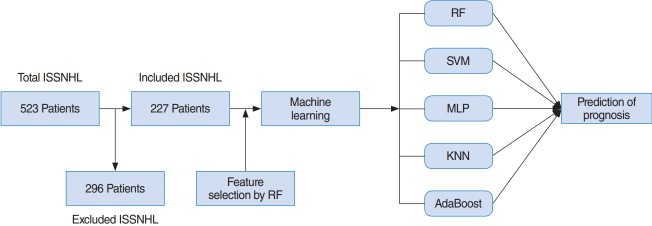
Prognosticating idiopathic sudden sensorineural hearing loss (ISSNHL) is an important challenge. In our study, a dataset was split into training and test sets and cross-validation was implemented on the training set, thereby determining the hyperparameters for machine learning models with high test accuracy and low bias. The effectiveness of the following five machine learning models for predicting the hearing prognosis in patients with ISSNHL after 1 month of treatment was assessed: adaptive boosting, K-nearest neighbor, multilayer perceptron, random forest (RF), and support vector machine (SVM).

METHODS

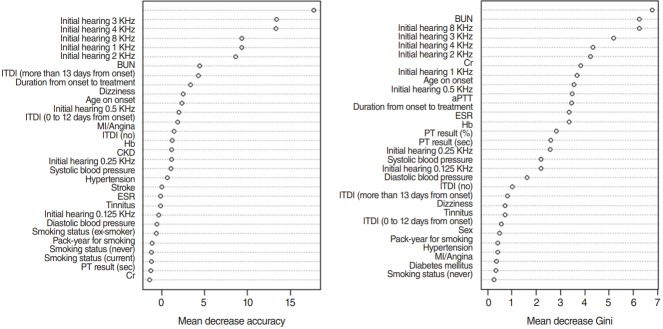
The medical records of 523 patients with ISSNHL admitted to Korea University Ansan Hospital between January 2010 and October 2017 were retrospectively reviewed. In this study, we analyzed data from 227 patients (recovery, 106; no recovery, 121) after excluding those with missing data. To determine risk factors, statistical hypothesis tests (e.g., the two-sample t-test for continuous variables and the chi-square test for categorical variables) were conducted to compare patients who did or did not recover. Variables were selected using an RF model depending on two criteria (mean decreases in the Gini index and accuracy).

RESULTS

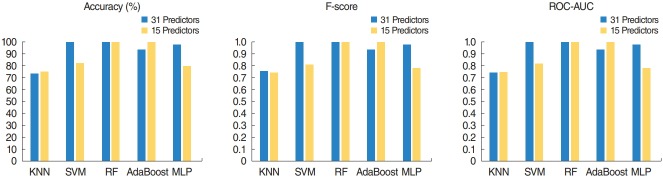
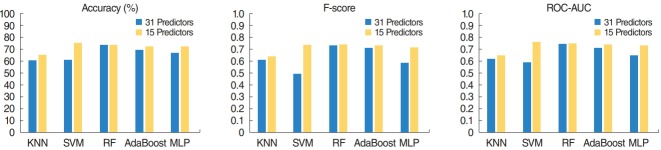
The SVM model using selected predictors achieved both the highest accuracy (75.36%) and the highest F-score (0.74) on the test set. The RF model with selected variables demonstrated the second-highest accuracy (73.91%) and F-score (0.74). The RF model with the original variables showed the same accuracy (73.91%) as that of the RF model with selected variables, but a lower F-score (0.73). All the tested models, except RF, demonstrated better performance after variable selection based on RF.

CONCLUSION

The SVM model with selected predictors was the best-performing of the tested prediction models. The RF model with selected predictors was the second-best model. Therefore, machine learning models can be used to predict hearing recovery in patients with ISSNHL.

摘要

目的

预测特发性突发性感音神经性听力损失(ISSNHL)是一项重要挑战。在我们的研究中,将一个数据集分为训练集和测试集,并在训练集上实施交叉验证,从而确定具有高测试准确性和低偏差的机器学习模型的超参数。评估了以下五种机器学习模型对ISSNHL患者治疗1个月后听力预后的预测效果:自适应增强、K近邻、多层感知器、随机森林(RF)和支持向量机(SVM)。

方法

回顾性分析2010年1月至2017年10月在韩国大学安山医院收治的523例ISSNHL患者的病历。在本研究中,我们分析了227例患者的数据(恢复,106例;未恢复,121例),排除了数据缺失的患者。为了确定风险因素,进行了统计假设检验(例如,连续变量的两样本t检验和分类变量的卡方检验)以比较恢复和未恢复的患者。根据两个标准(基尼指数的平均下降和准确性)使用RF模型选择变量。

结果

使用选定预测因子的SVM模型在测试集上实现了最高准确率(75.36%)和最高F值(0.74)。具有选定变量的RF模型表现出第二高的准确率(73.91%)和F值(0.74)。具有原始变量的RF模型显示出与具有选定变量的RF模型相同的准确率(73.91%),但F值较低(0.73)。除RF外,所有测试模型在基于RF进行变量选择后表现更好。

结论

具有选定预测因子的SVM模型是测试预测模型中表现最佳的。具有选定预测因子的RF模型是第二好的模型。因此,机器学习模型可用于预测ISSNHL患者的听力恢复情况。
https://cdn.ncbi.nlm.nih.gov/pmc/blobs/eff9/7248600/603fc5084406/ceo-2019-01858f9.jpg
https://cdn.ncbi.nlm.nih.gov/pmc/blobs/eff9/7248600/b51eb68f20ef/ceo-2019-01858f1.jpg
https://cdn.ncbi.nlm.nih.gov/pmc/blobs/eff9/7248600/3adab6ef9b82/ceo-2019-01858f2.jpg
https://cdn.ncbi.nlm.nih.gov/pmc/blobs/eff9/7248600/8c68bf92277b/ceo-2019-01858f3.jpg
https://cdn.ncbi.nlm.nih.gov/pmc/blobs/eff9/7248600/91fc7a5efa66/ceo-2019-01858f4.jpg
https://cdn.ncbi.nlm.nih.gov/pmc/blobs/eff9/7248600/75b0341f3e09/ceo-2019-01858f5.jpg
https://cdn.ncbi.nlm.nih.gov/pmc/blobs/eff9/7248600/69441807b03a/ceo-2019-01858f6.jpg
https://cdn.ncbi.nlm.nih.gov/pmc/blobs/eff9/7248600/1b5d2b87c1b4/ceo-2019-01858f7.jpg
https://cdn.ncbi.nlm.nih.gov/pmc/blobs/eff9/7248600/fb7e5ea3f50c/ceo-2019-01858f8.jpg
https://cdn.ncbi.nlm.nih.gov/pmc/blobs/eff9/7248600/603fc5084406/ceo-2019-01858f9.jpg
https://cdn.ncbi.nlm.nih.gov/pmc/blobs/eff9/7248600/b51eb68f20ef/ceo-2019-01858f1.jpg
https://cdn.ncbi.nlm.nih.gov/pmc/blobs/eff9/7248600/3adab6ef9b82/ceo-2019-01858f2.jpg
https://cdn.ncbi.nlm.nih.gov/pmc/blobs/eff9/7248600/8c68bf92277b/ceo-2019-01858f3.jpg
https://cdn.ncbi.nlm.nih.gov/pmc/blobs/eff9/7248600/91fc7a5efa66/ceo-2019-01858f4.jpg
https://cdn.ncbi.nlm.nih.gov/pmc/blobs/eff9/7248600/75b0341f3e09/ceo-2019-01858f5.jpg
https://cdn.ncbi.nlm.nih.gov/pmc/blobs/eff9/7248600/69441807b03a/ceo-2019-01858f6.jpg
https://cdn.ncbi.nlm.nih.gov/pmc/blobs/eff9/7248600/1b5d2b87c1b4/ceo-2019-01858f7.jpg
https://cdn.ncbi.nlm.nih.gov/pmc/blobs/eff9/7248600/fb7e5ea3f50c/ceo-2019-01858f8.jpg
https://cdn.ncbi.nlm.nih.gov/pmc/blobs/eff9/7248600/603fc5084406/ceo-2019-01858f9.jpg

相似文献

1
Machine Learning Models for Predicting Hearing Prognosis in Unilateral Idiopathic Sudden Sensorineural Hearing Loss.用于预测单侧特发性突发性感音神经性听力损失听力预后的机器学习模型
Clin Exp Otorhinolaryngol. 2020 May;13(2):148-156. doi: 10.21053/ceo.2019.01858. Epub 2020 Mar 12.
2
Predicting hearing recovery following treatment of idiopathic sudden sensorineural hearing loss with machine learning models.基于机器学习模型预测特发性突发性聋治疗后的听力恢复情况。
Am J Otolaryngol. 2021 Mar-Apr;42(2):102858. doi: 10.1016/j.amjoto.2020.102858. Epub 2021 Jan 4.
3
Prediction of hearing recovery in unilateral sudden sensorineural hearing loss using artificial intelligence.利用人工智能预测单侧突发性感音神经性听力损失的听力恢复情况。
Sci Rep. 2022 Mar 10;12(1):3977. doi: 10.1038/s41598-022-07881-2.
4
Predicting the hearing outcome in sudden sensorineural hearing loss via machine learning models.基于机器学习模型预测突发性聋的听力预后。
Clin Otolaryngol. 2018 Jun;43(3):868-874. doi: 10.1111/coa.13068. Epub 2018 Feb 20.
5
Machine Learning Models for the Hearing Impairment Prediction in Workers Exposed to Complex Industrial Noise: A Pilot Study.机器在学习模型预测暴露在复杂工业噪声环境下工人的听力损失:一项试点研究。
Ear Hear. 2019 May/Jun;40(3):690-699. doi: 10.1097/AUD.0000000000000649.
6
Machine Learning Models for Predicting Sudden Sensorineural Hearing Loss Outcome: A Systematic Review.机器学习模型预测突发性感音神经性听力损失结局的系统评价。
Ann Otol Rhinol Laryngol. 2024 Mar;133(3):268-276. doi: 10.1177/00034894231206902. Epub 2023 Oct 20.
7
Stroke Prediction with Machine Learning Methods among Older Chinese.基于机器学习方法对中国老年人进行中风预测。
Int J Environ Res Public Health. 2020 Mar 12;17(6):1828. doi: 10.3390/ijerph17061828.
8
Application of machine learning approaches for osteoporosis risk prediction in postmenopausal women.机器学习方法在绝经后妇女骨质疏松症风险预测中的应用。
Arch Osteoporos. 2020 Oct 23;15(1):169. doi: 10.1007/s11657-020-00802-8.
9
Development and validation of a machine-learning model for prediction of hypoxemia after extubation in intensive care units.用于预测重症监护病房拔管后低氧血症的机器学习模型的开发与验证
Ann Transl Med. 2022 May;10(10):577. doi: 10.21037/atm-22-2118.
10
Optimizing neural networks for medical data sets: A case study on neonatal apnea prediction.优化神经网络在医学数据集上的应用:以新生儿呼吸暂停预测为例的研究
Artif Intell Med. 2019 Jul;98:59-76. doi: 10.1016/j.artmed.2019.07.008. Epub 2019 Jul 25.

引用本文的文献

1
Artificial intelligence in otorhinolaryngology: current trends and application areas.耳鼻咽喉科学中的人工智能:当前趋势与应用领域
Eur Arch Otorhinolaryngol. 2025 May;282(5):2697-2707. doi: 10.1007/s00405-025-09272-5. Epub 2025 Feb 17.
2
Research on noise-induced hearing loss based on functional and structural MRI using machine learning methods.基于功能和结构磁共振成像并运用机器学习方法的噪声性听力损失研究。
Sci Rep. 2025 Jan 26;15(1):3289. doi: 10.1038/s41598-025-87168-4.
3
Evaluating Prediction Models with Hearing Handicap Inventory for the Elderly in Chronic Otitis Media Patients.

本文引用的文献

1
Machine Learning Models for the Hearing Impairment Prediction in Workers Exposed to Complex Industrial Noise: A Pilot Study.机器在学习模型预测暴露在复杂工业噪声环境下工人的听力损失:一项试点研究。
Ear Hear. 2019 May/Jun;40(3):690-699. doi: 10.1097/AUD.0000000000000649.
2
Prognostic role of haematological indices in sudden sensorineural hearing loss: Review and meta-analysis.血液学指标对突发性聋预后的作用:综述与荟萃分析。
Clin Chim Acta. 2018 Aug;483:104-111. doi: 10.1016/j.cca.2018.04.025. Epub 2018 Apr 20.
3
Predicting the hearing outcome in sudden sensorineural hearing loss via machine learning models.
用老年人听力障碍量表评估慢性中耳炎患者的预测模型。
Diagnostics (Basel). 2024 Sep 10;14(18):2000. doi: 10.3390/diagnostics14182000.
4
Prediction of hearing recovery with deep learning algorithm in sudden sensorineural hearing loss.深度学习算法预测突发性感音神经性听力损失的听力恢复情况。
Sci Rep. 2024 Aug 29;14(1):20058. doi: 10.1038/s41598-024-70436-0.
5
Applications of Machine Learning in Meniere's Disease Assessment Based on Pure-Tone Audiometry.基于纯音听力测试的机器学习在梅尼埃病评估中的应用。
Otolaryngol Head Neck Surg. 2025 Jan;172(1):233-242. doi: 10.1002/ohn.956. Epub 2024 Aug 28.
6
The inflammatory and metabolic status of patients with sudden-onset sensorineural hearing loss.突发性感音神经性听力损失患者的炎症和代谢状态
Front Neurol. 2024 Jul 2;15:1382096. doi: 10.3389/fneur.2024.1382096. eCollection 2024.
7
Predicting Sudden Sensorineural Hearing Loss Recovery with Patient-Personalized Seigel's Criteria Using Machine Learning.使用机器学习通过患者个性化的西格尔标准预测突发性感音神经性听力损失的恢复情况。
Diagnostics (Basel). 2024 Jun 19;14(12):1296. doi: 10.3390/diagnostics14121296.
8
Hearing Recovery Prediction for Patients with Chronic Otitis Media Who Underwent Canal-Wall-Down Mastoidectomy.接受开放式乳突根治术的慢性中耳炎患者听力恢复预测
J Clin Med. 2024 Mar 8;13(6):1557. doi: 10.3390/jcm13061557.
9
NcRNA: key and potential in hearing loss.非编码RNA:听力损失中的关键因素与潜力
Front Neurosci. 2024 Jan 17;17:1333131. doi: 10.3389/fnins.2023.1333131. eCollection 2023.
10
Differentially expressed miRNA profiles of serum-derived exosomes in patients with sudden sensorineural hearing loss.突发性感音神经性听力损失患者血清来源外泌体中差异表达的miRNA谱
Front Neurol. 2023 Jun 2;14:1177988. doi: 10.3389/fneur.2023.1177988. eCollection 2023.
基于机器学习模型预测突发性聋的听力预后。
Clin Otolaryngol. 2018 Jun;43(3):868-874. doi: 10.1111/coa.13068. Epub 2018 Feb 20.
4
Predictors of hearing recovery in patients with severe sudden sensorineural hearing loss.重度突发性感音神经性听力损失患者听力恢复的预测因素
J Otolaryngol Head Neck Surg. 2017 Apr 4;46(1):27. doi: 10.1186/s40463-017-0207-1.
5
Combined Intratympanic and Systemic Use of Steroids as a First-Line Treatment for Sudden Sensorineural Hearing Loss: A Meta-Analysis of Randomized, Controlled Trials.鼓室内及全身联合使用类固醇作为突发性感音神经性听力损失的一线治疗:随机对照试验的荟萃分析
Otol Neurotol. 2017 Apr;38(4):487-495. doi: 10.1097/MAO.0000000000001361.
6
Prediction of hearing outcomes by multiple regression analysis in patients with idiopathic sudden sensorineural hearing loss.采用多元回归分析预测特发性突发性感音神经性听力损失患者的听力预后。
Ann Otol Rhinol Laryngol. 2014 Dec;123(12):821-5. doi: 10.1177/0003489414538606. Epub 2014 Jun 18.
7
Analysis of frequency loss as a prognostic factor in idiopathic sensorineural hearing loss.频率损失作为特发性感音神经性听力损失预后因素的分析。
Acta Otolaryngol. 2012 Jun;132(6):590-6. doi: 10.3109/00016489.2011.652306. Epub 2012 Apr 12.
8
Clinical practice guideline: sudden hearing loss.临床实践指南:突发性聋。
Otolaryngol Head Neck Surg. 2012 Mar;146(3 Suppl):S1-35. doi: 10.1177/0194599812436449.
9
Systematic review and meta-analysis of the risk factors for sudden sensorineural hearing loss in adults.成人突发性聋的危险因素的系统回顾和荟萃分析。
Laryngoscope. 2012 Mar;122(3):624-35. doi: 10.1002/lary.22480. Epub 2012 Jan 17.
10
Prediction model for hearing outcome in patients with idiopathic sudden sensorineural hearing loss.特发性突发性聋患者听力结局预测模型。
Eur Arch Otorhinolaryngol. 2011 Apr;268(4):497-500. doi: 10.1007/s00405-010-1400-2. Epub 2010 Nov 3.