Ferdous Most Rifat Ara, Ahmed Md Raju, Khan Sayekul Hasan, Mukta Mufsana Akter, Anika Tasnia Tabassum, Hossain Md Tarek, Islam Md Zahorul, Rafiq Kazi
Department of Pharmacology, Faculty of Veterinary Science, Bangladesh Agricultural University, Mymensingh - 2202, Bangladesh.
Vet World. 2020 Jan;13(1):61-67. doi: 10.14202/vetworld.2020.61-67. Epub 2020 Jan 10.
This study aimed to evaluate the effects of discriminate and indiscriminate use of oxytetracycline on hematological parameters, residual status in soft tissue of broiler and of thermal effect on oxytetracycline residual status.
Eighteen, day-old male broiler chickens were purchased and were divided into three different groups (control group, discriminate group, and indiscriminate group). The control group received no antibiotics. The discriminate group received oxytetracycline 1 g/L drinking water for 5 consecutive days, and 10 days' withdrawal period was maintained before sacrifice. The indiscriminate group received oxytetracycline 1 g/L drinking water till the sacrificed day. Blood samples were collected before sacrificing for hematological analysis. After sacrificing liver, kidney, spleen, and muscle samples were collected for analysis of oxytetracycline residues in raw soft tissues. Since meat is used to cook by traditional method in Bangladesh before consumption that is why positive meat samples were cooked by traditional cooking method to evaluate the thermal effect on oxytetracycline residual status as well. Thin-layer chromatography (TLC) was done for screening of oxytetracycline residues in soft tissues.
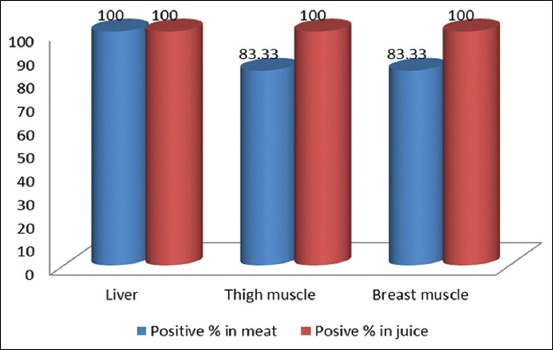
Mean differences of total erythrocyte count (million/mm), hemoglobin estimation (gm%), and packed cell volume (%) estimation were not statistically significant among the groups. TLC analysis of raw samples showed 100% positive results of all samples collected from the indiscriminate group. In contrast, samples collected from the discriminate group were negative for oxytetracycline residues. In the control group, all samples were negative for oxytetracycline residue. There was a significant (p<0.05) relationship of oxytetracycline residues among three different groups for liver, kidney, spleen, and muscle samples. Positive liver and muscle samples from the indiscriminate group were subjected to thermal treatment by traditional cooking method of Bangladesh. Oxytetracycline residues had found in cooked meat, liver, and juice part, suggesting that antibiotic residues disseminated to juice part from flesh part after cooking.
Evidence suggests that proper maintenance of withdrawal period would minimize oxytetracycline residues in broiler soft tissues, whereas antibiotics retained in soft tissues of broiler in case of indiscriminate use. Traditional cooking does not change oxytetracycline residual status in edible tissues. Therefore, awareness regarding the proper maintenance of withdrawal period after antibiotic treatment of broiler is one of the best strategies which may positively reduce the risk of antimicrobial drugs residue in meat.
本研究旨在评估区别性和无差别使用土霉素对血液学参数、肉鸡软组织中残留状况以及热处理对土霉素残留状况的影响。
购买18只1日龄雄性肉鸡,分为三个不同组(对照组、区别性使用组和无差别使用组)。对照组不使用抗生素。区别性使用组连续5天饮用含1 g/L土霉素的水,在宰杀前保持10天的停药期。无差别使用组直至宰杀日一直饮用含1 g/L土霉素的水。宰杀前采集血样进行血液学分析。宰杀后采集肝脏、肾脏、脾脏和肌肉样本,分析生软组织中土霉素残留情况。由于在孟加拉国,肉类在食用前采用传统方法烹饪,因此对阳性肉类样本也采用传统烹饪方法进行处理,以评估热处理对土霉素残留状况的影响。采用薄层色谱法(TLC)筛选软组织中土霉素残留。
各组间总红细胞计数(百万/mm)、血红蛋白估计值(gm%)和红细胞压积(%)估计值的平均差异无统计学意义。生样本的TLC分析显示,从无差别使用组采集的所有样本100%呈阳性结果。相比之下,从区别性使用组采集的样本中土霉素残留呈阴性。在对照组中,所有样本中土霉素残留均为阴性。在肝脏、肾脏、脾脏和肌肉样本的三个不同组之间,土霉素残留存在显著(p<0.05)关系。对无差别使用组的阳性肝脏和肌肉样本采用孟加拉国传统烹饪方法进行热处理。在熟肉、肝脏和汁液部分均发现土霉素残留,表明烹饪后抗生素残留从肉质部分扩散到汁液部分。
有证据表明,适当维持停药期可使肉鸡软组织中土霉素残留量降至最低,而无差别使用抗生素时,抗生素会残留在肉鸡软组织中。传统烹饪不会改变可食用组织中土霉素残留状况。因此,提高对肉鸡抗生素治疗后适当维持停药期的认识是积极降低肉类中抗菌药物残留风险的最佳策略之一。