More Alexander F, Spaulding Nicole E, Bohleber Pascal, Handley Michael J, Hoffmann Helene, Korotkikh Elena V, Kurbatov Andrei V, Loveluck Christopher P, Sneed Sharon B, McCormick Michael, Mayewski Paul A
Initiative for the Science of the Human Past and Department of History Harvard University Cambridge Massachusetts USA.
Climate Change Institute, Sawyer Environmental Research Building University of Maine Orono Maine USA.
Geohealth. 2017 Jun 28;1(4):211-219. doi: 10.1002/2017GH000064. eCollection 2017 Jun.
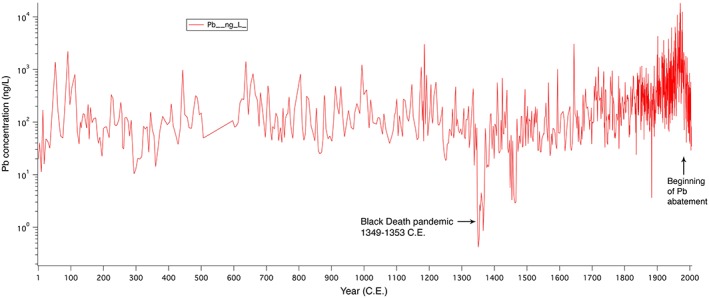
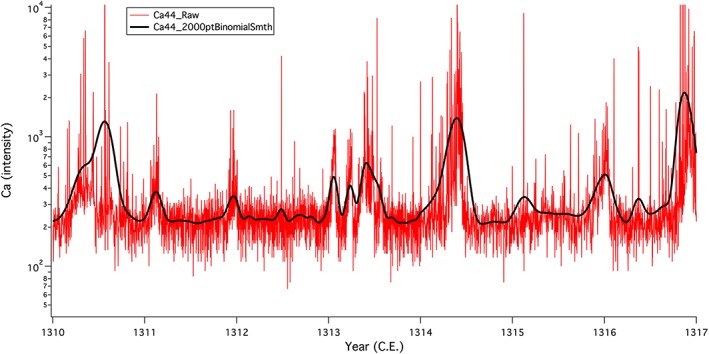
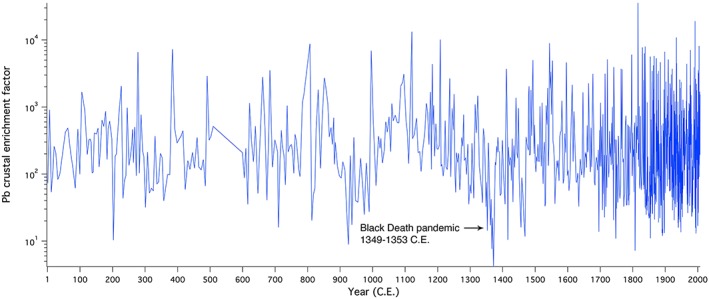
Contrary to widespread assumptions, next-generation high (annual to multiannual) and ultra-high (subannual) resolution analyses of an Alpine glacier reveal that true historical minimum natural levels of lead in the atmosphere occurred only once in the last 2000 years. During the Black Death pandemic, demographic and economic collapse interrupted metal production and atmospheric lead dropped to undetectable levels. This finding challenges current government and industry understanding of preindustrial lead pollution and its potential implications for human health of children and adults worldwide. Available technology and geographic location have limited previous ice core investigations. We provide new high- (discrete, inductively coupled plasma mass spectrometry, ICP-MS) and ultra-high resolution (laser ablation inductively coupled plasma mass spectrometry, LA-ICP-MS) records of atmospheric lead deposition extracted from the high Alpine glacier Colle Gnifetti, in the Swiss-Italian Alps. We show that contrary to the conventional wisdom, low levels at or approaching natural background occurred only in a single 4 year period in ~2000 years documented in the new ice core, during the Black Death (1349-1353 C.E.), the most devastating pandemic in Eurasian history. Ultra-high chronological resolution allows for the first time detailed and decisive comparison of the new glaciochemical data with historical records. Historical evidence shows that mining activity ceased upwind of the core site from ~1349 to 1353, while concurrently on the glacier lead (Pb) concentrations-dated by layer counting confirmed by radiocarbon dating-dropped to levels below detection, an order of magnitude beneath figures deemed low in earlier studies. Previous assumptions about preindustrial "natural" background lead levels in the atmosphere-and potential impacts on humans-have been misleading, with significant implications for current environmental, industrial, and public health policy, as well as for the history of human lead exposure. Trans-disciplinary application of this new technology opens the door to new approaches to the study of the anthropogenic impact on past and present human health.
与普遍观点相反,对一条阿尔卑斯冰川进行的下一代高分辨率(年度至多年度)和超高分辨率(亚年度)分析显示,在过去约2000年里,大气中铅的真正历史最低自然水平仅出现过一次。在黑死病大流行期间,人口和经济崩溃中断了金属生产,大气中的铅降至无法检测的水平。这一发现挑战了当前政府和行业对工业化前铅污染及其对全球儿童和成人健康潜在影响的理解。现有技术和地理位置限制了以往的冰芯研究。我们提供了从瑞士 - 意大利阿尔卑斯山的高海拔科莱尼费蒂冰川提取的大气铅沉积的新高分辨率(离散电感耦合等离子体质谱法,ICP - MS)和超高分辨率(激光烧蚀电感耦合等离子体质谱法,LA - ICP - MS)记录。我们表明,与传统观点相反,在新冰芯记录的约2000年中,只有在黑死病(公元1349 - 1353年)期间,即欧亚历史上最具毁灭性的大流行期间,自然背景水平或接近自然背景水平的低水平仅在一个4年期间出现过。超高的年代分辨率首次使得能够将新的冰川化学数据与历史记录进行详细且决定性的比较。历史证据表明,从约1349年到1353年,核心站点上风方向的采矿活动停止,与此同时,通过放射性碳测年确认的分层计数确定年代的冰川铅(Pb)浓度降至检测水平以下,比早期研究中认为低的数值低一个数量级。以往关于工业化前大气中“自然”背景铅水平以及对人类潜在影响的假设一直具有误导性,这对当前的环境、工业和公共卫生政策以及人类铅暴露史都具有重要意义。这项新技术的跨学科应用为研究人为因素对过去和现在人类健康的影响开辟了新途径。