Vasudevan Rama K, Choudhary Kamal, Mehta Apurva, Smith Ryan, Kusne Gilad, Tavazza Francesca, Vlcek Lukas, Ziatdinov Maxim, Kalinin Sergei V, Hattrick-Simpers Jason
Center for Nanophase Materials Sciences, Oak Ridge National Laboratory, Oak Ridge TN 37831, USA.
Material Measurement Laboratory, National Institute of Standards and Technology, Gaithersburg, MD 20899.
MRS Commun. 2019;9(3). doi: 10.1557/mrc.2019.95.
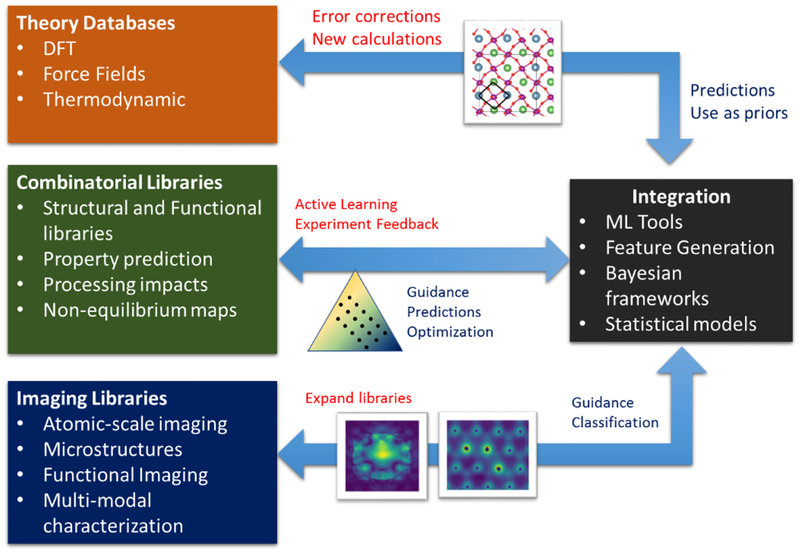
The use of advanced data analytics and applications of statistical and machine learning approaches ('AI') to materials science is experiencing explosive growth recently. In this prospective, we review recent work focusing on generation and application of libraries from both experiment and theoretical tools, across length scales. The available library data both enables classical correlative machine learning, and also opens the pathway for exploration of underlying causative physical behaviors. We highlight the key advances facilitated by this approach, and illustrate how modeling, macroscopic experiments and atomic-scale imaging can be combined to dramatically accelerate understanding and development of new material systems via a statistical physics framework. These developments point towards a data driven future wherein knowledge can be aggregated and used collectively, accelerating the advancement of materials science.
先进的数据分析以及统计和机器学习方法(“人工智能”)在材料科学中的应用近来正经历着爆炸式增长。从这个角度来看,我们回顾了近期的工作,这些工作聚焦于跨长度尺度从实验和理论工具生成库并应用这些库。可用的库数据既支持经典的关联机器学习,也为探索潜在的因果物理行为开辟了道路。我们强调了这种方法带来的关键进展,并说明了如何通过统计物理框架将建模、宏观实验和原子尺度成像结合起来,以显著加速对新型材料系统的理解和开发。这些进展指向一个数据驱动的未来,在这个未来中,知识可以被汇总并共同使用,从而加速材料科学的进步。