• 文献检索
  • 文档翻译
  • 深度研究
  • 学术资讯
  • Suppr Zotero 插件Zotero 插件
  • 邀请有礼
  • 套餐&价格
  • 历史记录
应用&插件
Suppr Zotero 插件Zotero 插件浏览器插件Mac 客户端Windows 客户端微信小程序
定价
高级版会员购买积分包购买API积分包
服务
文献检索文档翻译深度研究API 文档MCP 服务
关于我们
关于 Suppr公司介绍联系我们用户协议隐私条款
关注我们

Suppr 超能文献

核心技术专利:CN118964589B侵权必究
粤ICP备2023148730 号-1Suppr @ 2026

文献检索

告别复杂PubMed语法,用中文像聊天一样搜索,搜遍4000万医学文献。AI智能推荐,让科研检索更轻松。

立即免费搜索

文件翻译

保留排版,准确专业,支持PDF/Word/PPT等文件格式,支持 12+语言互译。

免费翻译文档

深度研究

AI帮你快速写综述,25分钟生成高质量综述,智能提取关键信息,辅助科研写作。

立即免费体验

混合密度网络在复杂基于个体的流行病学模型仿真中的应用。

The use of mixture density networks in the emulation of complex epidemiological individual-based models.

机构信息

MathSys CDT, Mathematics Institute, University of Warwick, Coventry, United Kingdom.

Zeeman Institute (SBIDER), University of Warwick, Coventry, United Kingdom.

出版信息

PLoS Comput Biol. 2020 Mar 16;16(3):e1006869. doi: 10.1371/journal.pcbi.1006869. eCollection 2020 Mar.

DOI:10.1371/journal.pcbi.1006869
PMID:32176687
原文链接:https://pmc.ncbi.nlm.nih.gov/articles/PMC7098654/
Abstract

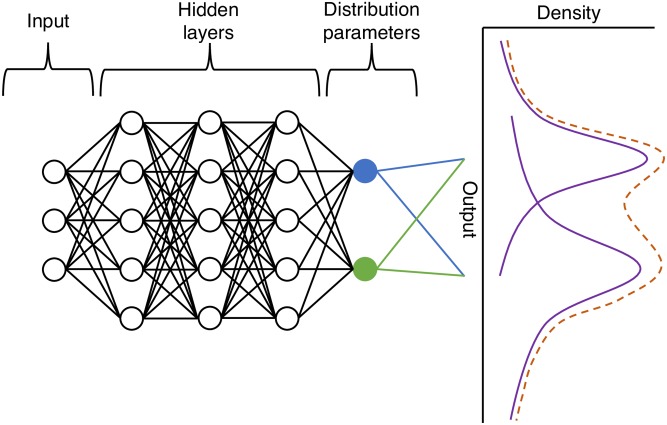
Complex, highly-computational, individual-based models are abundant in epidemiology. For epidemics such as macro-parasitic diseases, detailed modelling of human behaviour and pathogen life-cycle are required in order to produce accurate results. This can often lead to models that are computationally-expensive to analyse and perform model fitting, and often require many simulation runs in order to build up sufficient statistics. Emulation can provide a more computationally-efficient output of the individual-based model, by approximating it using a statistical model. Previous work has used Gaussian processes (GPs) in order to achieve this, but these can not deal with multi-modal, heavy-tailed, or discrete distributions. Here, we introduce the concept of a mixture density network (MDN) in its application in the emulation of epidemiological models. MDNs incorporate both a mixture model and a neural network to provide a flexible tool for emulating a variety of models and outputs. We develop an MDN emulation methodology and demonstrate its use on a number of simple models incorporating both normal, gamma and beta distribution outputs. We then explore its use on the stochastic SIR model to predict the final size distribution and infection dynamics. MDNs have the potential to faithfully reproduce multiple outputs of an individual-based model and allow for rapid analysis from a range of users. As such, an open-access library of the method has been released alongside this manuscript.

摘要

复杂的、高度计算的、基于个体的模型在流行病学中非常丰富。对于宏观寄生虫病等传染病,需要详细建模人类行为和病原体生命周期,才能得出准确的结果。这通常会导致分析和进行模型拟合的计算成本很高的模型,并且通常需要进行多次模拟运行才能建立足够的统计数据。通过使用统计模型来近似模拟,可以为基于个体的模型提供更具计算效率的输出。先前的工作已经使用高斯过程(GPs)来实现这一目标,但这些方法不能处理多峰、重尾或离散分布。在这里,我们介绍了混合密度网络(MDN)的概念,并将其应用于流行病学模型的仿真中。MDN 结合了混合模型和神经网络,为模拟各种模型和输出提供了灵活的工具。我们开发了一种 MDN 仿真方法,并在包含正态、伽马和贝塔分布输出的一些简单模型上演示了其使用。然后,我们探索了它在随机 SIR 模型中的使用,以预测最终规模分布和感染动态。MDN 有可能忠实地再现基于个体的模型的多个输出,并允许来自不同用户的快速分析。因此,在本文档旁边发布了该方法的一个开放访问库。
https://cdn.ncbi.nlm.nih.gov/pmc/blobs/a240/7098654/be6bf2a8085b/pcbi.1006869.g005.jpg
https://cdn.ncbi.nlm.nih.gov/pmc/blobs/a240/7098654/3f5a60438579/pcbi.1006869.g001.jpg
https://cdn.ncbi.nlm.nih.gov/pmc/blobs/a240/7098654/4096a2aa916f/pcbi.1006869.g002.jpg
https://cdn.ncbi.nlm.nih.gov/pmc/blobs/a240/7098654/c38248e96510/pcbi.1006869.g003.jpg
https://cdn.ncbi.nlm.nih.gov/pmc/blobs/a240/7098654/5538db4a5007/pcbi.1006869.g004.jpg
https://cdn.ncbi.nlm.nih.gov/pmc/blobs/a240/7098654/be6bf2a8085b/pcbi.1006869.g005.jpg
https://cdn.ncbi.nlm.nih.gov/pmc/blobs/a240/7098654/3f5a60438579/pcbi.1006869.g001.jpg
https://cdn.ncbi.nlm.nih.gov/pmc/blobs/a240/7098654/4096a2aa916f/pcbi.1006869.g002.jpg
https://cdn.ncbi.nlm.nih.gov/pmc/blobs/a240/7098654/c38248e96510/pcbi.1006869.g003.jpg
https://cdn.ncbi.nlm.nih.gov/pmc/blobs/a240/7098654/5538db4a5007/pcbi.1006869.g004.jpg
https://cdn.ncbi.nlm.nih.gov/pmc/blobs/a240/7098654/be6bf2a8085b/pcbi.1006869.g005.jpg

相似文献

1
The use of mixture density networks in the emulation of complex epidemiological individual-based models.混合密度网络在复杂基于个体的流行病学模型仿真中的应用。
PLoS Comput Biol. 2020 Mar 16;16(3):e1006869. doi: 10.1371/journal.pcbi.1006869. eCollection 2020 Mar.
2
Gaussian process approximations for fast inference from infectious disease data.基于高斯过程近似的传染病数据快速推断。
Math Biosci. 2018 Jul;301:111-120. doi: 10.1016/j.mbs.2018.02.003. Epub 2018 Feb 20.
3
Dynamics of stochastic epidemics on heterogeneous networks.异质网络上随机流行病的动力学
J Math Biol. 2014 Jun;68(7):1583-605. doi: 10.1007/s00285-013-0679-1. Epub 2013 Apr 30.
4
Continuous and discrete SIR-models with spatial distributions.具有空间分布的连续和离散SIR模型。
J Math Biol. 2017 Jun;74(7):1709-1727. doi: 10.1007/s00285-016-1071-8. Epub 2016 Oct 28.
5
Birth/birth-death processes and their computable transition probabilities with biological applications.出生/出生-死亡过程及其具有生物学应用的可计算转移概率。
J Math Biol. 2018 Mar;76(4):911-944. doi: 10.1007/s00285-017-1160-3. Epub 2017 Jul 24.
6
Mean-field models for non-Markovian epidemics on networks.网络上非马尔可夫传染病的平均场模型。
J Math Biol. 2018 Feb;76(3):755-778. doi: 10.1007/s00285-017-1155-0. Epub 2017 Jul 6.
7
Effects of pathogen dependency in a multi-pathogen infectious disease system including population level heterogeneity - a simulation study.包含人群水平异质性的多病原体传染病系统中病原体依赖性的影响——一项模拟研究
Theor Biol Med Model. 2017 Dec 13;14(1):26. doi: 10.1186/s12976-017-0072-7.
8
SIS Epidemic Propagation on Hypergraphs.超图上的SIS流行病传播
Bull Math Biol. 2016 Apr;78(4):713-735. doi: 10.1007/s11538-016-0158-0. Epub 2016 Mar 31.
9
Hybrid Markov chain models of S-I-R disease dynamics.S-I-R疾病动态的混合马尔可夫链模型
J Math Biol. 2017 Sep;75(3):521-541. doi: 10.1007/s00285-016-1085-2. Epub 2016 Dec 24.
10
Complex Dynamical Behaviour in an Epidemic Model with Control.具有控制措施的传染病模型中的复杂动力学行为
Bull Math Biol. 2016 Nov;78(11):2212-2227. doi: 10.1007/s11538-016-0217-6. Epub 2016 Oct 18.

引用本文的文献

1
Parametric seasonal-trend autoregressive neural network for long-term crop price forecasting.基于参数季节性趋势自回归神经网络的长期作物价格预测。
PLoS One. 2024 Sep 26;19(9):e0311199. doi: 10.1371/journal.pone.0311199. eCollection 2024.
2
Distilling dynamical knowledge from stochastic reaction networks.从随机反应网络中提取动态知识。
Proc Natl Acad Sci U S A. 2024 Apr 2;121(14):e2317422121. doi: 10.1073/pnas.2317422121. Epub 2024 Mar 26.
3
Using mixture density networks to emulate a stochastic within-host model of Francisella tularensis infection.

本文引用的文献

1
Kernel-density estimation and approximate Bayesian computation for flexible epidemiological model fitting in Python.Python 中用于灵活流行病学模型拟合的核密度估计和近似贝叶斯计算。
Epidemics. 2018 Dec;25:80-88. doi: 10.1016/j.epidem.2018.05.009. Epub 2018 May 26.
2
Lessons from a decade of individual-based models for infectious disease transmission: a systematic review (2006-2015).基于个体的传染病传播模型十年经验教训:一项系统综述(2006 - 2015年)
BMC Infect Dis. 2017 Sep 11;17(1):612. doi: 10.1186/s12879-017-2699-8.
3
History matching of a complex epidemiological model of human immunodeficiency virus transmission by using variance emulation.
使用混合密度网络模拟土拉弗朗西斯菌感染的随机体内模型。
PLoS Comput Biol. 2023 Dec 20;19(12):e1011266. doi: 10.1371/journal.pcbi.1011266. eCollection 2023 Dec.
4
Efficient Bayesian inference for stochastic agent-based models.基于代理的随机模型的高效贝叶斯推断。
PLoS Comput Biol. 2022 Oct 5;18(10):e1009508. doi: 10.1371/journal.pcbi.1009508. eCollection 2022 Oct.
5
Approximating solutions of the Chemical Master equation using neural networks.使用神经网络逼近化学主方程的解。
iScience. 2022 Aug 27;25(9):105010. doi: 10.1016/j.isci.2022.105010. eCollection 2022 Sep 16.
6
Optimizing COVID-19 vaccine distribution across the United States using deterministic and stochastic recurrent neural networks.利用确定性和随机递归神经网络优化美国的 COVID-19 疫苗分发。
PLoS One. 2021 Jul 6;16(7):e0253925. doi: 10.1371/journal.pone.0253925. eCollection 2021.
运用方差模拟对人类免疫缺陷病毒传播的复杂流行病学模型进行历史拟合。
J R Stat Soc Ser C Appl Stat. 2017 Aug;66(4):717-740. doi: 10.1111/rssc.12198. Epub 2016 Nov 24.
4
Making Transmission Models Accessible to End-Users: The Example of TRANSFIL.让终端用户能够使用传播模型:以TRANSFIL为例。
PLoS Negl Trop Dis. 2017 Feb 2;11(2):e0005206. doi: 10.1371/journal.pntd.0005206. eCollection 2017 Feb.
5
A Novel Tool Improves Existing Estimates of Recent Tuberculosis Transmission in Settings of Sparse Data Collection.一种新型工具改进了在数据收集稀疏环境下对近期结核病传播的现有估计。
PLoS One. 2015 Dec 17;10(12):e0144137. doi: 10.1371/journal.pone.0144137. eCollection 2015.
6
What makes an academic paper useful for health policy?什么样的学术论文对卫生政策有用?
BMC Med. 2015 Dec 17;13:301. doi: 10.1186/s12916-015-0544-8.
7
Quantitative analyses and modelling to support achievement of the 2020 goals for nine neglected tropical diseases.支持实现九种被忽视热带病2020年目标的定量分析与建模
Parasit Vectors. 2015 Dec 9;8:630. doi: 10.1186/s13071-015-1235-1.
8
Modelling strategies to break transmission of lymphatic filariasis--aggregation, adherence and vector competence greatly alter elimination.阻断淋巴丝虫病传播的建模策略——聚集、黏附和媒介能力极大地改变消除进程。
Parasit Vectors. 2015 Oct 22;8:547. doi: 10.1186/s13071-015-1152-3.
9
Defining the relationship between infection prevalence and clinical incidence of Plasmodium falciparum malaria.界定恶性疟原虫疟疾感染流行率与临床发病率之间的关系。
Nat Commun. 2015 Sep 8;6:8170. doi: 10.1038/ncomms9170.
10
Deep learning.深度学习。
Nature. 2015 May 28;521(7553):436-44. doi: 10.1038/nature14539.