Max Planck Institute for Terrestrial Microbiology, Karl-von-Frisch-Strasse 16, 35043, Marburg, Germany.
Max Planck Institute for Terrestrial Microbiology, Karl-von-Frisch-Strasse 16, 35043, Marburg, Germany.
Metab Eng. 2020 Jul;60:14-24. doi: 10.1016/j.ymben.2020.03.004. Epub 2020 Mar 13.
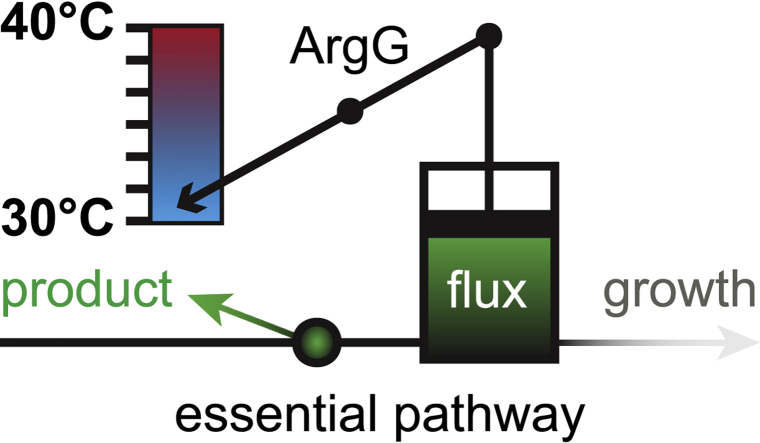
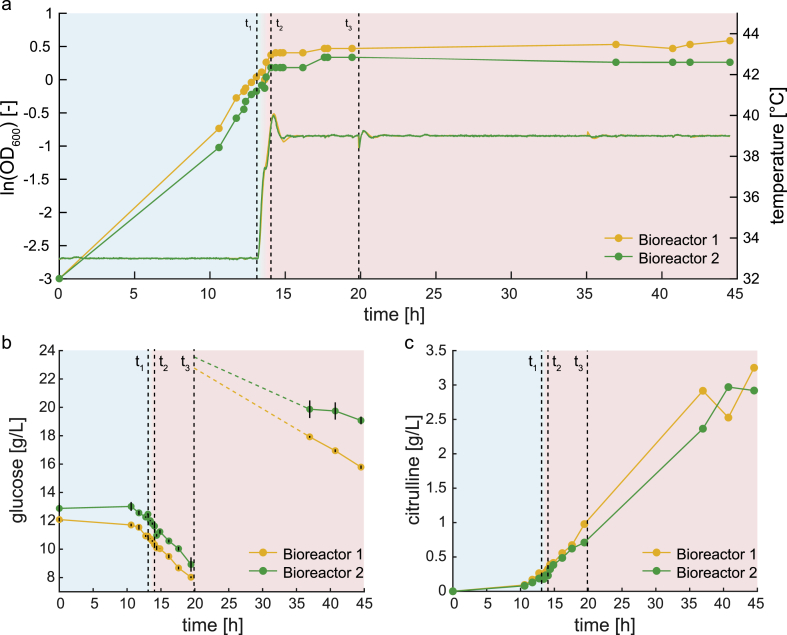
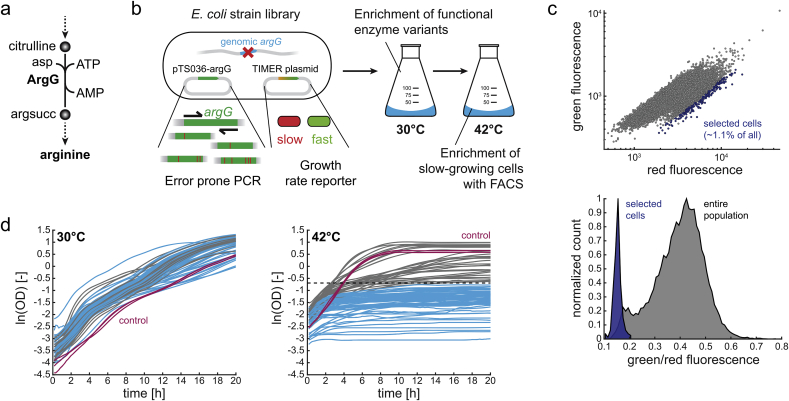
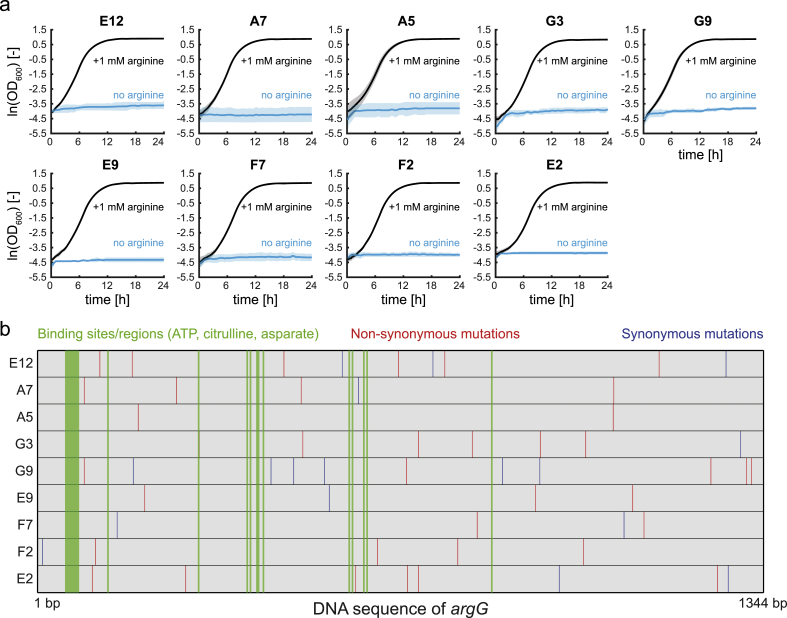
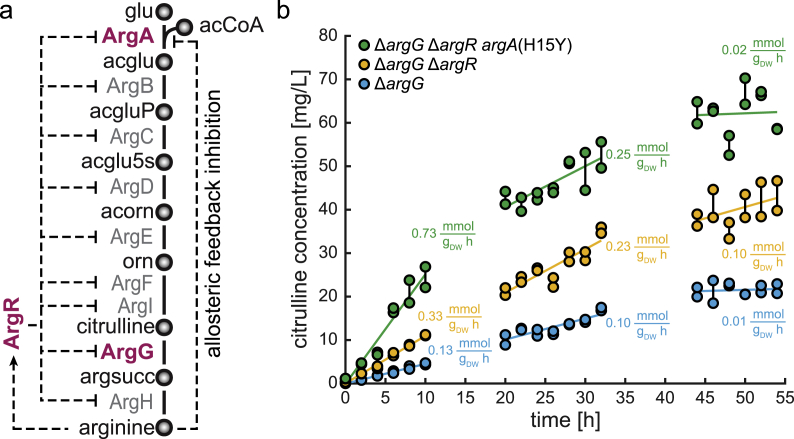
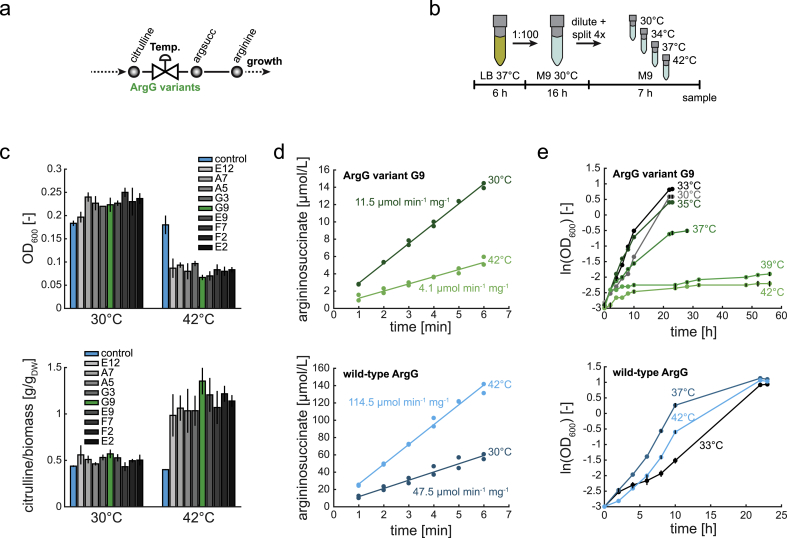
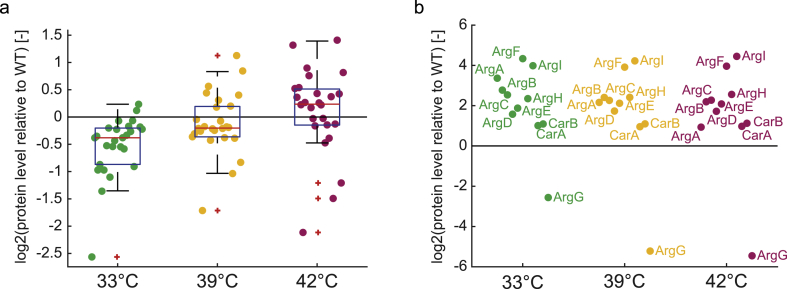
Controlling metabolism of engineered microbes is important to modulate cell growth and production during a bioprocess. For example, external parameters such as light, chemical inducers, or temperature can act on metabolism of production strains by changing the abundance or activity of enzymes. Here, we created temperature-sensitive variants of an essential enzyme in arginine biosynthesis of Escherichia coli (argininosuccinate synthetase, ArgG) and used them to dynamically control citrulline overproduction and growth of E. coli. We show a method for high-throughput enrichment of temperature-sensitive ArgG variants with a fluorescent TIMER protein and flow cytometry. With 90 of the thus derived ArgG variants, we complemented an ArgG deletion strain showing that 90% of the strains exhibit temperature-sensitive growth and 69% of the strains are auxotrophic for arginine at 42 °C and prototrophic at 30 °C. The best temperature-sensitive ArgG variant enabled precise and tunable control of cell growth by temperature changes. Expressing this variant in a feedback-dysregulated E. coli strain allowed us to realize a two-stage bioprocess: a 33 °C growth-phase for biomass accumulation and a 39 °C stationary-phase for citrulline production. With this two-stage strategy, we produced 3 g/L citrulline during 45 h cultivation in a 1-L bioreactor. These results show that temperature-sensitive enzymes can be created en masse and that they may function as metabolic valves in engineered bacteria.
控制工程微生物的代谢对于调节生物过程中的细胞生长和生产非常重要。例如,外部参数,如光、化学诱导剂或温度,可以通过改变酶的丰度或活性来作用于生产菌株的代谢。在这里,我们创建了大肠杆菌(精氨酸合成酶 ArgG)中精氨酸生物合成的必需酶的温度敏感变体,并将其用于动态控制瓜氨酸的过度生产和大肠杆菌的生长。我们展示了一种使用荧光 TIMER 蛋白和流式细胞术高通量富集温度敏感 ArgG 变体的方法。使用 90 个由此衍生的 ArgG 变体,我们对 ArgG 缺失菌株进行了互补,结果表明 90%的菌株在 42°C 时表现出温度敏感生长,69%的菌株在 42°C 时为精氨酸营养缺陷型,而在 30°C 时为原养型。最佳温度敏感 ArgG 变体可通过温度变化实现对细胞生长的精确和可调控制。在反馈失调的大肠杆菌菌株中表达这种变体,使我们能够实现两步生物过程:33°C 的生长阶段用于生物量积累,39°C 的静止阶段用于瓜氨酸生产。通过这种两步策略,我们在 1L 生物反应器中培养 45 小时生产了 3g/L 的瓜氨酸。这些结果表明,可以大量创建温度敏感酶,并且它们可以作为工程菌中的代谢阀发挥作用。