Food and Nutrition Group, Sheffield Business School, Sheffield Hallam University, Sheffield, UK
Food and Nutrition Group, Sheffield Business School, Sheffield Hallam University, Sheffield, UK.
BMJ Open. 2020 Mar 15;10(3):e035108. doi: 10.1136/bmjopen-2019-035108.
Gout is a painful form of inflammatory arthritis associated with several comorbidities, particularly cardiovascular disease. Cherries, which are rich in anti-inflammatory and antioxidative bioactive compounds, are proposed to be efficacious in preventing and treating gout, but recommendations to patients are conflicting. Cherry consumption has been demonstrated to lower serum urate levels and inflammation in several small studies. One observational case cross-over study reported that cherry consumption was associated with reduced risk of recurrent gout attacks. This preliminary evidence requires substantiation. The proposed randomised clinical trial aims to test the effect of consumption of tart cherry juice on risk of gout attacks.
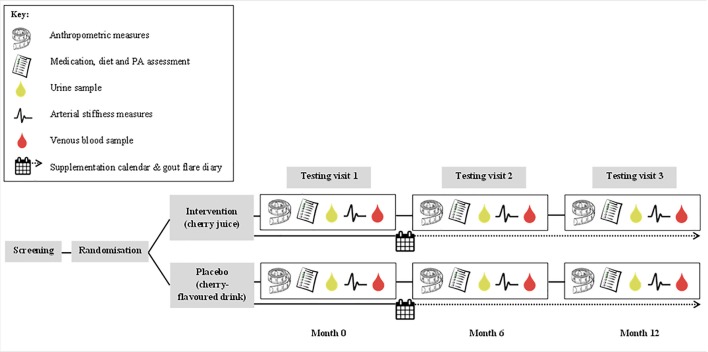
This 12-month, parallel, double-blind, randomised, placebo-controlled trial will recruit 120 individuals (aged 18-80 years) with a clinical diagnosis of gout who have self-reported a gout flare in the previous year. Participants will be randomly assigned to an intervention group, which will receive Montmorency tart cherry juice daily for a 12-month period, or a corresponding placebo group, which will receive a cherry-flavoured placebo drink. The primary study outcome is change in frequency of self-reported gout attacks. Secondary outcome measures include attack intensity, serum urate concentration, fractional excretion of uric acid, biomarkers of inflammation, blood lipids and other markers of cardiovascular risk. Other secondary outcome measures will be changes in physical activity and functional status. Statistical analysis will be conducted on an intention-to-treat basis.
This study has been granted ethical approval by the National Research Ethics Service, Yorkshire and The Humber-Leeds West Research Ethics Committee (ref: 18/SW/0262). Results of the trial will be submitted for publication in a peer-reviewed journal.
NCT03621215.
痛风是一种与多种合并症相关的疼痛性炎症性关节炎,尤其是心血管疾病。樱桃富含抗炎和抗氧化生物活性化合物,被认为在预防和治疗痛风方面有效,但给患者的建议却存在矛盾。一些小型研究表明,樱桃的摄入可以降低血清尿酸水平和炎症。一项观察性病例交叉研究报告称,樱桃的摄入与降低复发性痛风发作的风险有关。这一初步证据需要证实。本研究旨在测试樱桃汁摄入对痛风发作风险的影响。
这是一项为期 12 个月的平行、双盲、随机、安慰剂对照试验,将招募 120 名(年龄 18-80 岁)有临床痛风诊断且在过去一年中曾自行报告痛风发作的个体。参与者将被随机分配到干预组,每天接受蒙莫朗西酸樱桃汁治疗 12 个月,或接受樱桃味安慰剂的对照组。主要研究结果是自我报告的痛风发作频率的变化。次要结果包括发作强度、血清尿酸浓度、尿酸排泄分数、炎症生物标志物、血脂和其他心血管风险标志物。其他次要结果将是身体活动和功能状态的变化。统计分析将基于意向治疗进行。
本研究已获得国家伦理服务机构、约克郡和亨伯-利兹西部研究伦理委员会(编号:18/SW/0262)的伦理批准。试验结果将提交给同行评议期刊发表。
NCT03621215。