Section of Education Sciences and LEARN! Research Institute, Vrije Universiteit Amsterdam, 1081 BT, Amsterdam, The Netherlands.
Institute of Brain and Behavior Amsterdam, 1081 BT, Amsterdam, The Netherlands.
Sci Rep. 2020 Mar 16;10(1):4776. doi: 10.1038/s41598-020-61737-1.
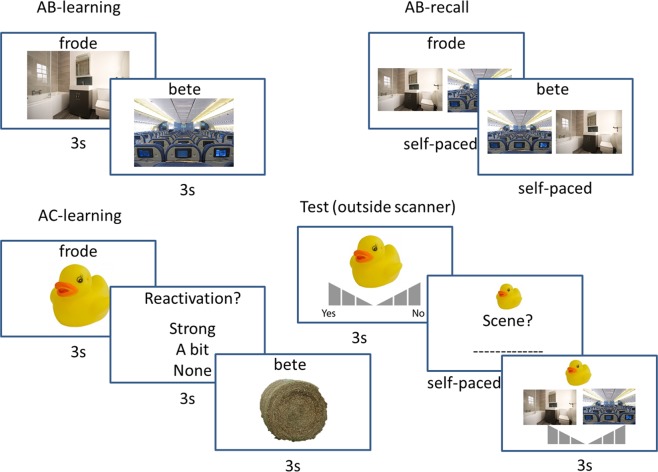
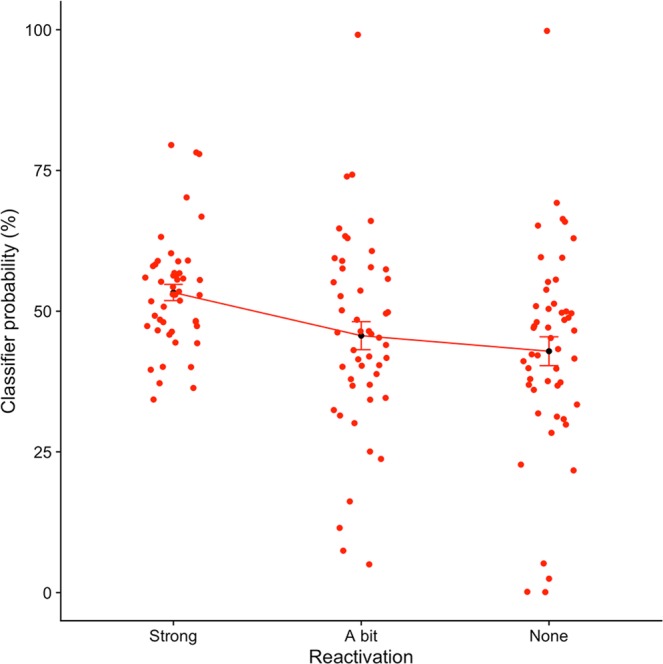
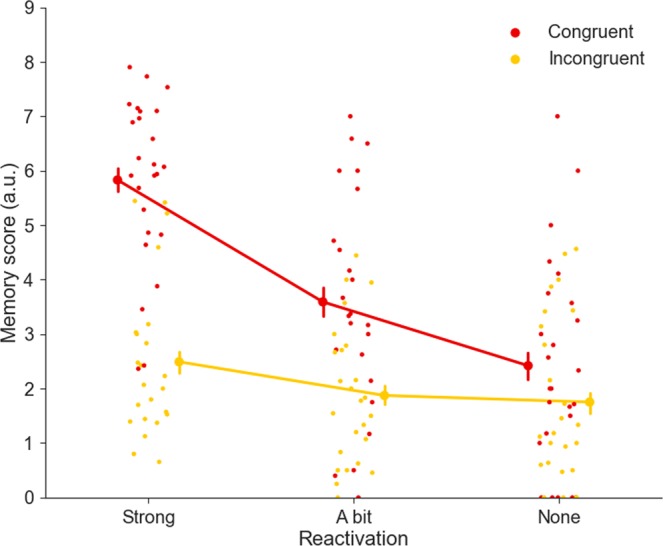
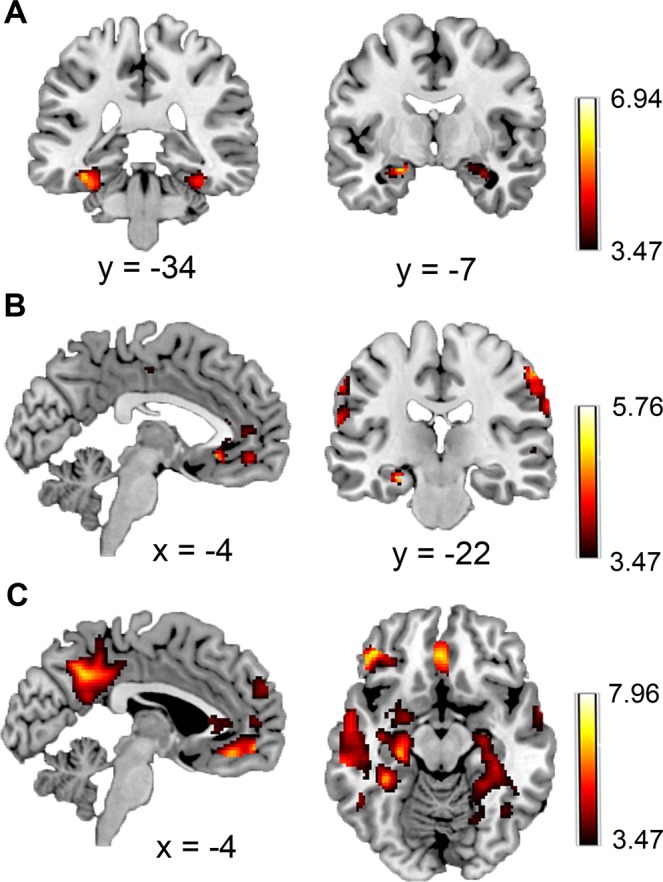
Building knowledge schemas that organize information and guide future learning is of great importance in everyday life. Such knowledge building is suggested to occur through reinstatement of prior knowledge during new learning, yielding integration of new with old memories supported by the medial prefrontal cortex (mPFC) and medial temporal lobe (MTL). Congruency with prior knowledge is also known to enhance subsequent memory. Yet, how reactivation and congruency interact to optimize memory integration is unknown. To investigate this question, we used an adapted AB-AC inference paradigm in combination with functional Magnetic Resonance Imaging (fMRI). Participants first studied an AB-association followed by an AC-association, so B (a scene) and C (an object) were indirectly linked through A (a pseudoword). BC-associations were either congruent or incongruent with prior knowledge (e.g. bathduck or hammer in a bathroom), and participants reported subjective B-reactivation strength while learning AC. Behaviorally, both congruency and reactivation enhanced memory integration. In the brain, these behavioral effects related to univariate and multivariate parametric effects in the MTL, mPFC, and Parahippocampal Place Area (PPA). Moreover, mPFC exhibited larger PPA-connectivity for more congruent associations. These outcomes provide insights into the neural mechanisms underlying memory enhancement, which has value for educational learning.
在日常生活中,构建组织信息和指导未来学习的知识图式非常重要。这种知识构建被认为是通过在新学习中恢复先前的知识来发生的,从而通过内侧前额叶皮层 (mPFC) 和内侧颞叶 (MTL) 支持新记忆与旧记忆的整合。先前知识的一致性也被认为可以增强后续记忆。然而,重新激活和一致性如何相互作用以优化记忆整合尚不清楚。为了研究这个问题,我们使用了一种经过改编的 AB-AC 推理范式结合功能磁共振成像 (fMRI)。参与者首先学习 AB 关联,然后学习 AC 关联,因此 B(场景)和 C(物体)通过 A(伪词)间接关联。BC 关联与先前知识一致或不一致(例如浴室中的 bathduck 或锤子),参与者在学习 AC 时报告主观 B 再激活强度。行为上,一致性和再激活都增强了记忆整合。在大脑中,这些行为效应与 MTL、mPFC 和海马旁区位置区域 (PPA) 的单变量和多变量参数效应有关。此外,mPFC 对更一致的关联表现出更大的 PPA 连接性。这些结果为记忆增强的神经机制提供了深入的了解,这对教育学习具有重要价值。