Islam Md Aminul, Takagi Michihiro, Fukuyama Kohtaro, Komatsu Ryoya, Albarracin Leonardo, Nochi Tomonori, Suda Yoshihito, Ikeda-Ohtsubo Wakako, Rutten Victor, Eden Willem van, Villena Julio, Aso Hisashi, Kitazawa Haruki
Food and Feed Immunology Group, Laboratory of Animal Products Chemistry, Graduate School of Agricultural Science, Tohoku University, Sendai 980-8572, Japan.
Livestock Immunology Unit, International Education and Research Center for Food and Agricultural Immunology (CFAI), Graduate School of Agricultural Science, Tohoku University, Sendai 980-8577, Japan.
Pathogens. 2020 Mar 9;9(3):200. doi: 10.3390/pathogens9030200.
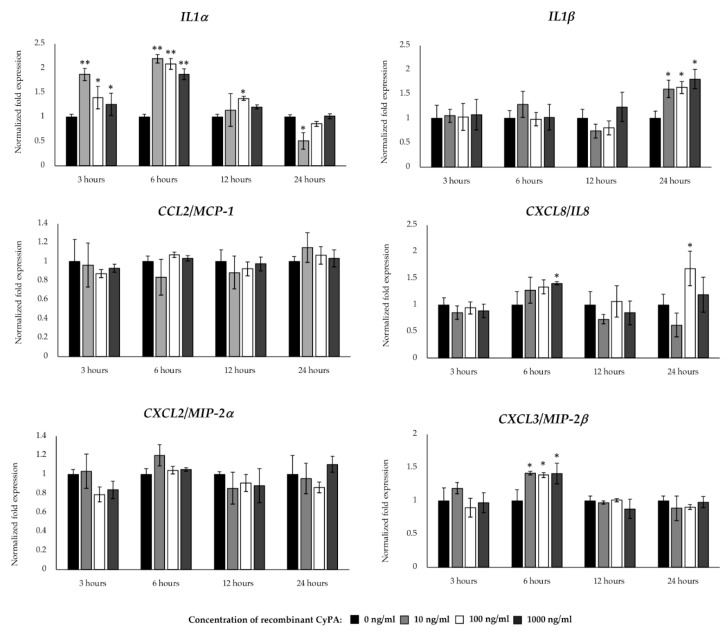
Bovine mastitis is the inflammatory reaction of the mammary gland and is commonly caused by bacterial infections in high-yielding dairy cows. The detailed investigation of the immunotranscriptomic response of bovine mammary epithelial (BME) cells to pattern recognition receptors (PRRs) activation by microbial-associated molecular patterns (MAMPs) can be of great importance for understanding the innate immune defense mechanisms, and for exploring the immunomodulatory candidate genes. In this work, we investigated the transcriptome modifications of BME cells after the in vitro stimulation with derived lipopolysaccharide (LPS) and heat-killed JE2 and SA003. In addition, the effect of Pam3CSK4 (a synthetic triacylated lipopeptide that activates Toll-like receptor 2 (TLR2)), and the intracellular chemotactic protein cyclophilin A (CyPA), which is secreted by BME cells during mastitis, in the expression changes of selected cytokines and chemokines were evaluated by qPCR. Microarray analysis identified 447, 465 and 520 differentially expressed genes (DEGs) in the BME cells after LPS, JE2 and SA003 stimulation, respectively. A major differential response in the inflammatory gene expression was noticed between the stimulation of LPS and strains. Unlike the strains, LPS stimulation resulted in significant upregulation of , , , and which were confirmed by qPCR analysis. Pam3CSK4 was not able to induce significant changes in the expression of cytokines and chemokines in challenged BME cells. The exogenous CyPA administration was able to upregulate , , and expression in BME cells indicating its ability to promote inflammation. The identification of transcriptional markers of mastitis specific for individual inflammatory factors such as LPS, Pam3CSK4 or CyPA, which can be evaluated in vitro in BME cells, may enable the development of novel diagnostics and/or immunomodulatory treatments, providing new tools for the effective management of mastitis in dairy cows. The results of this work are an advance in this regard.
牛乳腺炎是乳腺的炎症反应,通常由高产奶牛的细菌感染引起。详细研究牛乳腺上皮(BME)细胞对微生物相关分子模式(MAMPs)激活模式识别受体(PRRs)的免疫转录组反应,对于理解先天免疫防御机制以及探索免疫调节候选基因具有重要意义。在本研究中,我们研究了BME细胞在体外受到衍生脂多糖(LPS)、热灭活的JE2和SA003刺激后的转录组修饰。此外,通过qPCR评估了Pam3CSK4(一种激活Toll样受体2(TLR)的合成三酰化脂肽)以及乳腺炎期间BME细胞分泌的细胞内趋化蛋白亲环素A(CyPA)对选定细胞因子和趋化因子表达变化的影响。微阵列分析分别在LPS、JE2和SA003刺激后的BME细胞中鉴定出447、465和520个差异表达基因(DEG)。在LPS和菌株刺激之间,炎症基因表达存在主要差异反应。与菌株不同,LPS刺激导致、、、和显著上调,qPCR分析证实了这一点。Pam3CSK4在受挑战的BME细胞中不能诱导细胞因子和趋化因子表达的显著变化。外源性CyPA给药能够上调BME细胞中、、和的表达,表明其促进炎症的能力。鉴定乳腺炎针对LPS、Pam3CSK4或CyPA等个体炎症因子的转录标志物,这些标志物可在体外BME细胞中进行评估,可能有助于开发新的诊断方法和/或免疫调节治疗方法,为有效管理奶牛乳腺炎提供新工具。本研究结果在这方面是一个进展。