Department of Biostatistics, Epidemiology and Informatics, Perelman School of Medicine, University of Pennsylvania, Philadelphia, PA, 19104, USA.
Department of Computer and Information Science, School of Engineering and Applied Science, University of Pennsylvania, Philadelphia, PA, 19104, USA.
BMC Med Inform Decis Mak. 2020 Mar 18;20(Suppl 2):50. doi: 10.1186/s12911-020-1053-z.
Adverse drug events (ADEs) often occur as a result of drug-drug interactions (DDIs). The use of data mining for detecting effects of drug combinations on ADE has attracted growing attention and interest, however, most studies focused on analyzing pairwise DDIs. Recent efforts have been made to explore the directional relationships among high-dimensional drug combinations and have shown effectiveness on prediction of ADE risk. However, the existing approaches become inefficient from both computational and illustrative perspectives when considering more than three drugs.
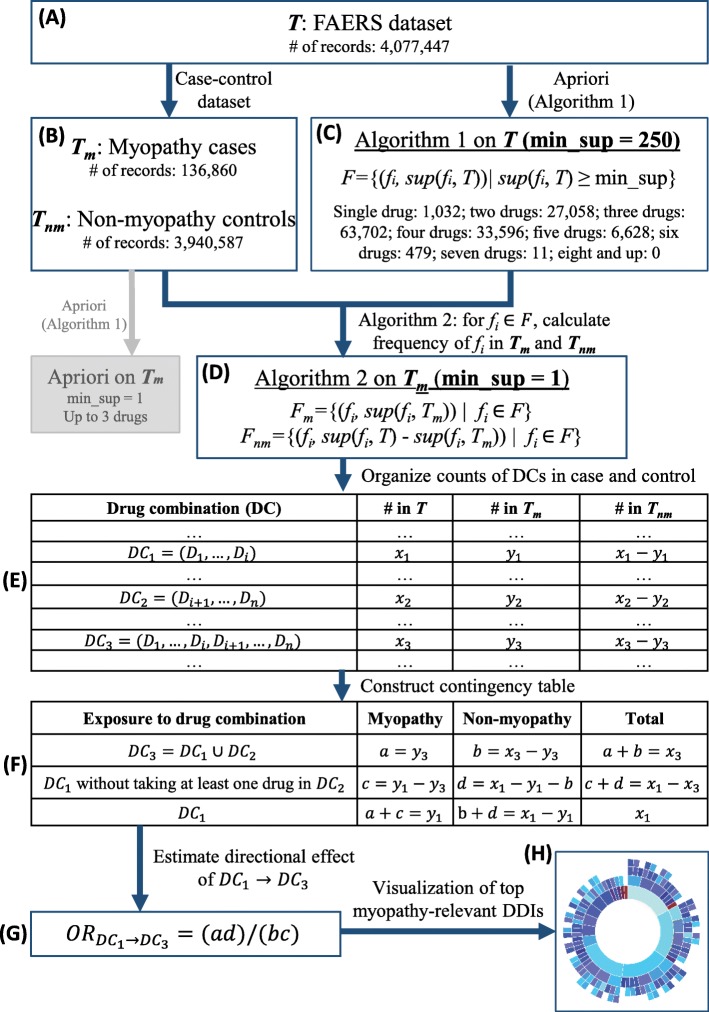
We proposed an efficient approach to estimate the directional effects of high-order DDIs through frequent itemset mining, and further developed a novel visualization method to organize and present the high-order directional DDI effects involving more than three drugs in an interactive, concise and comprehensive manner. We demonstrated its performance by mining the directional DDIs associated with myopathy using a publicly available FAERS dataset.
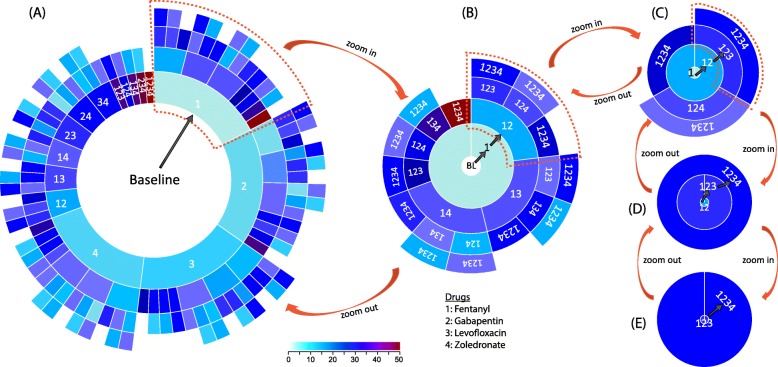
Directional effects of DDIs involving up to seven drugs were reported. Our analysis confirmed previously reported myopathy associated DDIs including interactions between fusidic acid with simvastatin and atorvastatin. Furthermore, we uncovered a number of novel DDIs leading to increased risk for myopathy, such as the co-administration of zoledronate with different types of drugs including antibiotics (ciprofloxacin, levofloxacin) and analgesics (acetaminophen, fentanyl, gabapentin, oxycodone). Finally, we visualized directional DDI findings via the proposed tool, which allows one to interactively select any drug combination as the baseline and zoom in/out to obtain both detailed and overall picture of interested drugs.
We developed a more efficient data mining strategy to identify high-order directional DDIs, and designed a scalable tool to visualize high-order DDI findings. The proposed method and tool have the potential to contribute to the drug interaction research and ultimately impact patient health care.
药物不良反应(ADE)常因药物-药物相互作用(DDI)而发生。数据挖掘在检测药物组合对 ADE 的影响方面的应用引起了越来越多的关注和兴趣,然而,大多数研究都集中在分析成对的 DDI 上。最近,人们努力探索高维药物组合之间的定向关系,并在预测 ADE 风险方面取得了有效性。然而,当考虑超过三种药物时,现有的方法从计算和说明性的角度来看都变得效率低下。
我们提出了一种通过频繁项集挖掘来估计高阶 DDI 的定向效应的有效方法,并进一步开发了一种新颖的可视化方法,以交互、简洁和全面的方式组织和呈现涉及超过三种药物的高阶定向 DDI 效应。我们使用公开的 FAERS 数据集挖掘与肌病相关的定向 DDI 来证明其性能。
报告了涉及多达七种药物的 DDI 的定向效应。我们的分析证实了先前报道的与肌病相关的 DDI,包括与 fusidic acid 与 simvastatin 和 atorvastatin 的相互作用。此外,我们还发现了一些导致肌病风险增加的新型 DDI,例如唑来膦酸与不同类型的药物(包括抗生素(环丙沙星、左氧氟沙星)和镇痛药(对乙酰氨基酚、芬太尼、加巴喷丁、羟考酮))的联合用药。最后,我们通过提出的工具可视化了定向 DDI 发现,该工具允许用户交互地选择任何药物组合作为基线,并放大/缩小以获得感兴趣药物的详细和整体图像。
我们开发了一种更有效的数据挖掘策略来识别高阶定向 DDI,并设计了一种可扩展的工具来可视化高阶 DDI 发现。该方法和工具有可能为药物相互作用研究做出贡献,并最终影响患者的医疗保健。