Putuo Hospital, Shanghai University of Traditional Chinese Medicine, Shanghai, People's Republic of China.
Department of General Surgery, Putuo Hospital, Shanghai University of Traditional Chinese Medicine, Shanghai, People's Republic of China.
Drug Des Devel Ther. 2020 Feb 28;14:907-919. doi: 10.2147/DDDT.S223646. eCollection 2020.
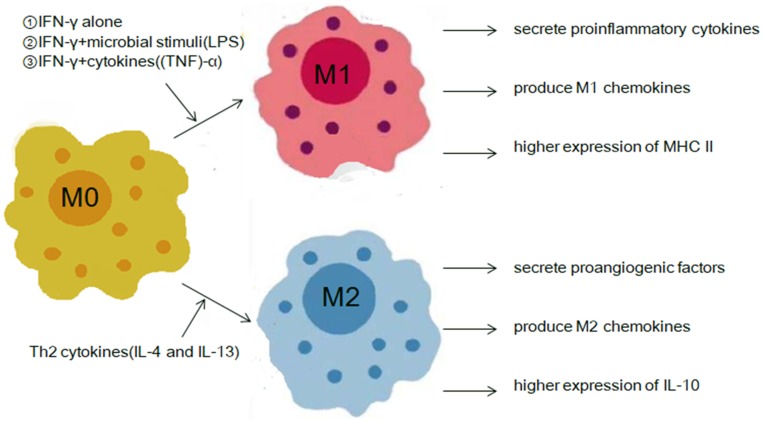
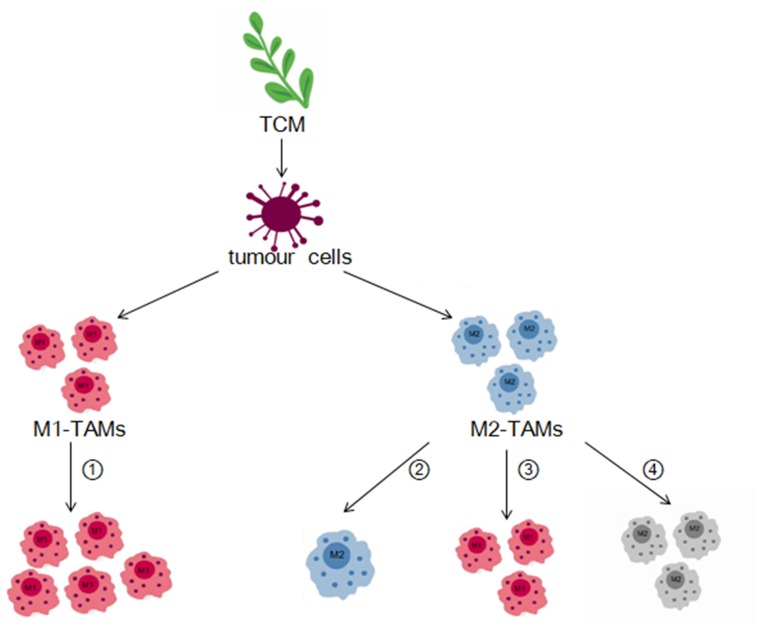
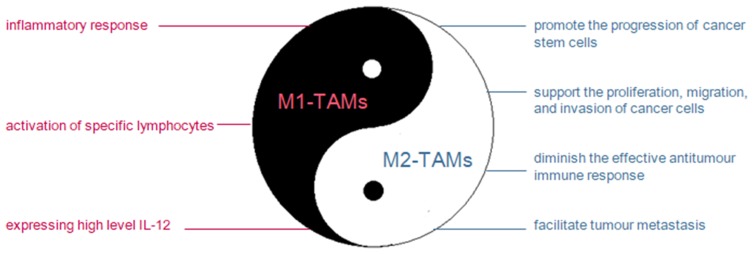
Traditional Chinese medicine (TCM) has been used as a significant cancer treatment method for many years in China. It has been demonstrated that TCM could assist in inhibiting the growth of tumors and prolonging the survival rates of cancer patients. Although the mechanism of TCM are still not clear, accumulating evidence has shown that they may be related to the tumor microenvironment (TME). Tumor-associated macrophages (TAMs) play a significant role in TME and are polarized to two phenotypes, M1 (classically activated) and M2 (alternatively activated) TAMs. The two different phenotypes of TAMs play converse roles in the TME and M2-polarized tumor-associated macrophages (M2-TAMs) always lead to poor prognosis in cancer patients compared to M1-polarized tumor-associated macrophages (M1-TAMs). In this review, the potential correlation between TCM and TAMs (especially the M2 phenotype) in tumor progression and promising TCM strategies targeting TAMs in cancer are discussed.
中医药(TCM)在中国作为一种重要的癌症治疗方法已经使用了多年。研究表明,中医药可以帮助抑制肿瘤生长,延长癌症患者的生存率。虽然中医药的作用机制尚不清楚,但越来越多的证据表明,它们可能与肿瘤微环境(TME)有关。肿瘤相关巨噬细胞(TAMs)在 TME 中起着重要作用,并极化为两种表型,M1(经典激活)和 M2(交替激活)TAMs。两种不同表型的 TAMs 在 TME 中发挥相反的作用,与 M1 极化的肿瘤相关巨噬细胞(M1-TAMs)相比,M2 极化的肿瘤相关巨噬细胞(M2-TAMs)往往导致癌症患者预后不良。本综述讨论了 TCM 与肿瘤进展中的 TAMs(特别是 M2 表型)之间的潜在相关性,以及针对 TAMs 的有前途的 TCM 策略。