Department of Pharmacy, College of Medicine and Health Sciences, Wollo University, Dessie, Ethiopia.
Tianjin State Key Laboratory of Modern Chinese Medicine, Tianjin Key Laboratory of TCM Chemistry and Analysis, Tianjin University of Traditional Chinese Medicine, Tianjin, People's Republic of China.
Drug Des Devel Ther. 2020 Mar 5;14:1003-1008. doi: 10.2147/DDDT.S241412. eCollection 2020.
The role of free radical reactions in disease pathology is well known to be involved in many acute and chronic disorders in human beings, such as diabetes, atherosclerosis, aging, immunosuppression and neurodegeneration. The search for new drugs of plant origin becomes increasingly urgent due to drug resistance. is an endemic species traditionally used for the treatment of infectious and chronic diseases.
This study was conducted to evaluate free radical scavenging activities of leaf latex of its isolated compounds.
The leaf latex of was subjected to preparative thin-layer chromatography to afford three compounds. Free radical scavenging activities of the leaf latex and its constituents was carried out using a 2, 2-diphenyl-1-picrylhydrazyl method.
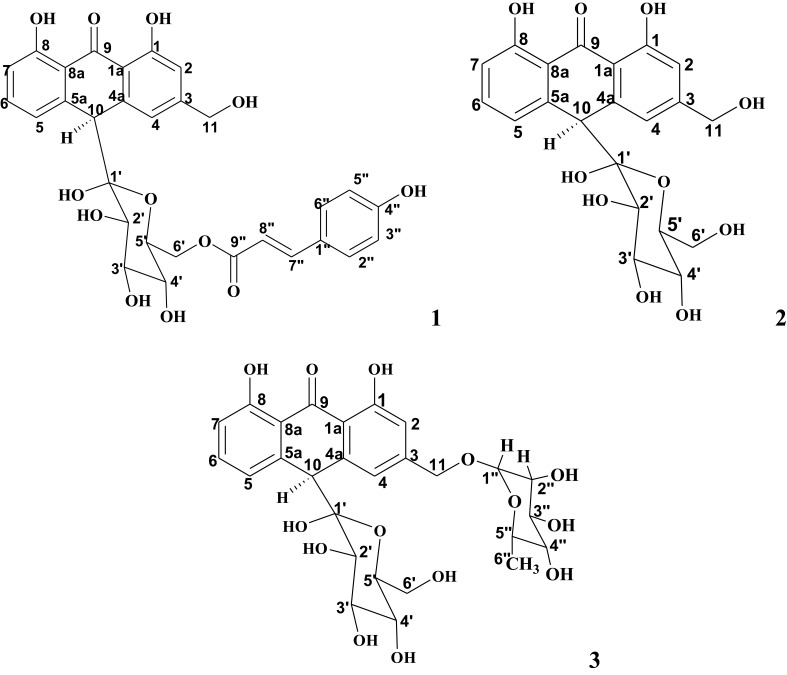
Phytochemical investigation of the leaf latex by prepartive thin layer chromatography led to the isolation of three compounds, identified as microdontin A/B (), aloin A/B () and aloinoside A/B (). The results showed that the leaf latex had a strong free radical scavenging activity reaching a maximum of 84.3% at a concentration of 100 μg/mL, and with an IC value of 25.3 ± 2.45 μg/mL ( < 0.05). Among the isolated compounds, microdontin A/B () was found to have the strongest free radical scavenging activity with an IC value of 0.07 ± 0.005 mμ, followed by aloinoside A/B (IC = 0.13 ± 0.01 mM) and aloin A/B (IC = 0.15 ± 0.02 mM).
The traditional medicinal practice of the leaf latex may be due to the antioxidant activities of the leaf latex of and the isolated compounds.
自由基反应在疾病病理学中的作用众所周知,涉及人类许多急性和慢性疾病,如糖尿病、动脉粥样硬化、衰老、免疫抑制和神经退行性变。由于耐药性的出现,寻找植物来源的新药变得越来越紧迫。 是一种地方性物种,传统上用于治疗传染病和慢性病。
本研究旨在评估其叶乳胶及其分离化合物的自由基清除活性。
将 的叶乳胶进行制备性薄层层析,得到三种化合物。采用 2,2-二苯基-1-苦基肼法测定叶乳胶及其成分的自由基清除活性。
通过预制备薄层层析对叶乳胶进行植物化学研究,分离得到三种化合物,鉴定为小桐子素 A/B()、芦荟素 A/B()和芦荟苷 A/B()。结果表明,叶乳胶具有很强的自由基清除活性,在 100μg/mL 浓度下达到最大值 84.3%,IC 值为 25.3±2.45μg/mL(<0.05)。在所分离的化合物中,小桐子素 A/B()表现出最强的自由基清除活性,IC 值为 0.07±0.005mμ,其次是芦荟苷 A/B(IC=0.13±0.01mM)和芦荟素 A/B(IC=0.15±0.02mM)。
传统医学实践可能是由于 的叶乳胶及其分离化合物具有抗氧化活性。