Szcześniak Małgorzata, Tułecka Maria
Institute of Psychology, University of Szczecin, Szczecin 71-017, Poland.
Psychol Res Behav Manag. 2020 Mar 4;13:223-232. doi: 10.2147/PRBM.S240898. eCollection 2020.
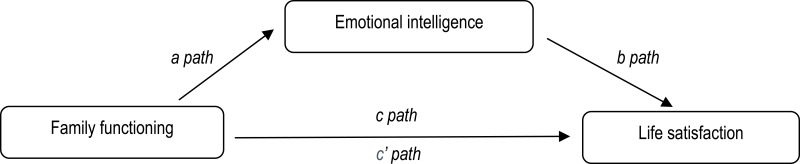
The functioning of the family of origin seems to be one of the key variables that contribute to life satisfaction. Since relationships with one's parents are associated with well-being throughout life, the purpose of our study was to examine the association between family functioning and life satisfaction among Polish adults. Moreover, because some researchers postulate that family functioning affects quality of life directly as well as indirectly through some other variables, we focused on investigating how emotional intelligence might affect the link between family functioning and life satisfaction, as the character of this relationship has received surprisingly little attention.
The sample consisted of 204 participants (86% women). We measured family functioning, satisfaction with life, and emotional intelligence. The data were collected using online forums through convenience sampling on the basis of availability and the willingness of the participants to respond.
The results showed that both life satisfaction and emotional intelligence correlated positively and significantly with cohesion, flexibility, communication, and family satisfaction. Life satisfaction correlated negatively and significantly with enmeshed, disengaged, and chaotic functioning. In contrast, emotional intelligence correlated negatively and significantly only with chaotic and disengaged functioning. Moreover, emotional intelligence partially mediated the relationship between six dimensions of family functioning (cohesion, flexibility, communication, family satisfaction, disengagement, and chaos) and life satisfaction.
Our findings provide evidence of an indirect association between family functioning and life satisfaction through the mediating role of emotional intelligence. They indicate that individuals who evaluate their family functioning as cohesive, flexible, communicative, and fulfilled, are more likely to process their own emotions and enjoy higher life satisfaction. Conversely, assessment of family of origin as disengaged and chaotic may diminish the ability to manage one's own emotions, which, in turn, can lead to lower life satisfaction.
原生家庭的功能似乎是影响生活满意度的关键变量之一。由于与父母的关系与一生的幸福感相关,我们研究的目的是检验波兰成年人家庭功能与生活满意度之间的关联。此外,由于一些研究人员假设家庭功能直接以及通过其他一些变量间接影响生活质量,我们专注于研究情商如何影响家庭功能与生活满意度之间的联系,因为这种关系的性质出人意料地很少受到关注。
样本包括204名参与者(86%为女性)。我们测量了家庭功能、生活满意度和情商。数据通过在线论坛,基于参与者的可得性和回应意愿采用便利抽样的方式收集。
结果表明,生活满意度和情商与凝聚力、灵活性、沟通和家庭满意度均呈显著正相关。生活满意度与纠缠、疏离和混乱的功能呈显著负相关。相比之下,情商仅与混乱和疏离的功能呈显著负相关。此外,情商部分中介了家庭功能的六个维度(凝聚力、灵活性、沟通、家庭满意度、疏离和混乱)与生活满意度之间的关系。
我们的研究结果提供了证据,证明家庭功能与生活满意度之间通过情商的中介作用存在间接关联。它们表明,那些将自己的家庭功能评价为有凝聚力、灵活、善于沟通且美满的个体,更有可能处理自己的情绪并享有更高的生活满意度。相反,将原生家庭评价为疏离和混乱可能会削弱管理自身情绪的能力,进而导致较低的生活满意度。