Kulke Louisa, Feyerabend Dennis, Schacht Annekathrin
Affective Neuroscience and Psychophysiology Laboratory, University of Göttingen, Göttingen, Germany.
Leibniz ScienceCampus Primate Cognition, Göttingen, Germany.
Front Psychol. 2020 Feb 28;11:329. doi: 10.3389/fpsyg.2020.00329. eCollection 2020.
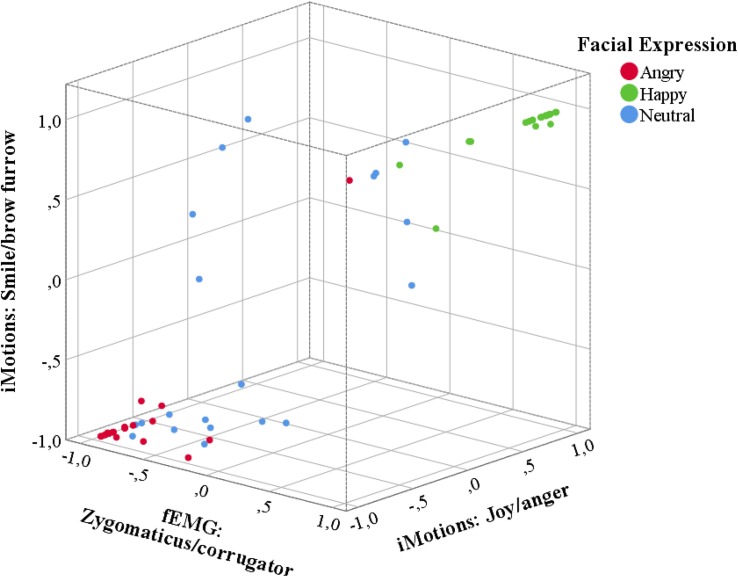
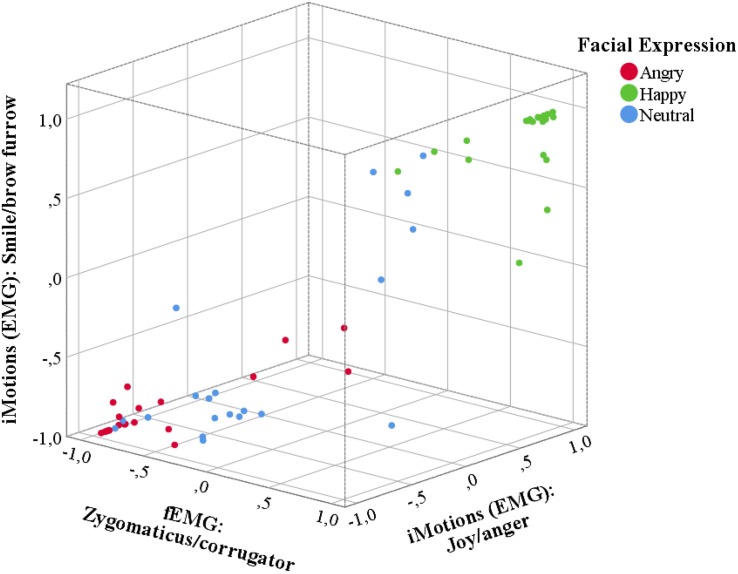
Human faces express emotions, informing others about their affective states. In order to measure expressions of emotion, facial Electromyography (EMG) has widely been used, requiring electrodes and technical equipment. More recently, emotion recognition software has been developed that detects emotions from video recordings of human faces. However, its validity and comparability to EMG measures is unclear. The aim of the current study was to compare the Affectiva Affdex emotion recognition software by iMotions with EMG measurements of the zygomaticus mayor and corrugator supercilii muscle, concerning its ability to identify happy, angry and neutral faces. Twenty participants imitated these facial expressions while videos and EMG were recorded. Happy and angry expressions were detected by both the software and by EMG above chance, while neutral expressions were more often falsely identified as negative by EMG compared to the software. Overall, EMG and software values correlated highly. In conclusion, Affectiva Affdex software can identify facial expressions and its results are comparable to EMG findings.
人类的面部会表达情感,向他人传达自身的情感状态。为了测量情感表达,面部肌电图(EMG)已被广泛应用,但这需要电极和技术设备。最近,已经开发出了情感识别软件,该软件可从人类面部的视频记录中检测情感。然而,其有效性以及与肌电图测量结果的可比性尚不清楚。本研究的目的是将iMotions公司的Affectiva Affdex情感识别软件与颧大肌和皱眉肌的肌电图测量结果进行比较,考察其识别开心、愤怒和中性面部表情的能力。20名参与者在录制视频和肌电图时模仿这些面部表情。软件和肌电图都能高于随机概率地检测到开心和愤怒表情,而与软件相比,肌电图更常将中性表情错误地识别为负面表情。总体而言,肌电图和软件的值高度相关。总之,Affectiva Affdex软件能够识别面部表情,其结果与肌电图测量结果具有可比性。