• 文献检索
  • 文档翻译
  • 深度研究
  • 学术资讯
  • Suppr Zotero 插件Zotero 插件
  • 邀请有礼
  • 套餐&价格
  • 历史记录
应用&插件
Suppr Zotero 插件Zotero 插件浏览器插件Mac 客户端Windows 客户端微信小程序
定价
高级版会员购买积分包购买API积分包
服务
文献检索文档翻译深度研究API 文档MCP 服务
关于我们
关于 Suppr公司介绍联系我们用户协议隐私条款
关注我们

Suppr 超能文献

核心技术专利:CN118964589B侵权必究
粤ICP备2023148730 号-1Suppr @ 2026

文献检索

告别复杂PubMed语法,用中文像聊天一样搜索,搜遍4000万医学文献。AI智能推荐,让科研检索更轻松。

立即免费搜索

文件翻译

保留排版,准确专业,支持PDF/Word/PPT等文件格式,支持 12+语言互译。

免费翻译文档

深度研究

AI帮你快速写综述,25分钟生成高质量综述,智能提取关键信息,辅助科研写作。

立即免费体验

从人下颌下腺干细胞/祖细胞生成功能性唾液腺组织。

Generation of functional salivary gland tissue from human submandibular gland stem/progenitor cells.

机构信息

Department of Oral and Maxillofacial Surgery and Central Laboratory, School and Hospital of Stomatology, Peking University, No. 22 Zhong-Guan-Cun South Road, Hai-Dian District, Beijing, 100081, China.

Laboratory of Biomaterials and Regenerative Medicine, Academy for Advanced Interdisciplinary Studies, Peking University, Beijing, 100871, China.

出版信息

Stem Cell Res Ther. 2020 Mar 20;11(1):127. doi: 10.1186/s13287-020-01628-4.

DOI:10.1186/s13287-020-01628-4
PMID:32197647
原文链接:https://pmc.ncbi.nlm.nih.gov/articles/PMC7083056/
Abstract

BACKGROUND

Organ replacement regenerative therapy based on human adult stem cells may be effective for salivary gland hypofunction. However, the generated tissues are immature because the signaling factors that induce the differentiation of human salivary gland stem cells into salivary glands are unknown.

METHODS

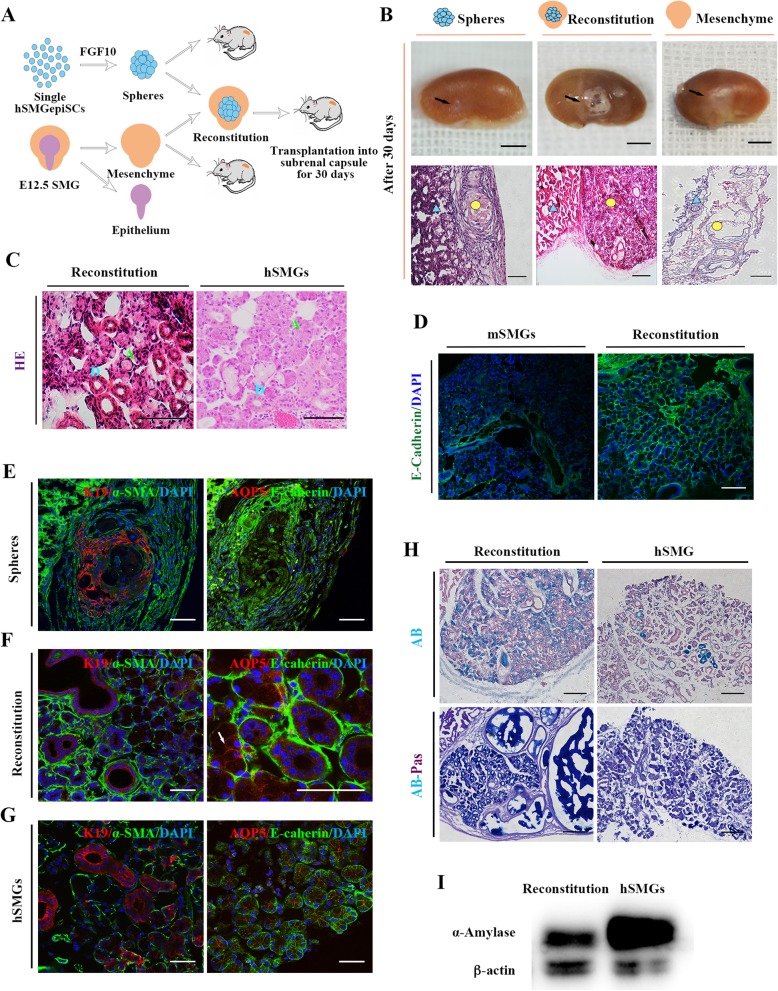
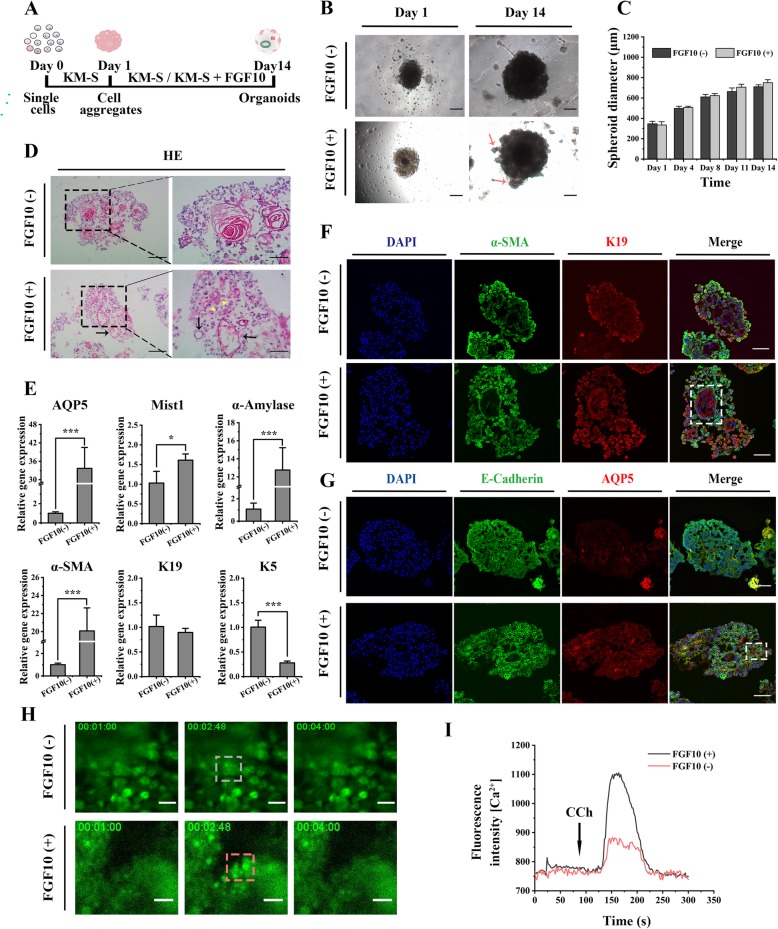
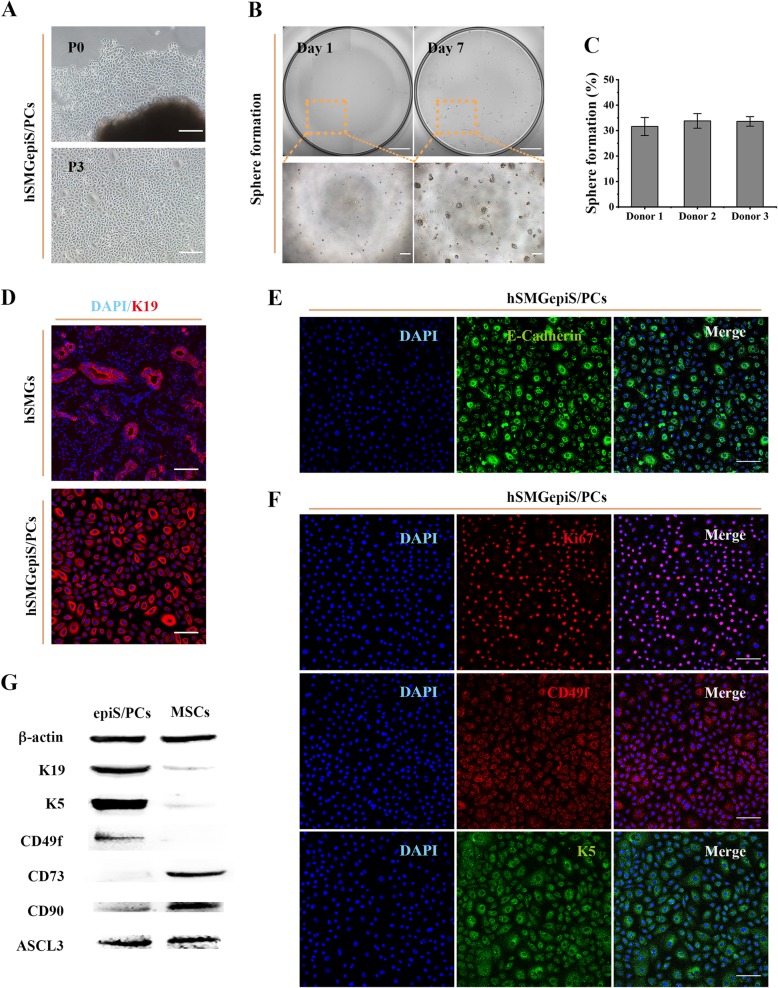
Isolated human submandibular gland stem/progenitor cells (hSMGepiS/PCs) were characterized and three-dimensionally (3D) cultured to generate organoids and further induced by fibroblast growth factor 10 (FGF10) in vitro. The induced spheres alone or in combination with embryonic day 12.5 (E12.5) mouse salivary gland mesenchyme were transplanted into the renal capsules of nude mice to assess their development in vivo. Immunofluorescence, quantitative reverse transcriptase-polymerase chain reaction, calcium release analysis, western blotting, hematoxylin-eosin staining, Alcian blue-periodic acid-Schiff staining, and Masson's trichrome staining were performed to assess the structure and function of generated tissues in vitro and in vivo.

RESULTS

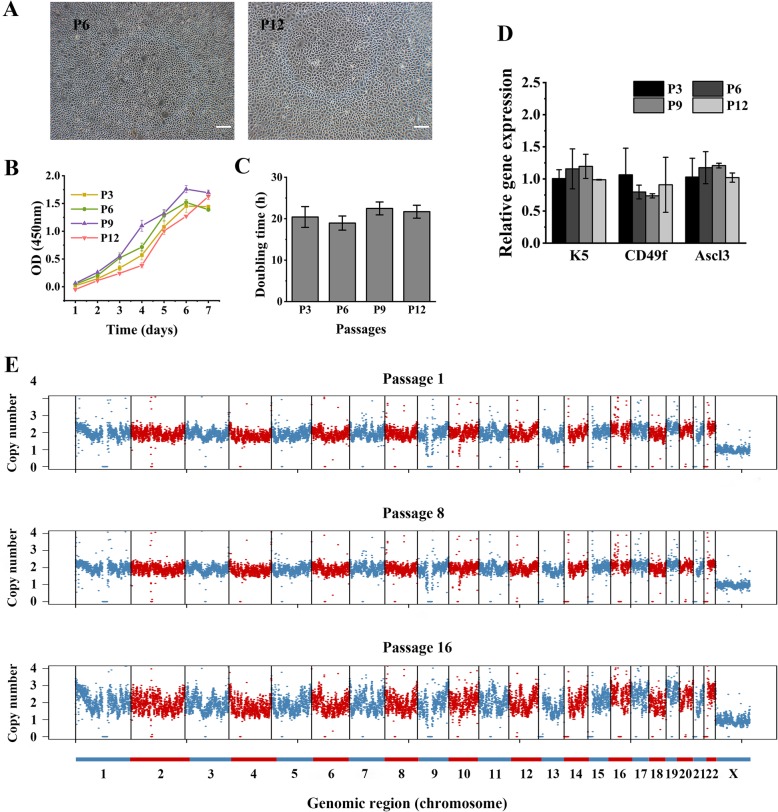
The isolated hSMGepiS/PCs could be long-term cultured with a stable genome. The organoids treated with FGF10 [FGF10 (+) group] exhibited higher expression of salivary gland-specific markers; showed spatial arrangement of AQP5, K19, and SMA cells; and were more sensitive to the stimulation by neurotransmitters than untreated organoids [FGF10 (-) group]. After heterotopic transplantation, the induced cell spheres combined with mouse embryonic salivary gland mesenchyme showed characteristics of mature salivary glands, including a natural morphology and saliva secretion.

CONCLUSION

FGF10 promoted the development of the hSMGepiS/PC-derived salivary gland organoids by the expression of differentiation markers, structure formation, and response to neurotransmitters in vitro. Moreover, the hSMGepiS/PCs responded to the niche in mouse embryonic mesenchyme and further differentiated into salivary gland tissues with mature characteristics. Our study provides a foundation for the regenerative therapy of salivary gland diseases.

摘要

背景

基于人成体干细胞的器官替代再生疗法可能对唾液腺功能低下有效。然而,由于诱导人唾液腺干细胞分化为唾液腺的信号因子尚不清楚,因此产生的组织不成熟。

方法

分离人下颌下腺干细胞/祖细胞(hSMGepiS/PC)并进行三维(3D)培养以生成类器官,然后在体外进一步用成纤维细胞生长因子 10(FGF10)诱导。单独诱导的球体或与胚胎第 12.5 天(E12.5)的小鼠唾液腺间充质一起移植到裸鼠肾囊中,以评估其体内发育情况。免疫荧光、实时定量逆转录-聚合酶链反应、钙释放分析、Western blot、苏木精-伊红染色、阿辛蓝-过碘酸-希夫染色和马松三色染色用于评估体外和体内生成组织的结构和功能。

结果

分离的 hSMGepiS/PC 可长期稳定培养。用 FGF10 处理的类器官[FGF10(+)组]表现出更高的唾液腺特异性标志物表达;显示 AQP5、K19 和 SMA 细胞的空间排列;并且对神经递质的刺激比未经处理的类器官[FGF10(-)组]更敏感。异位移植后,诱导的细胞球与小鼠胚胎唾液腺间充质结合显示出成熟唾液腺的特征,包括自然形态和唾液分泌。

结论

FGF10 在体外通过分化标志物的表达、结构形成和对神经递质的反应促进了 hSMGepiS/PC 衍生的唾液腺类器官的发育。此外,hSMGepiS/PC 对小鼠胚胎间充质的小生境有反应,并进一步分化为具有成熟特征的唾液腺组织。我们的研究为唾液腺疾病的再生治疗提供了基础。
https://cdn.ncbi.nlm.nih.gov/pmc/blobs/2655/7083056/af4cf02e8ecf/13287_2020_1628_Fig4_HTML.jpg
https://cdn.ncbi.nlm.nih.gov/pmc/blobs/2655/7083056/30f4a89ccc68/13287_2020_1628_Fig1_HTML.jpg
https://cdn.ncbi.nlm.nih.gov/pmc/blobs/2655/7083056/74056dc9dce0/13287_2020_1628_Fig2_HTML.jpg
https://cdn.ncbi.nlm.nih.gov/pmc/blobs/2655/7083056/981b45574850/13287_2020_1628_Fig3_HTML.jpg
https://cdn.ncbi.nlm.nih.gov/pmc/blobs/2655/7083056/af4cf02e8ecf/13287_2020_1628_Fig4_HTML.jpg
https://cdn.ncbi.nlm.nih.gov/pmc/blobs/2655/7083056/30f4a89ccc68/13287_2020_1628_Fig1_HTML.jpg
https://cdn.ncbi.nlm.nih.gov/pmc/blobs/2655/7083056/74056dc9dce0/13287_2020_1628_Fig2_HTML.jpg
https://cdn.ncbi.nlm.nih.gov/pmc/blobs/2655/7083056/981b45574850/13287_2020_1628_Fig3_HTML.jpg
https://cdn.ncbi.nlm.nih.gov/pmc/blobs/2655/7083056/af4cf02e8ecf/13287_2020_1628_Fig4_HTML.jpg

相似文献

1
Generation of functional salivary gland tissue from human submandibular gland stem/progenitor cells.从人下颌下腺干细胞/祖细胞生成功能性唾液腺组织。
Stem Cell Res Ther. 2020 Mar 20;11(1):127. doi: 10.1186/s13287-020-01628-4.
2
FGF2-dependent mesenchyme and laminin-111 are niche factors in salivary gland organoids.FGF2 依赖性间充质和层粘连蛋白-111 是唾液腺类器官中的小生境因子。
J Cell Sci. 2018 Feb 20;131(4):jcs208728. doi: 10.1242/jcs.208728.
3
Retinoic acid and FGF10 promote the differentiation of pluripotent stem cells into salivary gland placodes.视黄酸和 FGF10 促进多能干细胞分化为唾液腺基板。
Stem Cell Res Ther. 2022 Jul 28;13(1):368. doi: 10.1186/s13287-022-03033-5.
4
Engineering innervated secretory epithelial organoids by magnetic three-dimensional bioprinting for stimulating epithelial growth in salivary glands.通过磁三维生物打印工程化有神经支配的分泌上皮类器官,以刺激唾液腺中的上皮生长。
Biomaterials. 2018 Oct;180:52-66. doi: 10.1016/j.biomaterials.2018.06.011. Epub 2018 Jun 12.
5
Maintenance of adult stem cells from human minor salivary glands via the Wnt signaling pathway.通过 Wnt 信号通路维持人小唾液腺中的成体干细胞。
Stem Cell Res Ther. 2023 Aug 25;14(1):220. doi: 10.1186/s13287-023-03445-x.
6
Primary Salivary Human Stem/Progenitor Cells Undergo Microenvironment-Driven Acinar-Like Differentiation in Hyaluronate Hydrogel Culture.原代唾液人干细胞/祖细胞在透明质酸水凝胶培养中经历微环境驱动的腺泡样分化。
Stem Cells Transl Med. 2017 Jan;6(1):110-120. doi: 10.5966/sctm.2016-0083. Epub 2016 Aug 18.
7
Organ-specific extracellular matrix directs trans-differentiation of mesenchymal stem cells and formation of salivary gland-like organoids in vivo.器官特异性细胞外基质指导间充质干细胞的转分化和体内唾液腺类器官的形成。
Stem Cell Res Ther. 2022 Jul 15;13(1):306. doi: 10.1186/s13287-022-02993-y.
8
Mouse parotid salivary gland organoids for the in vitro study of stem cell radiation response.用于体外研究干细胞辐射反应的鼠腮腺腺泡器官样体。
Oral Dis. 2021 Jan;27(1):52-63. doi: 10.1111/odi.13475. Epub 2020 Jun 29.
9
Sox9 function in salivary gland development.Sox9 在唾液腺发育中的作用。
J Oral Biosci. 2021 Mar;63(1):8-13. doi: 10.1016/j.job.2021.01.005. Epub 2021 Jan 23.
10
Unveiling Stem Cell Heterogeneity Toward the Development of Salivary Gland Regenerative Strategies.揭示干细胞异质性,以开发唾液腺再生策略。
Adv Exp Med Biol. 2019;1123:151-164. doi: 10.1007/978-3-030-11096-3_9.

引用本文的文献

1
Chemical reprogramming culture for the expansion of salivary gland epithelial basal progenitor cells.用于唾液腺上皮基底祖细胞扩增的化学重编程培养
Stem Cell Res Ther. 2025 Apr 18;16(1):187. doi: 10.1186/s13287-025-04295-5.
2
AQP5 trafficking is regulated by its C-terminal tail and interaction with prolactin-inducible protein.水通道蛋白5(AQP5)的转运受其C末端尾巴以及与催乳素诱导蛋白相互作用的调控。
Biol Direct. 2025 Apr 16;20(1):53. doi: 10.1186/s13062-025-00647-6.
3
Organoids in the oral and maxillofacial region: present and future.

本文引用的文献

1
HeLa-CCL2 cell heterogeneity studied by single-cell DNA and RNA sequencing.单细胞 DNA 和 RNA 测序研究 HeLa-CCL2 细胞异质性。
PLoS One. 2019 Dec 2;14(12):e0225466. doi: 10.1371/journal.pone.0225466. eCollection 2019.
2
Efficacy of saliva substitutes and stimulants in the treatment of dry mouth.唾液替代品和刺激剂治疗口干症的疗效
Spec Care Dentist. 2019 May;39(3):287-297. doi: 10.1111/scd.12370. Epub 2019 Feb 27.
3
Generation of orthotopically functional salivary gland from embryonic stem cells.胚胎干细胞来源的功能性唾液腺的构建。
口腔颌面器官类器官:现状与未来。
Int J Oral Sci. 2024 Nov 1;16(1):61. doi: 10.1038/s41368-024-00324-w.
4
Cell therapy in Sjögren's syndrome: opportunities and challenges.干燥综合征的细胞治疗:机遇与挑战。
Expert Rev Mol Med. 2024 Oct 23;26:e28. doi: 10.1017/erm.2024.21.
5
Induced Pluripotent Stem Cell-Derived Parathyroid Organoids Resemble Parathyroid Morphology and Function.诱导多能干细胞衍生甲状旁腺类器官类似于甲状旁腺的形态和功能。
Adv Sci (Weinh). 2024 Nov;11(43):e2407567. doi: 10.1002/advs.202407567. Epub 2024 Sep 27.
6
Salivary gland organoid transplantation as a therapeutic option for radiation-induced xerostomia.唾液腺类器官移植作为放射性口干症的一种治疗选择。
Stem Cell Res Ther. 2024 Aug 26;15(1):265. doi: 10.1186/s13287-024-03833-x.
7
Spheroids and organoids: Their implications for oral and craniofacial tissue/organ regeneration.球体和类器官:它们对口腔和颅面组织/器官再生的影响。
J Oral Biol Craniofac Res. 2024 Sep-Oct;14(5):540-546. doi: 10.1016/j.jobcr.2024.07.002. Epub 2024 Jul 9.
8
Unlocking the Future: Bioprinting Salivary Glands-From Possibility to Reality.开启未来:生物打印唾液腺——从可能性到现实
J Funct Biomater. 2024 Jun 1;15(6):151. doi: 10.3390/jfb15060151.
9
Current developments and opportunities of pluripotent stem cells-based therapies for salivary gland hypofunction.基于多能干细胞的唾液腺功能减退治疗的当前进展与机遇
Front Cell Dev Biol. 2024 Jan 19;12:1346996. doi: 10.3389/fcell.2024.1346996. eCollection 2024.
10
Salivary Gland Bioengineering.唾液腺生物工程
Bioengineering (Basel). 2023 Dec 26;11(1):28. doi: 10.3390/bioengineering11010028.
Nat Commun. 2018 Oct 11;9(1):4216. doi: 10.1038/s41467-018-06469-7.
4
Salivary gland stem cells: A review of development, regeneration and cancer.唾液腺干细胞:发育、再生与癌症综述
Genesis. 2018 May;56(5):e23211. doi: 10.1002/dvg.23211. Epub 2018 May 4.
5
Expansion of Adult Human Pancreatic Tissue Yields Organoids Harboring Progenitor Cells with Endocrine Differentiation Potential.成人胰腺组织的扩展产生含有内分泌分化潜能的祖细胞类器官。
Stem Cell Reports. 2018 Mar 13;10(3):712-724. doi: 10.1016/j.stemcr.2018.02.005.
6
Therapeutic potential of human minor salivary gland epithelial progenitor cells in liver regeneration.人小唾液腺上皮祖细胞在肝脏再生中的治疗潜力。
Sci Rep. 2017 Oct 5;7(1):12707. doi: 10.1038/s41598-017-11880-z.
7
Etiology, evaluation, and management of xerostomia.口干症的病因、评估与管理
Clin Dermatol. 2017 Sep-Oct;35(5):468-476. doi: 10.1016/j.clindermatol.2017.06.010. Epub 2017 Jun 27.
8
SOX2 regulates acinar cell development in the salivary gland.SOX2调节唾液腺腺泡细胞的发育。
Elife. 2017 Jun 17;6:e26620. doi: 10.7554/eLife.26620.
9
Fgf10 and Sox9 are essential for the establishment of distal progenitor cells during mouse salivary gland development.在小鼠唾液腺发育过程中,Fgf10和Sox9对于远端祖细胞的建立至关重要。
Development. 2017 Jun 15;144(12):2294-2305. doi: 10.1242/dev.146019. Epub 2017 May 15.
10
Primary Salivary Human Stem/Progenitor Cells Undergo Microenvironment-Driven Acinar-Like Differentiation in Hyaluronate Hydrogel Culture.原代唾液人干细胞/祖细胞在透明质酸水凝胶培养中经历微环境驱动的腺泡样分化。
Stem Cells Transl Med. 2017 Jan;6(1):110-120. doi: 10.5966/sctm.2016-0083. Epub 2016 Aug 18.