• 文献检索
  • 文档翻译
  • 深度研究
  • 学术资讯
  • Suppr Zotero 插件Zotero 插件
  • 邀请有礼
  • 套餐&价格
  • 历史记录
应用&插件
Suppr Zotero 插件Zotero 插件浏览器插件Mac 客户端Windows 客户端微信小程序
定价
高级版会员购买积分包购买API积分包
服务
文献检索文档翻译深度研究API 文档MCP 服务
关于我们
关于 Suppr公司介绍联系我们用户协议隐私条款
关注我们

Suppr 超能文献

核心技术专利:CN118964589B侵权必究
粤ICP备2023148730 号-1Suppr @ 2026

文献检索

告别复杂PubMed语法,用中文像聊天一样搜索,搜遍4000万医学文献。AI智能推荐,让科研检索更轻松。

立即免费搜索

文件翻译

保留排版,准确专业,支持PDF/Word/PPT等文件格式,支持 12+语言互译。

免费翻译文档

深度研究

AI帮你快速写综述,25分钟生成高质量综述,智能提取关键信息,辅助科研写作。

立即免费体验

基于卷积神经网络的弥散张量图像阿尔茨海默病诊断。

Alzheimer's disease diagnosis from diffusion tensor images using convolutional neural networks.

机构信息

Biomedical Engineering and Systems, Faculty of Engineering, Cairo University, Giza, Egypt.

Biomedical Engineering Program, Electrical and Computer Engineering Department, King Abdulaziz University, Jeddah, Saudi Arabia.

出版信息

PLoS One. 2020 Mar 24;15(3):e0230409. doi: 10.1371/journal.pone.0230409. eCollection 2020.

DOI:10.1371/journal.pone.0230409
PMID:32208428
原文链接:https://pmc.ncbi.nlm.nih.gov/articles/PMC7092978/
Abstract

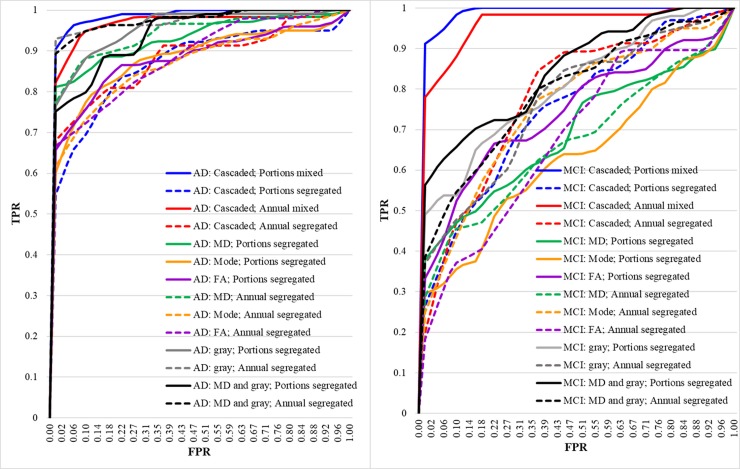
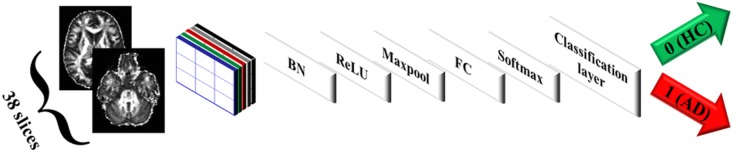
Machine learning algorithms are currently being implemented in an escalating manner to classify and/or predict the onset of some neurodegenerative diseases; including Alzheimer's Disease (AD); this could be attributed to the fact of the abundance of data and powerful computers. The objective of this work was to deliver a robust classification system for AD and Mild Cognitive Impairment (MCI) against healthy controls (HC) in a low-cost network in terms of shallow architecture and processing. In this study, the dataset included was downloaded from the Alzheimer's disease neuroimaging initiative (ADNI). The classification methodology implemented was the convolutional neural network (CNN), where the diffusion maps, and gray-matter (GM) volumes were the input images. The number of scans included was 185, 106, and 115 for HC, MCI and AD respectively. Ten-fold cross-validation scheme was adopted and the stacked mean diffusivity (MD) and GM volume produced an AUC of 0.94 and 0.84, an accuracy of 93.5% and 79.6%, a sensitivity of 92.5% and 62.7%, and a specificity of 93.9% and 89% for AD/HC and MCI/HC classification respectively. This work elucidates the impact of incorporating data from different imaging modalities; i.e. structural Magnetic Resonance Imaging (MRI) and Diffusion Tensor Imaging (DTI), where deep learning was employed for the aim of classification. To the best of our knowledge, this is the first study assessing the impact of having more than one scan per subject and propose the proper maneuver to confirm the robustness of the system. The results were competitive among the existing literature, which paves the way for improving medications that could slow down the progress of the AD or prevent it.

摘要

机器学习算法目前正在被大量应用于分类和/或预测一些神经退行性疾病的发生,包括阿尔茨海默病(AD);这可能归因于大量的数据和强大的计算机。本研究的目的是开发一个针对 AD 和轻度认知障碍(MCI)与健康对照组(HC)的鲁棒分类系统,该系统在浅层架构和处理方面具有成本效益。在这项研究中,使用的数据集是从阿尔茨海默病神经影像学倡议(ADNI)下载的。所实施的分类方法是卷积神经网络(CNN),其中扩散图和灰质(GM)体积是输入图像。纳入的扫描数量分别为 185、106 和 115,用于 HC、MCI 和 AD。采用 10 折交叉验证方案,堆叠平均扩散系数(MD)和 GM 体积的 AUC 分别为 0.94 和 0.84,准确率为 93.5%和 79.6%,敏感度为 92.5%和 62.7%,特异性为 93.9%和 89%,用于 AD/HC 和 MCI/HC 分类。本研究阐明了整合来自不同成像模式的数据的影响,即结构磁共振成像(MRI)和弥散张量成像(DTI),其中深度学习被用于分类目的。据我们所知,这是第一项评估每个被试有多个扫描的影响并提出正确的操作来确认系统的稳健性的研究。结果在现有的文献中具有竞争力,为改善可以减缓 AD 进展或预防 AD 的药物铺平了道路。
https://cdn.ncbi.nlm.nih.gov/pmc/blobs/d7ab/7092978/70c61dc68880/pone.0230409.g003.jpg
https://cdn.ncbi.nlm.nih.gov/pmc/blobs/d7ab/7092978/6a902480e374/pone.0230409.g001.jpg
https://cdn.ncbi.nlm.nih.gov/pmc/blobs/d7ab/7092978/6172185fab91/pone.0230409.g002.jpg
https://cdn.ncbi.nlm.nih.gov/pmc/blobs/d7ab/7092978/70c61dc68880/pone.0230409.g003.jpg
https://cdn.ncbi.nlm.nih.gov/pmc/blobs/d7ab/7092978/6a902480e374/pone.0230409.g001.jpg
https://cdn.ncbi.nlm.nih.gov/pmc/blobs/d7ab/7092978/6172185fab91/pone.0230409.g002.jpg
https://cdn.ncbi.nlm.nih.gov/pmc/blobs/d7ab/7092978/70c61dc68880/pone.0230409.g003.jpg

相似文献

1
Alzheimer's disease diagnosis from diffusion tensor images using convolutional neural networks.基于卷积神经网络的弥散张量图像阿尔茨海默病诊断。
PLoS One. 2020 Mar 24;15(3):e0230409. doi: 10.1371/journal.pone.0230409. eCollection 2020.
2
A parameter-efficient deep learning approach to predict conversion from mild cognitive impairment to Alzheimer's disease.一种参数高效的深度学习方法,用于预测轻度认知障碍向阿尔茨海默病的转化。
Neuroimage. 2019 Apr 1;189:276-287. doi: 10.1016/j.neuroimage.2019.01.031. Epub 2019 Jan 14.
3
Predicting Prodromal Alzheimer's Disease in Subjects with Mild Cognitive Impairment Using Machine Learning Classification of Multimodal Multicenter Diffusion-Tensor and Magnetic Resonance Imaging Data.使用多模态多中心扩散张量和磁共振成像数据的机器学习分类法预测轻度认知障碍受试者的前驱阿尔茨海默病
J Neuroimaging. 2015 Sep-Oct;25(5):738-47. doi: 10.1111/jon.12214. Epub 2015 Jan 28.
4
A multi-model deep convolutional neural network for automatic hippocampus segmentation and classification in Alzheimer's disease.一种用于阿尔茨海默病中海马自动分割和分类的多模态深度卷积神经网络。
Neuroimage. 2020 Mar;208:116459. doi: 10.1016/j.neuroimage.2019.116459. Epub 2019 Dec 16.
5
Classification of Alzheimer's disease and prediction of mild cognitive impairment-to-Alzheimer's conversion from structural magnetic resource imaging using feature ranking and a genetic algorithm.基于特征排序和遗传算法,利用结构磁共振成像对阿尔茨海默病进行分类及预测轻度认知障碍向阿尔茨海默病的转化
Comput Biol Med. 2017 Apr 1;83:109-119. doi: 10.1016/j.compbiomed.2017.02.011. Epub 2017 Feb 27.
6
Cross-cohort generalizability of deep and conventional machine learning for MRI-based diagnosis and prediction of Alzheimer's disease.基于 MRI 的阿尔茨海默病诊断和预测的深度学习和传统机器学习在不同队列间的泛化能力。
Neuroimage Clin. 2021;31:102712. doi: 10.1016/j.nicl.2021.102712. Epub 2021 Jun 4.
7
Random forest feature selection, fusion and ensemble strategy: Combining multiple morphological MRI measures to discriminate among healhy elderly, MCI, cMCI and alzheimer's disease patients: From the alzheimer's disease neuroimaging initiative (ADNI) database.随机森林特征选择、融合和集成策略:结合多种形态磁共振成像指标对健康老年人、MCI、cMCI 和阿尔茨海默病患者进行分类:来自阿尔茨海默病神经影像学倡议(ADNI)数据库。
J Neurosci Methods. 2018 May 15;302:14-23. doi: 10.1016/j.jneumeth.2017.12.010. Epub 2017 Dec 18.
8
A hybrid Convolutional and Recurrent Neural Network for Hippocampus Analysis in Alzheimer's Disease.一种用于阿尔茨海默病中海马分析的卷积循环混合神经网络。
J Neurosci Methods. 2019 Jul 15;323:108-118. doi: 10.1016/j.jneumeth.2019.05.006. Epub 2019 May 25.
9
Automated MRI-Based Deep Learning Model for Detection of Alzheimer's Disease Process.基于 MRI 的自动化深度学习模型用于阿尔茨海默病进程的检测。
Int J Neural Syst. 2020 Jun;30(6):2050032. doi: 10.1142/S012906572050032X.
10
Latent diffusion model-based MRI superresolution enhances mild cognitive impairment prognostication and Alzheimer's disease classification.基于潜在扩散模型的 MRI 超分辨率可增强轻度认知障碍的预后预测和阿尔茨海默病的分类。
Neuroimage. 2024 Aug 1;296:120663. doi: 10.1016/j.neuroimage.2024.120663. Epub 2024 Jun 4.

引用本文的文献

1
AlzheimerViT: harnessing lightweight vision transformer architecture for proactive Alzheimer's screening.阿尔茨海默病视觉变换器(AlzheimerViT):利用轻量级视觉变换器架构进行早期阿尔茨海默病筛查
Front Med (Lausanne). 2025 Jun 17;12:1568312. doi: 10.3389/fmed.2025.1568312. eCollection 2025.
2
White matter trajectories in Down syndrome and Alzheimer's disease: Insights from diffusion tensor-based morphometry.唐氏综合征和阿尔茨海默病中的白质纤维束:基于扩散张量形态学的见解。
Alzheimers Dement. 2025 Jun;21(6):e70382. doi: 10.1002/alz.70382.
3
Hybrid-RViT: Hybridizing ResNet-50 and Vision Transformer for Enhanced Alzheimer's disease detection.

本文引用的文献

1
Multimodal Hippocampal Subfield Grading For Alzheimer's Disease Classification.多模态海马亚区分级用于阿尔茨海默病分类。
Sci Rep. 2019 Sep 25;9(1):13845. doi: 10.1038/s41598-019-49970-9.
2
Identification of Leukemia Subtypes from Microscopic Images Using Convolutional Neural Network.使用卷积神经网络从显微图像中识别白血病亚型
Diagnostics (Basel). 2019 Aug 25;9(3):104. doi: 10.3390/diagnostics9030104.
3
Diagnosis of Alzheimer's disease with Sobolev gradient-based optimization and 3D convolutional neural network.基于 Sobolev 梯度优化和 3D 卷积神经网络的阿尔茨海默病诊断。
混合视网膜视觉Transformer(Hybrid-RViT):融合ResNet-50和视觉Transformer以增强阿尔茨海默病检测
PLoS One. 2025 Feb 14;20(2):e0318998. doi: 10.1371/journal.pone.0318998. eCollection 2025.
4
Synergistic associations of CD33 variants and hypertension with brain and cognitive aging among dementia-free older adults: A population-based study.CD33 变体与高血压协同作用与痴呆症老年人的脑和认知老化的关系:一项基于人群的研究。
Alzheimers Dement. 2024 Oct;20(10):7193-7204. doi: 10.1002/alz.14209. Epub 2024 Aug 30.
5
Understanding machine learning applications in dementia research and clinical practice: a review for biomedical scientists and clinicians.了解机器学习在痴呆症研究和临床实践中的应用:给生物医学科学家和临床医生的综述
Alzheimers Res Ther. 2024 Aug 1;16(1):175. doi: 10.1186/s13195-024-01540-6.
6
Detection of mild cognitive impairment based on attention mechanism and parallel dilated convolution.基于注意力机制和并行扩张卷积的轻度认知障碍检测
PeerJ Comput Sci. 2024 May 22;10:e2056. doi: 10.7717/peerj-cs.2056. eCollection 2024.
7
Explainability of three-dimensional convolutional neural networks for functional magnetic resonance imaging of Alzheimer's disease classification based on gradient-weighted class activation mapping.基于梯度加权类激活映射的阿尔茨海默病分类的功能性磁共振成像的三维卷积神经网络的可解释性。
PLoS One. 2024 May 21;19(5):e0303278. doi: 10.1371/journal.pone.0303278. eCollection 2024.
8
MTNeuro: A Benchmark for Evaluating Representations of Brain Structure Across Multiple Levels of Abstraction.MTNeuro:一个用于评估跨多个抽象层次的脑结构表征的基准。
Adv Neural Inf Process Syst. 2022;35:5299-5314.
9
Predictive modelling of brain disorders with magnetic resonance imaging: A systematic review of modelling practices, transparency, and interpretability in the use of convolutional neural networks.基于磁共振成像的脑疾病预测建模:卷积神经网络使用中的建模实践、透明度和可解释性的系统评价。
Hum Brain Mapp. 2023 Dec 15;44(18):6561-6574. doi: 10.1002/hbm.26521. Epub 2023 Nov 1.
10
Can T1-Weighted Magnetic Resonance Imaging Significantly Improve Mini-Mental State Examination-Based Distinguishing Between Mild Cognitive Impairment and Early-Stage Alzheimer's Disease?T1 加权磁共振成像能否显著提高基于简易精神状态检查的轻度认知障碍与早期阿尔茨海默病的鉴别诊断能力?
J Alzheimers Dis. 2023;92(3):941-957. doi: 10.3233/JAD-220806.
Int J Numer Method Biomed Eng. 2019 Jul;35(7):e3225. doi: 10.1002/cnm.3225. Epub 2019 Jun 19.
4
Convolutional Neural Networks-Based MRI Image Analysis for the Alzheimer's Disease Prediction From Mild Cognitive Impairment.基于卷积神经网络的磁共振成像图像分析用于从轻度认知障碍预测阿尔茨海默病
Front Neurosci. 2018 Nov 5;12:777. doi: 10.3389/fnins.2018.00777. eCollection 2018.
5
Machine Learning for Predicting Cognitive Diseases: Methods, Data Sources and Risk Factors.机器学习在预测认知疾病中的应用:方法、数据源和风险因素。
J Med Syst. 2018 Oct 27;42(12):243. doi: 10.1007/s10916-018-1071-x.
6
Anatomical Landmark Based Deep Feature Representation for MR Images in Brain Disease Diagnosis.基于解剖学标志的深度特征表示在脑疾病诊断中的磁共振图像应用。
IEEE J Biomed Health Inform. 2018 Sep;22(5):1476-1485. doi: 10.1109/JBHI.2018.2791863. Epub 2018 Jan 10.
7
Brain MRI analysis for Alzheimer's disease diagnosis using an ensemble system of deep convolutional neural networks.使用深度卷积神经网络集成系统进行阿尔茨海默病诊断的脑磁共振成像分析
Brain Inform. 2018 May 31;5(2):2. doi: 10.1186/s40708-018-0080-3.
8
White matter changes in Alzheimer's disease: a focus on myelin and oligodendrocytes.阿尔茨海默病中的白质改变:聚焦于髓鞘和少突胶质细胞。
Acta Neuropathol Commun. 2018 Mar 2;6(1):22. doi: 10.1186/s40478-018-0515-3.
9
Sensitivity, Specificity, and Predictive Values: Foundations, Pliabilities, and Pitfalls in Research and Practice.敏感性、特异性和预测值:研究与实践中的基础、灵活性及陷阱
Front Public Health. 2017 Nov 20;5:307. doi: 10.3389/fpubh.2017.00307. eCollection 2017.
10
Mean diffusivity in cortical gray matter in Alzheimer's disease: The importance of partial volume correction.阿尔茨海默病患者大脑皮质灰质的平均弥散系数:部分容积校正的重要性。
Neuroimage Clin. 2017 Oct 4;17:579-586. doi: 10.1016/j.nicl.2017.10.005. eCollection 2018.