Department of Nephrology and Hypertension, Medical School Hannover, Hannover, Germany.
Department of Pathology, Medical School Hannover, Hannover, Germany.
J Am Soc Nephrol. 2020 May;31(5):983-995. doi: 10.1681/ASN.2019101085. Epub 2020 Mar 24.
Expression of SerpinB2, a regulator of inflammatory processes, has been described in the context of macrophage activation and cellular senescence. Given that mechanisms for these processes interact and can shape kidney disease, it seems plausible that SerpinB2 might play a role in renal aging, injury, and repair.
We subjected SerpinB2 knockout mice to ischemia-reperfusion injury or unilateral ureteral obstruction. We performed phagocyte depletion to study SerpinB2's role beyond the effects of macrophages and transplanted bone marrow from knockout mice to wild-type mice and to dissect cell type-dependent effects. Primary tubular cells and macrophages from SerpinB2 knockout and wild-type mice were used for functional studies and transcriptional profiling.
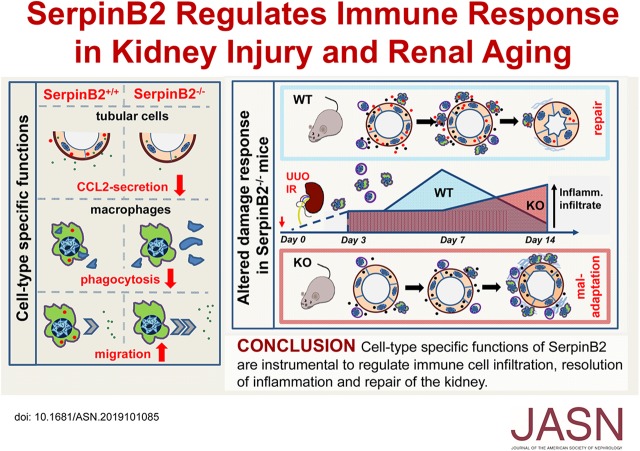
Cultured senescent tubular cells, kidneys of aged mice, and renal stress models exhibited upregulation of SerpinB2 expression. Functionally, lack of SerpinB2 in aged knockout mice had no effect on the magnitude of senescence markers but associated with enhanced kidney damage and fibrosis. In stress models, inflammatory cell infiltration was initially lower in knockout mice but later increased, leading to an accumulation of significantly more macrophages. SerpinB2 knockout tubular cells showed significantly reduced expression of the chemokine CCL2. Macrophages from knockout mice exhibited reduced phagocytosis and enhanced migration. Macrophage depletion and bone marrow transplantation experiments validated the functional relevance of these cell type-specific functions of SerpinB2.
SerpinB2 influences tubule-macrophage crosstalk by supporting tubular CCL2 expression and regulating macrophage phagocytosis and migration. In mice, SerpinB2 expression seems to be needed for coordination and timely resolution of inflammation, successful repair, and kidney homeostasis during aging. Implications of SerpinB2 in human kidney disease deserve further exploration.
丝氨酸蛋白酶抑制剂 B2(SerpinB2)是炎症过程的调节因子,其表达已在巨噬细胞激活和细胞衰老的背景下得到描述。鉴于这些过程的机制相互作用并能影响肾脏疾病,SerpinB2 可能在肾脏衰老、损伤和修复中发挥作用似乎是合理的。
我们使 SerpinB2 敲除小鼠发生缺血再灌注损伤或单侧输尿管梗阻。我们进行吞噬细胞耗竭以研究 SerpinB2 的作用超出巨噬细胞的影响,并将敲除小鼠的骨髓移植到野生型小鼠中,以剖析细胞类型依赖性效应。我们使用 SerpinB2 敲除和野生型小鼠的原代肾小管细胞和巨噬细胞进行功能研究和转录谱分析。
培养的衰老肾小管细胞、老年小鼠肾脏和肾脏应激模型均表现出 SerpinB2 表达上调。功能上,老年敲除小鼠缺乏 SerpinB2 对衰老标志物的幅度没有影响,但与增强的肾脏损伤和纤维化相关。在应激模型中,敲除小鼠的炎症细胞浸润最初较低,但后来增加,导致显著更多的巨噬细胞积累。SerpinB2 敲除的肾小管细胞表现出趋化因子 CCL2 的表达显著降低。敲除小鼠的巨噬细胞表现出吞噬作用降低和迁移增强。巨噬细胞耗竭和骨髓移植实验验证了 SerpinB2 的这些细胞类型特异性功能的功能相关性。
SerpinB2 通过支持肾小管 CCL2 表达和调节巨噬细胞吞噬作用和迁移来影响肾小管-巨噬细胞串扰。在小鼠中,SerpinB2 表达似乎需要协调和及时解决炎症、成功修复和衰老过程中的肾脏内稳态。SerpinB2 在人类肾脏疾病中的意义值得进一步探索。