Kwon Young Suk, Baek Moon Seong
Department of Anaesthesiology and Pain Medicine, College of Medicine, Hallym University, Chuncheon Sacred Heart Hospital, Chuncheon 24253, Korea.
Division of Pulmonary, Allergy and Critical Care Medicine, Hallym University Dongtan Sacred Heart Hospital, Hwaseong-si 18450, Korea.
J Clin Med. 2020 Mar 23;9(3):875. doi: 10.3390/jcm9030875.
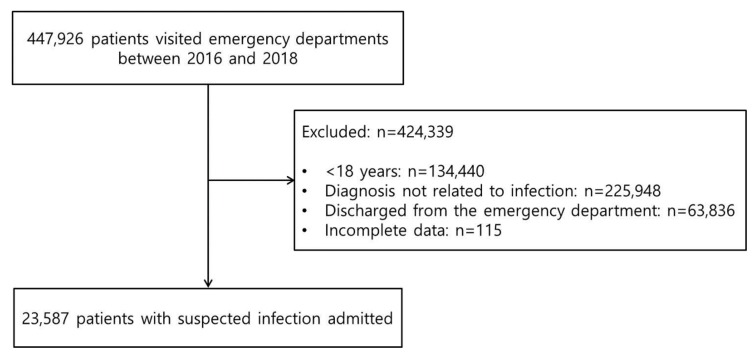
The quick sepsis-related organ failure assessment (qSOFA) score has been introduced to predict the likelihood of organ dysfunction in patients with suspected infection. We hypothesized that machine-learning models using qSOFA variables for predicting three-day mortality would provide better accuracy than the qSOFA score in the emergency department (ED). Between January 2016 and December 2018, the medical records of patients aged over 18 years with suspected infection were retrospectively obtained from four EDs in Korea. Data from three hospitals ( = 19,353) were used as training-validation datasets and data from one ( = 4234) as the test dataset. Machine-learning algorithms including extreme gradient boosting, light gradient boosting machine, and random forest were used. We assessed the prediction ability of machine-learning models using the area under the receiver operating characteristic (AUROC) curve, and DeLong's test was used to compare AUROCs between the qSOFA scores and qSOFA-based machine-learning models. A total of 447,926 patients visited EDs during the study period. We analyzed 23,587 patients with suspected infection who were admitted to the EDs. The median age of the patients was 63 years (interquartile range: 43-78 years) and in-hospital mortality was 4.0% ( = 941). For predicting three-day mortality among patients with suspected infection in the ED, the AUROC of the qSOFA-based machine-learning model (0.86 [95% CI 0.85-0.87]) for three -day mortality was higher than that of the qSOFA scores (0.78 [95% CI 0.77-0.79], < 0.001). For predicting three-day mortality in patients with suspected infection in the ED, the qSOFA-based machine-learning model was found to be superior to the conventional qSOFA scores.
快速脓毒症相关器官功能衰竭评估(qSOFA)评分已被用于预测疑似感染患者发生器官功能障碍的可能性。我们假设,在急诊科(ED)使用qSOFA变量的机器学习模型预测三日死亡率的准确性会高于qSOFA评分。2016年1月至2018年12月期间,我们回顾性获取了韩国四家急诊科18岁以上疑似感染患者的病历。来自三家医院的数据(n = 19353)用作训练-验证数据集,来自一家医院的数据(n = 4234)用作测试数据集。使用了包括极端梯度提升、轻梯度提升机和随机森林在内的机器学习算法。我们使用受试者操作特征(AUROC)曲线下面积评估机器学习模型的预测能力,并使用德龙检验比较qSOFA评分和基于qSOFA的机器学习模型之间的AUROC。研究期间共有447926名患者前往急诊科就诊。我们分析了23587名入住急诊科的疑似感染患者。患者的中位年龄为63岁(四分位间距:43 - 78岁),住院死亡率为4.0%(n = 941)。对于预测急诊科疑似感染患者的三日死亡率,基于qSOFA的机器学习模型预测三日死亡率的AUROC(0.86 [95% CI 0.85 - 0.87])高于qSOFA评分(0.78 [95% CI 0.77 - 0.79],P < 0.001)。对于预测急诊科疑似感染患者的三日死亡率,发现基于qSOFA的机器学习模型优于传统的qSOFA评分。