Department of Applied Physics and Applied Mathematics, Columbia University, New York, NY, USA.
Atmospheric, Oceanic and Planetary Physics, Department of Physics, University of Oxford, Oxford, UK.
Nat Commun. 2020 Mar 24;11(1):1540. doi: 10.1038/s41467-020-15285-x.
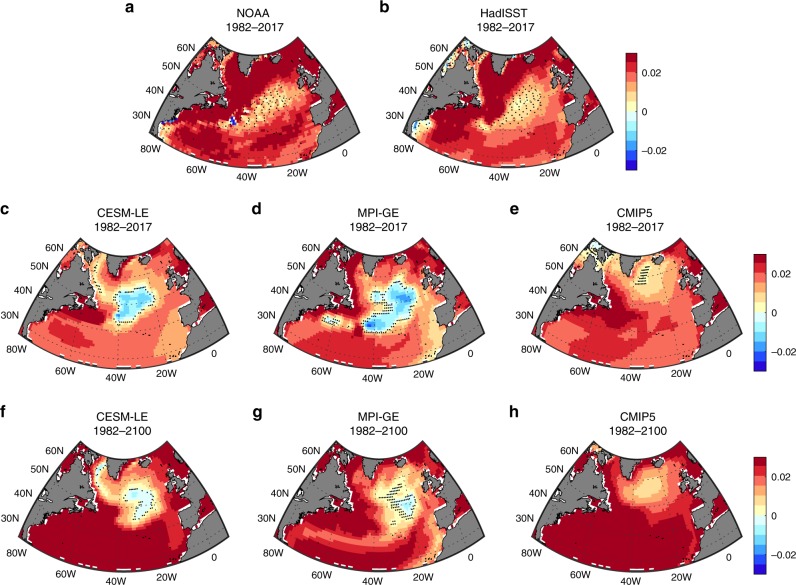
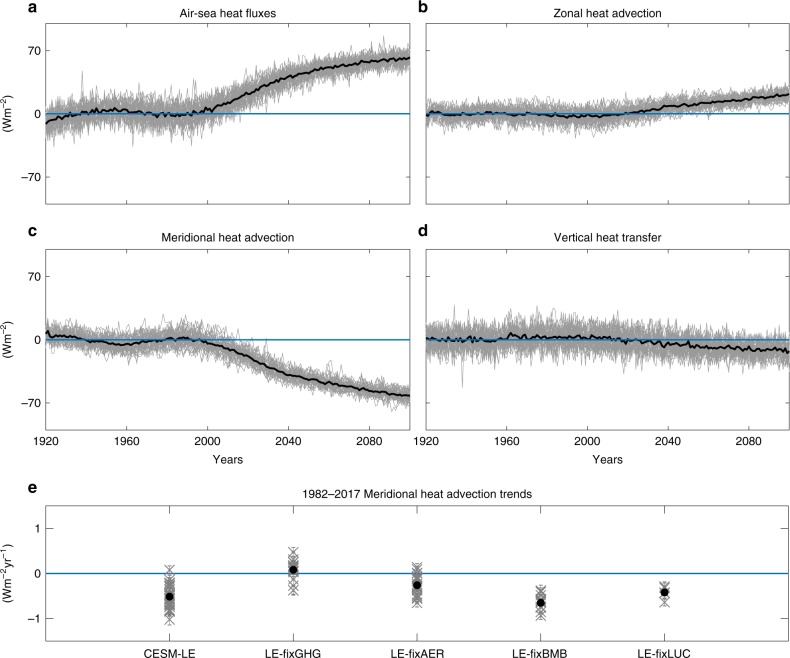
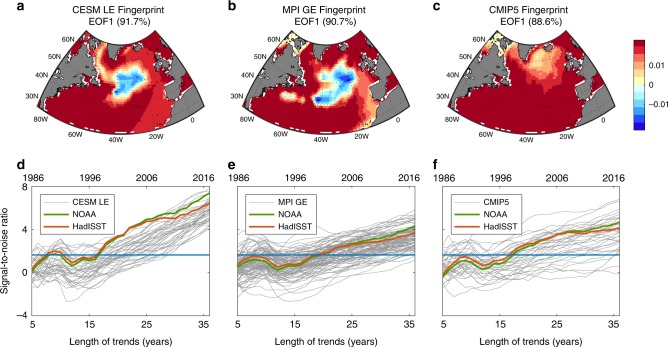
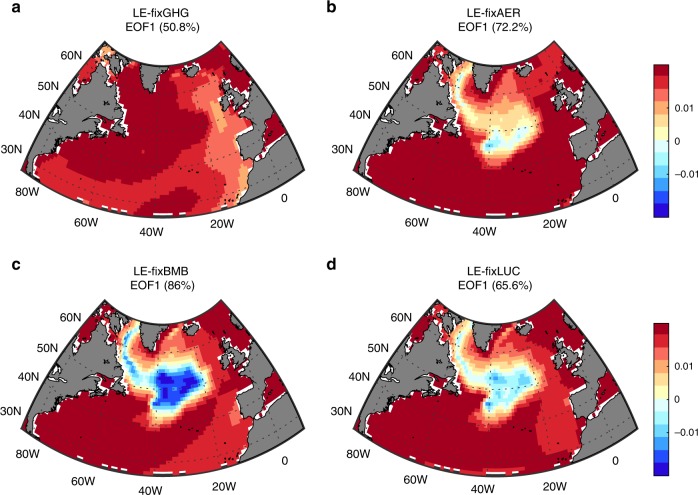
North Atlantic sea surface temperatures have large climate impacts affecting the weather of the Northern Hemisphere. In addition to a substantial warming over much of the North Atlantic, caused by increasing greenhouse gases over the 21st century, climate projections show a surprising region of considerable future cooling at midlatitudes, referred to as the North Atlantic warming hole. A similar pattern of surface temperature trends has been observed in recent decades, but it remains unclear whether this pattern is of anthropogenic origin or a simple manifestation of internal climate variability. Here, analyzing state-of-the-art climate models and observations, we show that the recent North Atlantic warming hole is of anthropogenic origin. Our analysis reveals that the anthropogenic signal has only recently emerged from the internal climate variability, and can be attributed to greenhouse gas emissions. We further show that a declining northward oceanic heat flux in recent decades, which is linked to this surface temperature pattern, is also of anthropogenic origin.
北大西洋海表温度对北半球的天气具有重要的气候影响。除了由于 21 世纪温室气体增加而导致的北大西洋大部分地区显著变暖之外,气候预测还显示中纬度地区未来会出现一个令人惊讶的相当大的冷却区域,被称为北大西洋暖池空洞。在最近几十年中,已经观察到类似的表面温度趋势模式,但尚不清楚这种模式是人为引起的还是内部气候变率的简单表现。在这里,通过分析最先进的气候模型和观测结果,我们表明,最近的北大西洋暖池空洞是人为引起的。我们的分析表明,人为信号最近才从内部气候变率中显现出来,并且可以归因于温室气体排放。我们还表明,最近几十年中与这种表面温度模式相关的北向海洋热通量的减少也是人为引起的。