Lam Angie Ho Yan, Leung Sau Fong, Lin Jessie Jingxia, Chien Wai Tong
School of Nursing, The University of Hong Kong, Hong Kong.
School of Nursing, The Hong Kong Polytechnic University, Hong Kong.
Neuropsychiatr Dis Treat. 2020 Mar 12;16:729-747. doi: 10.2147/NDT.S231877. eCollection 2020.
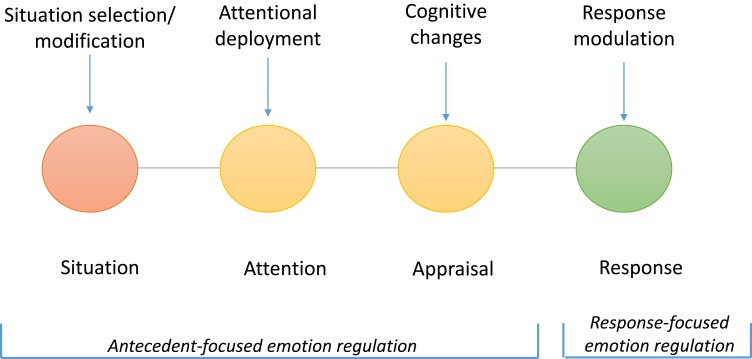
Emotion dysregulation has emerged as a transdiagnostic factor that potentially exacerbates the risk of early-onset, maintenance, and relapse of psychosis. Mindfulness is described as the awareness that emerges from paying attention to the present moment without judgment. It gently pulls the mind out of the negative emotions induced by the disparity between expectation and reality by focusing on the present moment, instead of worrying about the future or regretting the past. However, only a few research has ever focused on the efficacy of using a mindfulness-based intervention to improve emotion regulation in schizophrenia spectrum disorders.
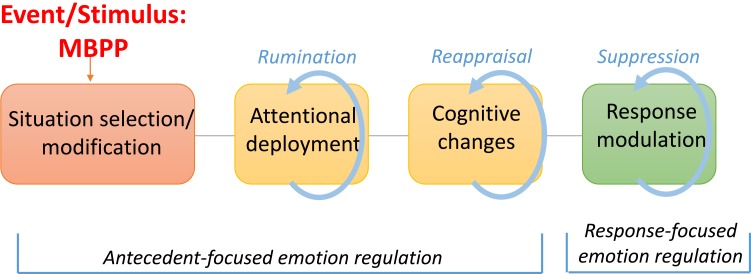
The purpose of this study was to examine the effectiveness of a Mindfulness-Based Psychoeducation Programme (MBPP) on the emotion regulation of individuals with schizophrenia, in particular, to access emotion regulation strategies. The objective of this study was to find out whether MBPP is feasible for improving emotion regulation strategies, in terms of rumination, cognitive reappraisal, and expressive suppression, with a sustainable effect at a three-month follow-up.
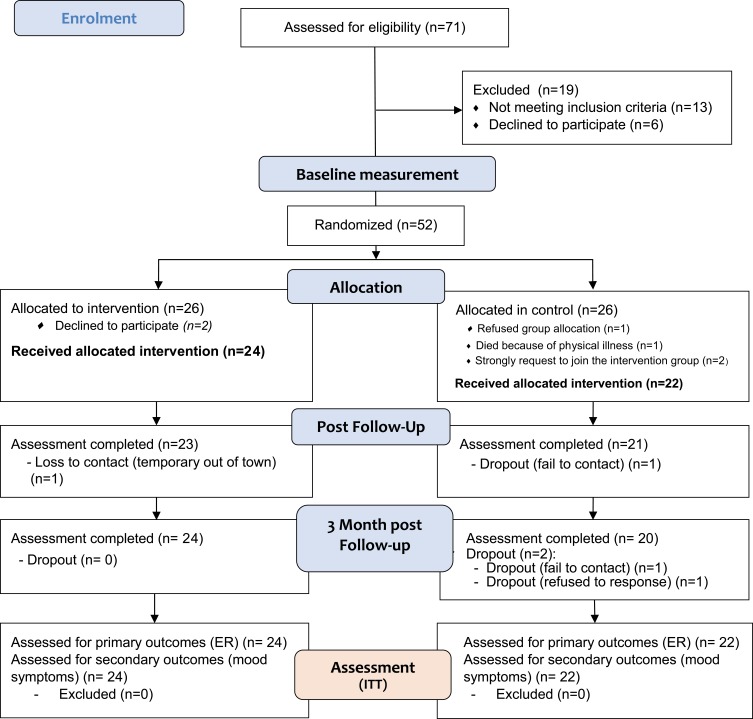
A single-blinded pilot randomised controlled trial with repeated-measures designs was adopted. Forty-six participants diagnosed with schizophrenia and its subtypes were randomised in either the 8-week mindfulness-based psychoeducation programme or treatment-as-usual (control) group.
The results of the Generalised Estimating Equations test indicated that the MBPP group showed a significant improvement in reappraisal at a three-month follow-up (β = -6.59, Wald's =4.55, p=0.033), and a significant reduction in rumination across time. However, the Generalised Estimating Equations indicated no significant difference in rumination and expressive suppression in the MBPP group. Two participants reported having unwanted experiences, including feelings of terror and distress during the mindfulness practice.
The MBPP appeared to be effective for improving emotion regulation, which will contribute to future large-scale RCT to confirm the treatment effects in more diverse groups of schizophrenic patients.
情绪调节障碍已成为一种跨诊断因素,可能会增加精神病早发、维持及复发的风险。正念被描述为通过不加评判地关注当下而产生的一种觉知。它通过聚焦当下,而非担忧未来或悔恨过去,将思维从期望与现实的差距所引发的负面情绪中轻轻拉出来。然而,仅有少数研究关注基于正念的干预措施对改善精神分裂症谱系障碍患者情绪调节的疗效。
本研究旨在检验基于正念的心理教育项目(MBPP)对精神分裂症患者情绪调节的有效性,尤其是探究情绪调节策略。本研究的目的是确定MBPP在改善反刍、认知重评和表达抑制等情绪调节策略方面是否可行,并在三个月的随访中产生持续效果。
采用单盲试点随机对照试验及重复测量设计。46名被诊断为精神分裂症及其亚型的参与者被随机分为8周的基于正念的心理教育项目组或常规治疗(对照组)。
广义估计方程检验结果表明,MBPP组在三个月随访时重评方面有显著改善(β = -6.59,Wald值 = 4.55,p = 0.033),且反刍在整个时间段内显著减少。然而,广义估计方程表明MBPP组在反刍和表达抑制方面无显著差异。两名参与者报告在正念练习过程中出现了不良体验,包括恐惧和痛苦的感觉。
MBPP似乎对改善情绪调节有效,这将有助于未来进行大规模随机对照试验,以在更多样化的精神分裂症患者群体中确认治疗效果。