Tomaselli Gianpaolo, Buttigieg Sandra C, Rosano Aldo, Cassar Maria, Grima George
Department of Health Services Management, Faculty of Health Sciences, University of Malta, Msida, Malta.
Italian National Agency for Regional Health Services (AGENAS), Rome, Italy.
Front Public Health. 2020 Mar 6;8:44. doi: 10.3389/fpubh.2020.00044. eCollection 2020.
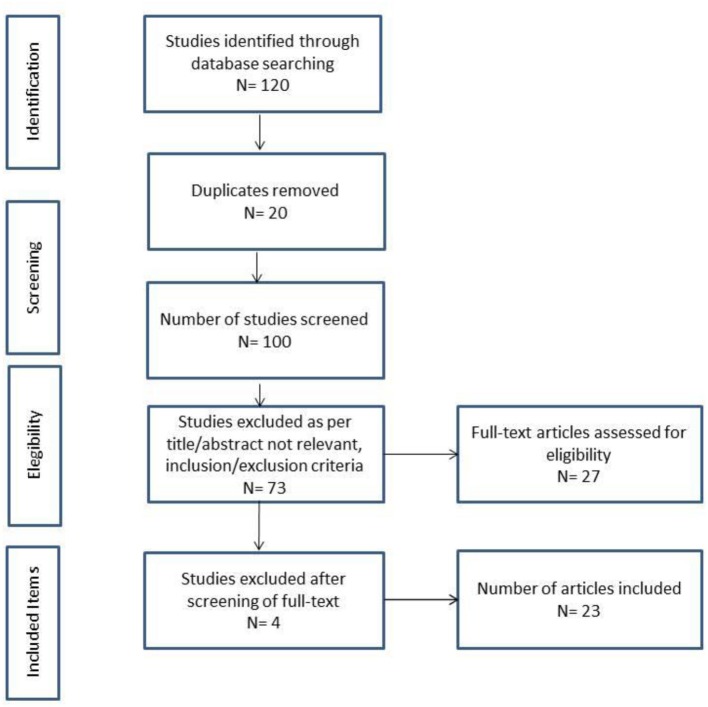
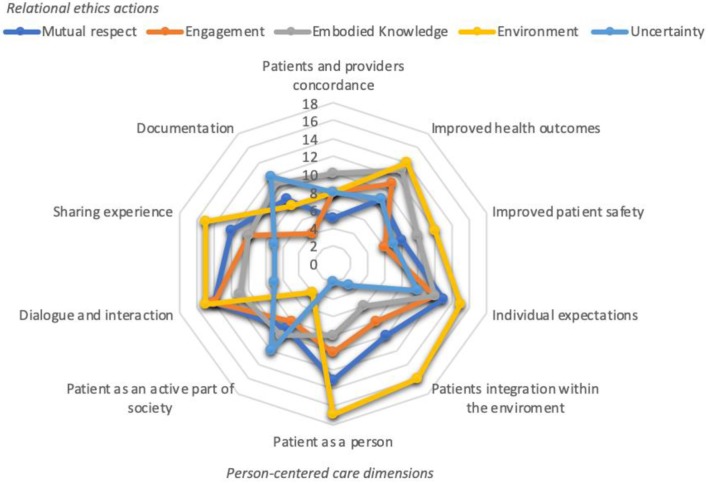
The aim of this scoping review is to explore whether or not person-centered care (PCC), in its quest to deliver high quality and safe health care, has a relational-ethics perspective. To do so, we first need to relate the extant literature pertaining to PCC and relational ethics. To this extent, the specific features that define PCC and relational ethics were identified. PCC dimensions include: patient and provider concordance, improved health outcomes, improved patient safety, individual expectations, patients' integration within the environment, patient as a person, patient as an active part of society, dialogue and interaction, sharing experience, and documentation of patient's (person's) narrative. Relational ethics framework includes the following actions: mutual respect, engagement, embodied knowledge, environment, and uncertainty. Data were retrieved through multiple keywords search on PubMed, Medline, and Scopus. Inclusion/exclusion criteria were set, and these were based on year of publication (2008-2018), language, paper focus, research method and document types. A total of 23 articles ( = 23) were selected and reviewed. Content analysis was conducted in order to identify and compare the main features of PCC and relational ethics. The most important relational ethics action referred to in conjunction with PCC features is environment (referred to as person's integration within a social environment/community). This is followed by mutual respect, engagement and embodied knowledge. These were the salient relational ethics actions both directly and indirectly linked to PCC. Uncertainty was the less recurrent relational ethical action mentioned. This paper revealed that while PCC features embrace most of the relational ethics approaches, these are not exploited in their entirety and therefore PCC emerges as a unique ethical stance in healthcare. PCC's ethical approach goes beyond what is explained within provider-patient relational ethics and emphasizes that the patient is an active person and a partner in care with capabilities and resources. This distinction enables us to explain the paradigm shift from "patient-centered" to "person-centered" care. The healthcare provider partnership and co-creation of the healthcare plan contributes to the delivery of high quality, safe and cost-contained healthcare.
本范围综述的目的是探讨以患者为中心的护理(PCC)在追求提供高质量和安全的医疗保健过程中是否具有关系伦理视角。为此,我们首先需要关联与PCC和关系伦理相关的现有文献。在此范围内,确定了定义PCC和关系伦理的具体特征。PCC维度包括:患者与提供者的一致性、改善的健康结果、提高的患者安全性、个人期望、患者在环境中的融入、作为个体的患者、作为社会积极成员的患者、对话与互动、经验分享以及患者(个体)叙述的记录。关系伦理框架包括以下行动:相互尊重、参与、具身知识、环境和不确定性。通过在PubMed、Medline和Scopus上进行多个关键词搜索来检索数据。设定了纳入/排除标准,这些标准基于出版年份(2008 - 2018年)、语言、论文重点、研究方法和文献类型。总共选择并审查了23篇文章(n = 23)。进行了内容分析,以识别和比较PCC和关系伦理的主要特征。与PCC特征一起提及的最重要的关系伦理行动是环境(称为个体在社会环境/社区中的融入)。其次是相互尊重、参与和具身知识。这些是与PCC直接和间接相关的显著关系伦理行动。不确定性是提及较少的关系伦理行动。本文表明,虽然PCC特征包含了大多数关系伦理方法,但这些方法并未得到充分利用,因此PCC在医疗保健中呈现为一种独特的伦理立场。PCC的伦理方法超越了医患关系伦理中所解释的内容,并强调患者是护理中的积极个体和伙伴,具有能力和资源。这种区别使我们能够解释从“以患者为中心”到“以个体为中心”护理的范式转变。医疗保健提供者的伙伴关系以及医疗保健计划的共同制定有助于提供高质量、安全且成本可控的医疗保健。