• 文献检索
  • 文档翻译
  • 深度研究
  • 学术资讯
  • Suppr Zotero 插件Zotero 插件
  • 邀请有礼
  • 套餐&价格
  • 历史记录
应用&插件
Suppr Zotero 插件Zotero 插件浏览器插件Mac 客户端Windows 客户端微信小程序
定价
高级版会员购买积分包购买API积分包
服务
文献检索文档翻译深度研究API 文档MCP 服务
关于我们
关于 Suppr公司介绍联系我们用户协议隐私条款
关注我们

Suppr 超能文献

核心技术专利:CN118964589B侵权必究
粤ICP备2023148730 号-1Suppr @ 2026

文献检索

告别复杂PubMed语法,用中文像聊天一样搜索,搜遍4000万医学文献。AI智能推荐,让科研检索更轻松。

立即免费搜索

文件翻译

保留排版,准确专业,支持PDF/Word/PPT等文件格式,支持 12+语言互译。

免费翻译文档

深度研究

AI帮你快速写综述,25分钟生成高质量综述,智能提取关键信息,辅助科研写作。

立即免费体验

老年人对三种与认知能力相关的游戏体验的反思性和反射性应激反应:混合方法交叉研究

Reflective and Reflexive Stress Responses of Older Adults to Three Gaming Experiences In Relation to Their Cognitive Abilities: Mixed Methods Crossover Study.

作者信息

Khalili-Mahani Najmeh, Assadi Atousa, Li Kate, Mirgholami Mahsa, Rivard Marie-Eve, Benali Habib, Sawchuk Kim, De Schutter Bob

机构信息

PERFORM Centre, Concordia University, Montreal, QC, Canada.

McGill Centre for Integrative Neuroscience, Montreal Neurological Institute, McGill University, Montreal, QC, Canada.

出版信息

JMIR Ment Health. 2020 Mar 26;7(3):e12388. doi: 10.2196/12388.

DOI:10.2196/12388
PMID:32213474
原文链接:https://pmc.ncbi.nlm.nih.gov/articles/PMC7146255/
Abstract

BACKGROUND

The gamification of digital health provisions for older adults (eg, for rehabilitation) is a growing trend; however, many older adults are not familiar with digital games. This lack of experience could cause stress and thus impede participants' motivations to adopt these technologies.

OBJECTIVE

This crossover longitudinal multifactorial study aimed to examine the interactions between game difficulty, appraisal, cognitive ability, and physiological and cognitive responses that indicate game stress using the Affective Game Planning for Health Applications framework.

METHODS

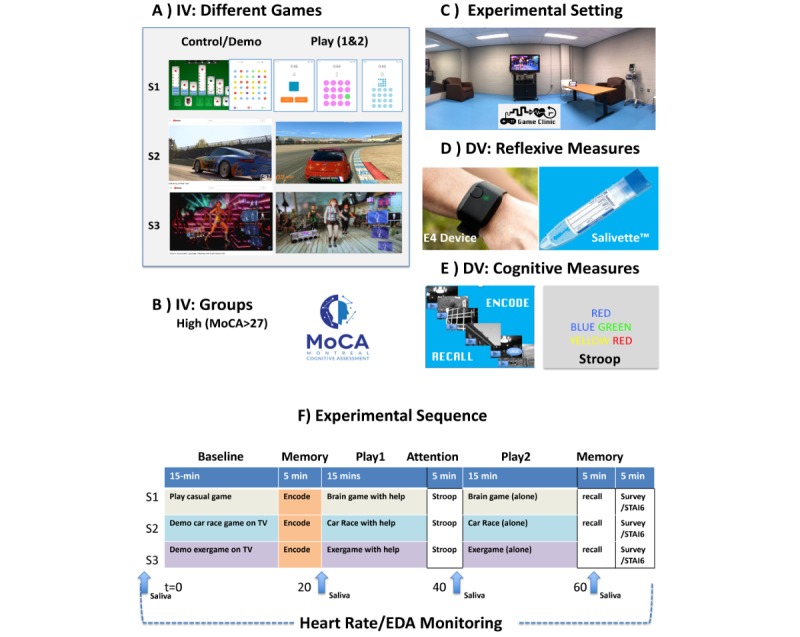
A total of 18 volunteers (mean age 71 years, SD 4.5; 12 women) completed a three-session study to evaluate different genres of games in increasing order of difficulty (S-BrainGame, S-CarRace, and S-Exergame). Each session included an identical sequence of activities (t-Baseline, t-Picture encode, t-Play, t-Stroop test, t-Play, and t-Picture recall), a repeated sampling of salivary cortisol, and time-tagged ambulatory data from a wrist-worn device. Generalized estimating equations were used to investigate the effect of session×activity or session×activity×cognitive ability on physiology and cognitive performance. Scores derived from the Montreal Cognitive Assessment (MoCA) test were used to define cognitive ability (MoCA-high: MoCA>27, n=11/18). Kruskal-Wallis tests were used to test session or session×group effects on the scores of the postgame appraisal questionnaire.

RESULTS

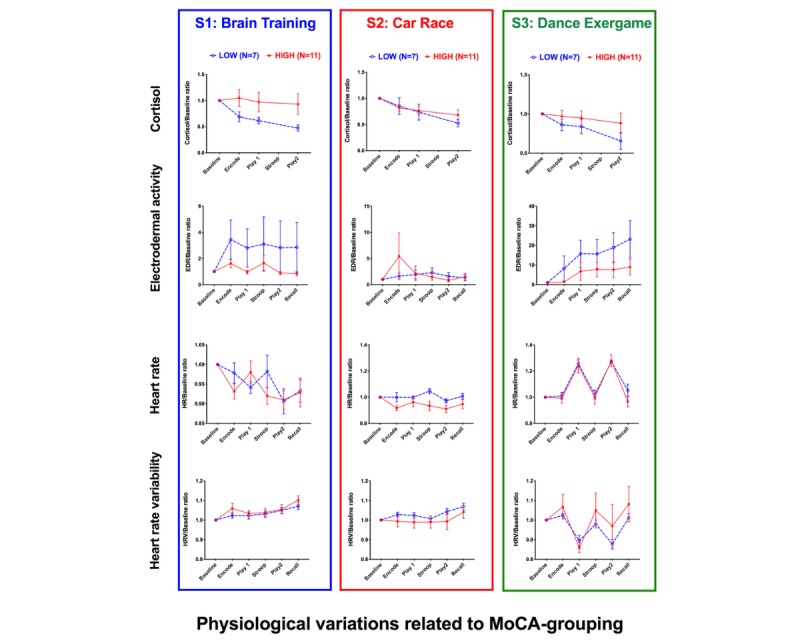
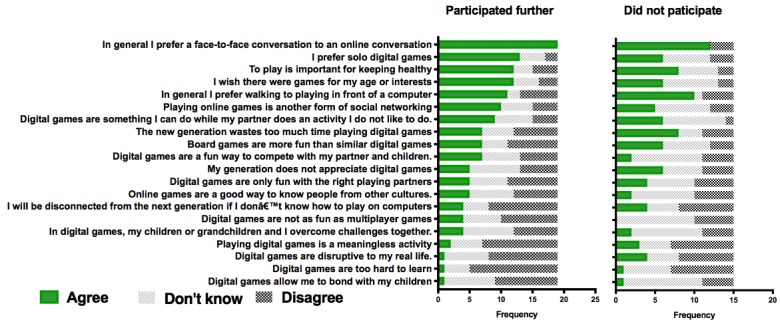
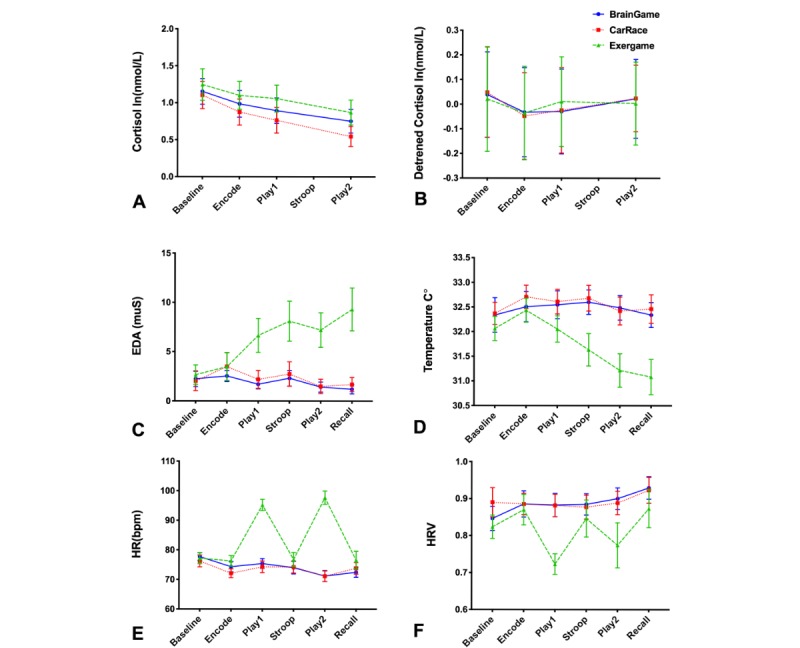
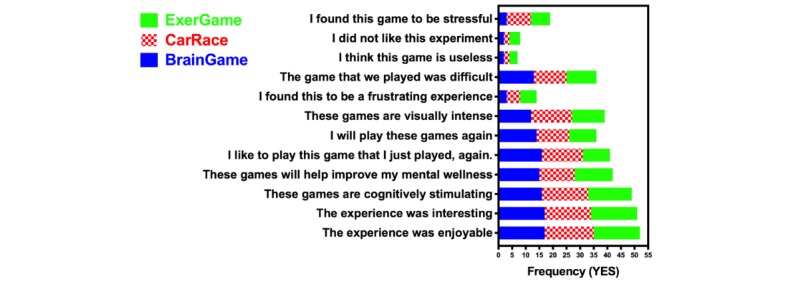
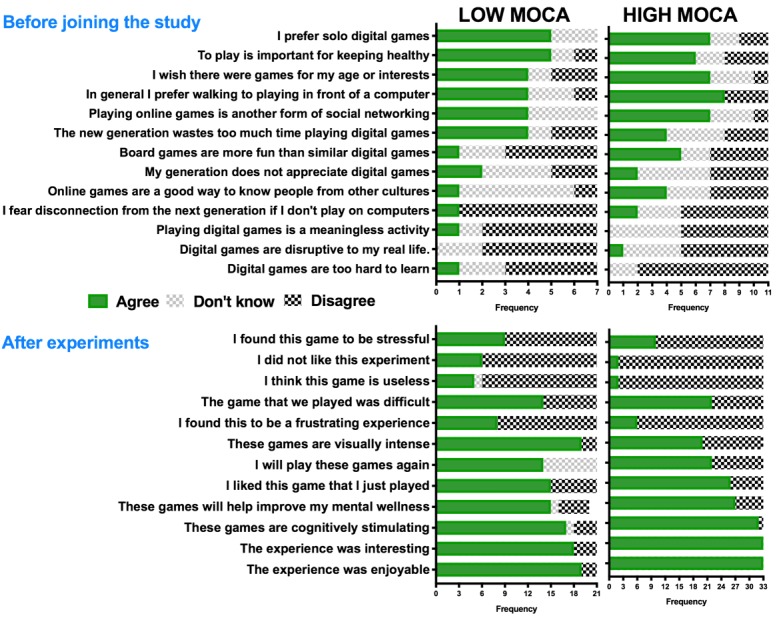
Session×activity effects were significant on all ambulatory measures (χ>20; P<.001) other than cortisol (P=.37). Compared with S and S, S was associated with approximately 10 bpm higher heart rate (P<.001) and approximately 5 muS higher electrodermal activity (P<.001), which were both independent of the movement caused by the exergame. Compared with S, we measured a moderate but statistically significant drop in the rate of hits in immediate recall and rate of delayed recall in S. The low-MoCA group did not differ from the high-MoCA group in general characteristics (age, general self-efficacy, and perceived stress) but was more likely to agree with statements such as digital games are too hard to learn. In addition, the low-MoCA group was more likely to dislike the gaming experience and find it useless, uninteresting, and visually more intense (χ>4; P<.04). Group differences in ambulatory signals did not reach statistical significance; however, the rate of cortisol decline with respect to the baseline was significantly larger in the low-MoCA group.

CONCLUSIONS

Our results show that the experience of playing digital games was not stressful for our participants. Comparatively, the neurophysiological effects of exergame were more pronounced in the low-MoCA group, suggesting greater potential of this genre of games for cognitive and physical stimulation by gamified interventions; however, the need for enjoyment of this type of challenging game must be addressed.

摘要

背景

针对老年人的数字健康服务(如康复治疗)游戏化是一个日益增长的趋势;然而,许多老年人并不熟悉数字游戏。这种经验的缺乏可能会导致压力,从而阻碍参与者采用这些技术的积极性。

目的

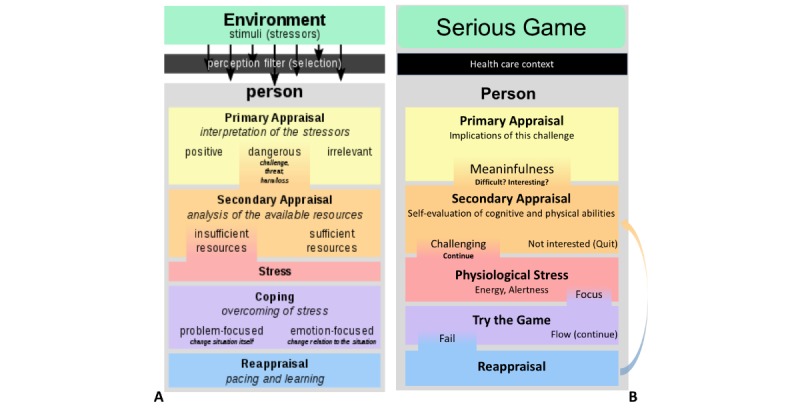
本交叉纵向多因素研究旨在使用健康应用情感游戏规划框架,研究游戏难度、评价、认知能力以及表明游戏压力的生理和认知反应之间的相互作用。

方法

共有18名志愿者(平均年龄71岁,标准差4.5;12名女性)完成了一项为期三阶段的研究,以按难度递增顺序评估不同类型的游戏(S-脑游戏、S-赛车游戏和S-健身游戏)。每个阶段都包括相同的活动顺序(t-基线、t-图片编码、t-游戏、t-斯特鲁普测试、t-游戏和t-图片回忆)、唾液皮质醇的重复采样以及来自腕戴设备的带时间标记的动态数据。使用广义估计方程来研究阶段×活动或阶段×活动×认知能力对生理和认知表现的影响。蒙特利尔认知评估(MoCA)测试得出的分数用于定义认知能力(MoCA高:MoCA>27,n = 11/18)。使用Kruskal-Wallis检验来测试阶段或阶段×组对游戏后评价问卷分数的影响。

结果

除皮质醇外(P = 0.37),阶段×活动效应在所有动态测量指标上均具有显著性(χ>20;P < 0.001)。与S和S相比,S与心率高出约10次/分钟(P < 0.001)以及皮肤电活动高出约5微西门子(P < 0.001)相关,这两者均与健身游戏引起的运动无关。与S相比,我们在S中测量到即时回忆命中率和延迟回忆率有适度但具有统计学显著性的下降。低MoCA组在一般特征(年龄、一般自我效能感和感知压力)方面与高MoCA组没有差异,但更有可能同意诸如数字游戏太难学之类的说法。此外,低MoCA组更有可能不喜欢游戏体验,并认为其无用、无趣且视觉上更刺激(χ>4;P < 0.04)。动态信号中的组间差异未达到统计学显著性;然而,低MoCA组中皮质醇相对于基线的下降速率明显更大。

结论

我们的结果表明,玩数字游戏的体验对我们的参与者来说并不具有压力。相比之下,健身游戏的神经生理效应在低MoCA组中更为明显,这表明这种类型的游戏通过游戏化干预在认知和身体刺激方面具有更大的潜力;然而,必须解决对这种具有挑战性的游戏的喜爱需求。
https://cdn.ncbi.nlm.nih.gov/pmc/blobs/fa3a/7146255/ddf55542b852/mental_v7i3e12388_fig8.jpg
https://cdn.ncbi.nlm.nih.gov/pmc/blobs/fa3a/7146255/e3ffe552f92f/mental_v7i3e12388_fig1.jpg
https://cdn.ncbi.nlm.nih.gov/pmc/blobs/fa3a/7146255/b7028bc8dabe/mental_v7i3e12388_fig2.jpg
https://cdn.ncbi.nlm.nih.gov/pmc/blobs/fa3a/7146255/75082438c471/mental_v7i3e12388_fig3.jpg
https://cdn.ncbi.nlm.nih.gov/pmc/blobs/fa3a/7146255/9c8fe5163d01/mental_v7i3e12388_fig4.jpg
https://cdn.ncbi.nlm.nih.gov/pmc/blobs/fa3a/7146255/5002b4e75763/mental_v7i3e12388_fig5.jpg
https://cdn.ncbi.nlm.nih.gov/pmc/blobs/fa3a/7146255/7c55d98e5ef7/mental_v7i3e12388_fig6.jpg
https://cdn.ncbi.nlm.nih.gov/pmc/blobs/fa3a/7146255/4e301acf2dbb/mental_v7i3e12388_fig7.jpg
https://cdn.ncbi.nlm.nih.gov/pmc/blobs/fa3a/7146255/ddf55542b852/mental_v7i3e12388_fig8.jpg
https://cdn.ncbi.nlm.nih.gov/pmc/blobs/fa3a/7146255/e3ffe552f92f/mental_v7i3e12388_fig1.jpg
https://cdn.ncbi.nlm.nih.gov/pmc/blobs/fa3a/7146255/b7028bc8dabe/mental_v7i3e12388_fig2.jpg
https://cdn.ncbi.nlm.nih.gov/pmc/blobs/fa3a/7146255/75082438c471/mental_v7i3e12388_fig3.jpg
https://cdn.ncbi.nlm.nih.gov/pmc/blobs/fa3a/7146255/9c8fe5163d01/mental_v7i3e12388_fig4.jpg
https://cdn.ncbi.nlm.nih.gov/pmc/blobs/fa3a/7146255/5002b4e75763/mental_v7i3e12388_fig5.jpg
https://cdn.ncbi.nlm.nih.gov/pmc/blobs/fa3a/7146255/7c55d98e5ef7/mental_v7i3e12388_fig6.jpg
https://cdn.ncbi.nlm.nih.gov/pmc/blobs/fa3a/7146255/4e301acf2dbb/mental_v7i3e12388_fig7.jpg
https://cdn.ncbi.nlm.nih.gov/pmc/blobs/fa3a/7146255/ddf55542b852/mental_v7i3e12388_fig8.jpg

相似文献

1
Reflective and Reflexive Stress Responses of Older Adults to Three Gaming Experiences In Relation to Their Cognitive Abilities: Mixed Methods Crossover Study.老年人对三种与认知能力相关的游戏体验的反思性和反射性应激反应:混合方法交叉研究
JMIR Ment Health. 2020 Mar 26;7(3):e12388. doi: 10.2196/12388.
2
What Older People Like to Play: Genre Preferences and Acceptance of Casual Games.老年人喜欢玩的游戏:类型偏好与对休闲游戏的接受度
JMIR Serious Games. 2017 Apr 18;5(2):e8. doi: 10.2196/games.7025.
3
Erratum.勘误
Mult Scler. 2016 Oct;22(12):NP9-NP11. doi: 10.1177/1352458515585718. Epub 2015 Jun 3.
4
Understanding Senior Adults' Needs, Preferences, and Experiences of Commercial Exergames for Health: Usability Study.了解老年人对用于健康的商业健身游戏的需求、偏好和体验:可用性研究。
JMIR Serious Games. 2024 Apr 5;12:e36154. doi: 10.2196/36154.
5
6
Digital Gaming for Improving the Functioning of People With Traumatic Brain Injury: Randomized Clinical Feasibility Study.数字游戏改善创伤性脑损伤患者的功能:随机临床可行性研究。
J Med Internet Res. 2018 Mar 19;20(3):e77. doi: 10.2196/jmir.7618.
7
Past Gaming Experience and Cognition as Selective Predictors of Novel Game Learning Across Different Gaming Genres.过往游戏体验与认知作为跨不同游戏类型新型游戏学习的选择性预测因素
Front Psychol. 2020 May 26;11:786. doi: 10.3389/fpsyg.2020.00786. eCollection 2020.
8
The Potential of Game-Based Digital Biomarkers for Modeling Mental Health.基于游戏的数字生物标志物在心理健康建模中的潜力
JMIR Ment Health. 2019 Apr 23;6(4):e13485. doi: 10.2196/13485.
9
Is experience in multi-genre video game playing accompanied by impulsivity?多类型电子游戏游玩经验是否与冲动性相关?
Acta Psychol (Amst). 2018 Oct;190:78-84. doi: 10.1016/j.actpsy.2018.07.006. Epub 2018 Jul 19.
10
Comparing the Impact of Heart Rate-Based In-Game Adaptations in an Exergame-Based Functional High-Intensity Interval Training on Training Intensity and Experience in Healthy Young Adults.比较基于心率的游戏内适应对健康年轻人进行的基于健身游戏的功能性高强度间歇训练的训练强度和体验的影响。
Front Psychol. 2021 Jun 21;12:572877. doi: 10.3389/fpsyg.2021.572877. eCollection 2021.

引用本文的文献

1
Assessing the Relationship Between Digital Trail Making Test Performance and IT Task Performance: Empirical Study.评估数字连线测试表现与信息技术任务表现之间的关系:实证研究。
JMIR Hum Factors. 2024 Jun 14;11:e49992. doi: 10.2196/49992.
2
Double-Bind of Recruitment of Older Adults Into Studies of Successful Aging via Assistive Information and Communication Technologies: Mapping Review.通过辅助信息通信技术招募老年人参与成功老龄化研究的双重约束:映射综述
JMIR Aging. 2022 Dec 23;5(4):e43564. doi: 10.2196/43564.
3
Toward a digital citizen lab for capturing data about alternative ways of self-managing chronic pain: An attitudinal user study.

本文引用的文献

1
Affective Game Planning for Health Applications: Quantitative Extension of Gerontoludic Design Based on the Appraisal Theory of Stress and Coping.健康应用的情感游戏规划:基于压力与应对评估理论的老年游戏设计的定量扩展
JMIR Serious Games. 2019 Jun 6;7(2):e13303. doi: 10.2196/13303.
2
The Enhanced Interactive Physical and Cognitive Exercise System (iPACES v2.0): Pilot Clinical Trial of an In-Home iPad-Based Neuro-Exergame for Mild Cognitive Impairment (MCI).增强型交互式身体与认知锻炼系统(iPACES v2.0):一项针对轻度认知障碍(MCI)的基于iPad的家庭神经锻炼游戏的试点临床试验。
J Clin Med. 2018 Aug 30;7(9):249. doi: 10.3390/jcm7090249.
3
迈向用于收集关于慢性疼痛自我管理替代方法数据的数字公民实验室:一项态度性用户研究。
Front Rehabil Sci. 2022 Aug 15;3:942822. doi: 10.3389/fresc.2022.942822. eCollection 2022.
4
Depressed Mood Prediction of Elderly People with a Wearable Band.可穿戴手环预测老年人的抑郁情绪。
Sensors (Basel). 2022 May 31;22(11):4174. doi: 10.3390/s22114174.
5
Conceptual Ambiguity Surrounding Gamification and Serious Games in Health Care: Literature Review and Development of Game-Based Intervention Reporting Guidelines (GAMING).概念模糊性围绕游戏化和严肃游戏在医疗保健:文献综述和发展基于游戏的干预措施报告指南(GAMING)。
J Med Internet Res. 2021 Sep 10;23(9):e30390. doi: 10.2196/30390.
6
Effective Gamification of the Stop-Signal Task: Two Controlled Laboratory Experiments.停止信号任务的有效游戏化:两项对照实验室实验
JMIR Serious Games. 2020 Sep 8;8(3):e17810. doi: 10.2196/17810.
7
What Media Helps, What Media Hurts: A Mixed Methods Survey Study of Coping with COVID-19 Using the Media Repertoire Framework and the Appraisal Theory of Stress.何种媒体有益,何种媒体有害:一项运用媒体库框架和应激评估理论应对新冠疫情的混合方法调查研究
J Med Internet Res. 2020 Aug 6;22(8):e20186. doi: 10.2196/20186.
Narrative and active video game in separate and additive effects of physical activity and cognitive function among young adults.
叙事和积极的视频游戏对年轻人身体活动和认知功能的单独和附加影响。
Sci Rep. 2018 Jul 20;8(1):11020. doi: 10.1038/s41598-018-29274-0.
4
The Social Effects of Exergames on Older Adults: Systematic Review and Metric Analysis.健身游戏对老年人的社会影响:系统评价与指标分析
J Med Internet Res. 2018 Jun 28;20(6):e10486. doi: 10.2196/10486.
5
Using a community advisory board to develop a serious game for older adults undergoing treatment for cancer.利用社区咨询委员会为正在接受癌症治疗的老年人开发一款严肃游戏。
Appl Nurs Res. 2018 Feb;39:207-210. doi: 10.1016/j.apnr.2017.11.030. Epub 2017 Nov 21.
6
Exergames Designed for Older Adults: A Pilot Evaluation on Psychosocial Well-Being.专为老年人设计的运动游戏:心理社会健康的初步评估。
Games Health J. 2017 Dec;6(6):371-378. doi: 10.1089/g4h.2017.0072. Epub 2017 Nov 13.
7
Effects of galvanic skin response feedback on user experience in gaze-controlled gaming: A pilot study.皮肤电反应反馈对凝视控制游戏中用户体验的影响:一项初步研究。
Annu Int Conf IEEE Eng Med Biol Soc. 2017 Jul;2017:2458-2461. doi: 10.1109/EMBC.2017.8037354.
8
Gaming Preferences of Aging Generations.老年群体的游戏偏好。
Gerontechnology. 2014;12(3):174-184. doi: 10.4017/gt.2014.12.3.008.00.
9
Recommendations for the Use of Serious Games in Neurodegenerative Disorders: 2016 Delphi Panel.神经退行性疾病中严肃游戏使用的建议:2016年德尔菲小组
Front Psychol. 2017 Jul 25;8:1243. doi: 10.3389/fpsyg.2017.01243. eCollection 2017.
10
The Effect of a Virtual Reality Game Intervention on Balance for Patients with Stroke: A Randomized Controlled Trial.虚拟现实游戏干预对脑卒中患者平衡的影响:一项随机对照试验。
Games Health J. 2017 Oct;6(5):303-311. doi: 10.1089/g4h.2016.0109. Epub 2017 Aug 3.