Greer Meredith, Saha Raj, Gogliettino Alex, Yu Chialin, Zollo-Venecek Kyle
Department of Mathematics, Bates College, Lewiston, Maine 04240, USA.
Department of Geology and Department of Physics and Astronomy, Bates College, Lewiston, Maine 04240, USA.
R Soc Open Sci. 2020 Jan 29;7(1):191187. doi: 10.1098/rsos.191187. eCollection 2020 Jan.
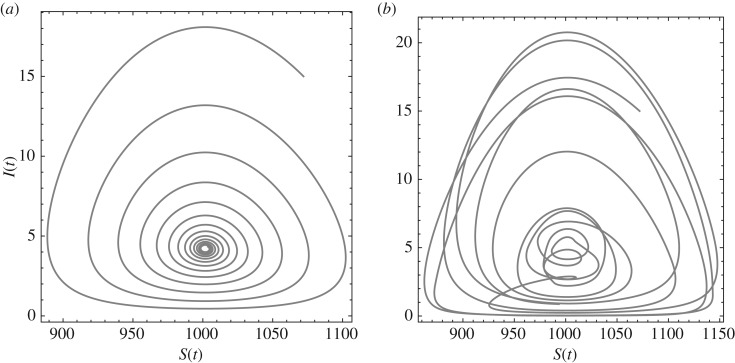
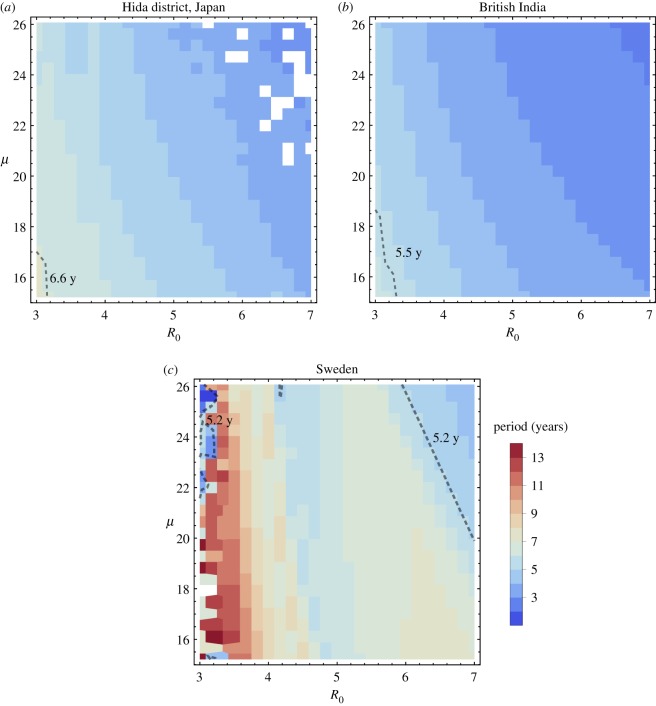
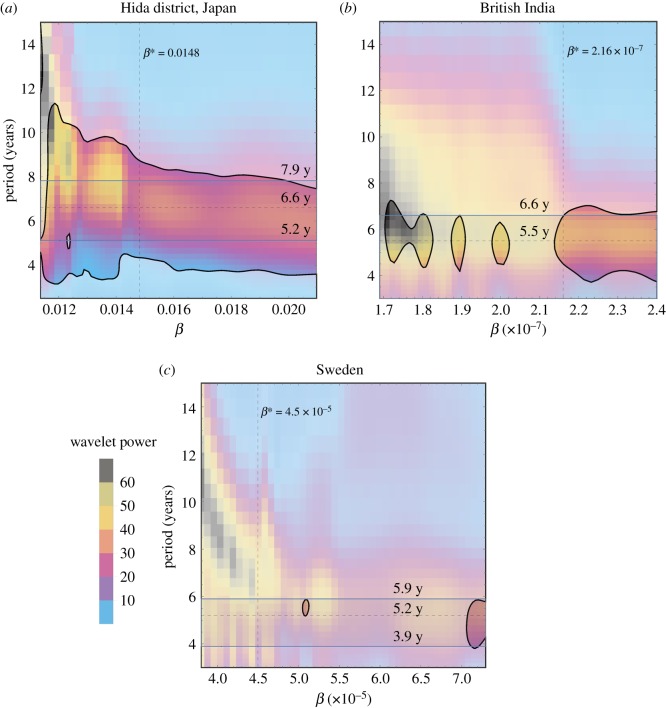
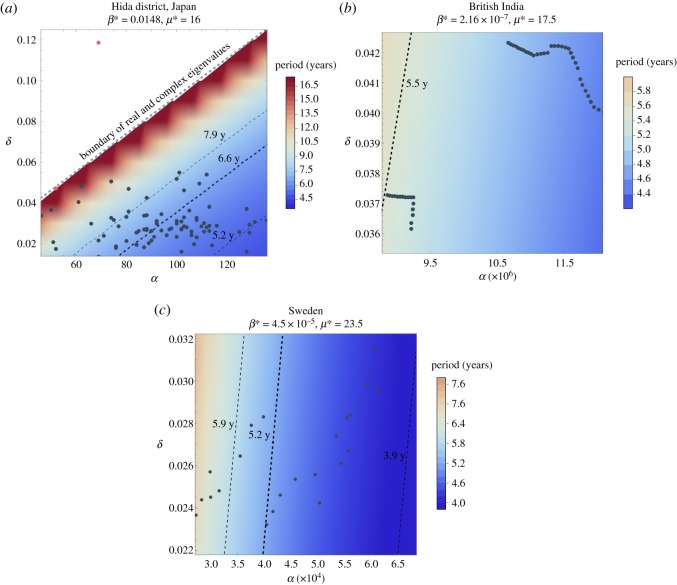
A simple susceptible-infectious-removed epidemic model for smallpox, with birth and death rates based on historical data, produces oscillatory dynamics with remarkably accurate periodicity. Stochastic population data cause oscillations to be sustained rather than damped, and data analysis regarding the oscillations provides insights into the same set of population data. Notably, oscillations arise naturally from the model, instead of from a periodic forcing term or other exogenous mechanism that guarantees oscillation: the model has no such mechanism. These emergent natural oscillations display appropriate periodicity for smallpox, even when the model is applied to different locations and populations. The model and datasets, in turn, offer new observations about disease dynamics and solution trajectories. These results call for renewed attention to relatively simple models, in combination with datasets from real outbreaks.
一个基于历史数据的带有出生率和死亡率的简单天花易感-感染-移除流行病模型,产生了具有显著精确周期性的振荡动态。随机人口数据使振荡得以持续而非衰减,并且对振荡的数据分析为同一组人口数据提供了见解。值得注意的是,振荡是自然地从模型中产生的,而非来自保证振荡的周期性强迫项或其他外部机制:该模型没有这样的机制。即使将该模型应用于不同的地点和人群,这些自然出现的振荡对于天花也显示出适当的周期性。反过来,该模型和数据集提供了关于疾病动态和求解轨迹的新观察结果。这些结果呼吁重新关注相对简单的模型,并结合实际疫情爆发的数据集。