Firmino Paulo Renato Alves, de Sales Jair Paulino, Gonçalves Júnior Jucier, da Silva Taciana Araújo
Center for Science and Technology, Federal University of Cariri, Juazeiro do Norte-CE, Brazil.
Quixadá Catholic University Center, Quixadá-CE, Brazil.
Chaos Solitons Fractals. 2020 Nov;140:110211. doi: 10.1016/j.chaos.2020.110211. Epub 2020 Aug 23.
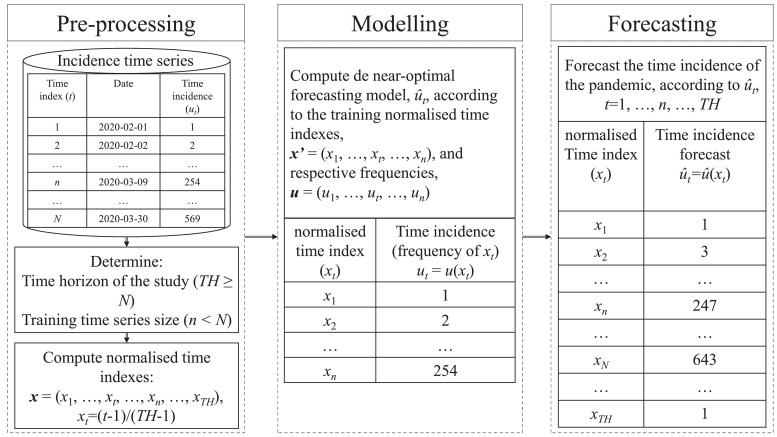
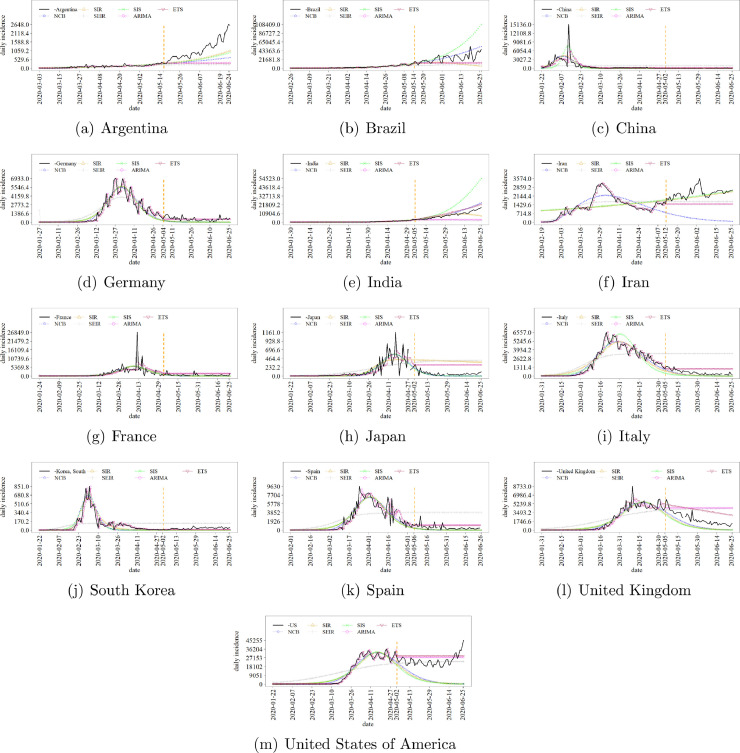
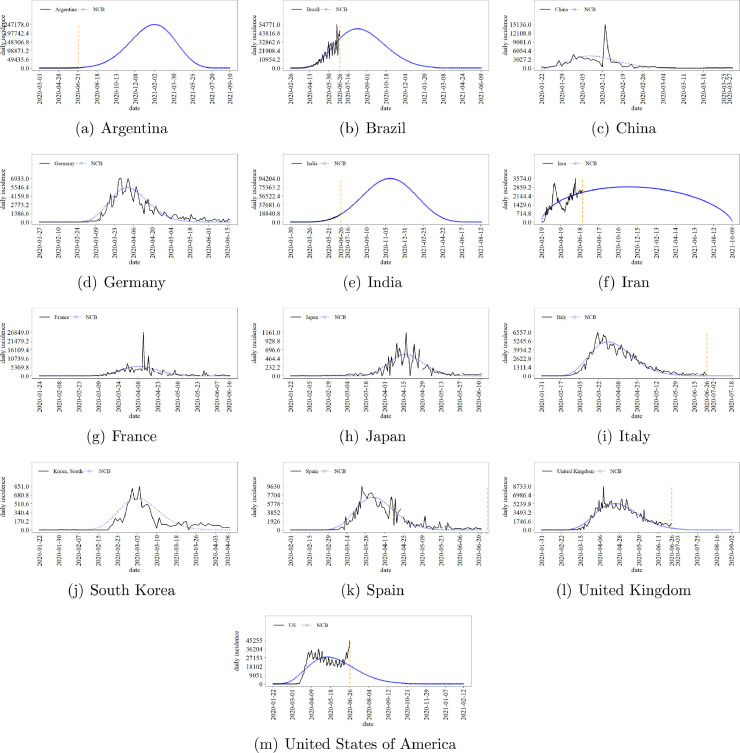
Government, researchers, and health professionals have been challenged to model, forecast, and evaluate pandemics time series (e.g. new coronavirus SARS-CoV-2, COVID-19). The main difficulty is the level of novelty imposed by these phenomena. Information from previous epidemics is only partially relevant. Further, the spread is local-dependent, reflecting a number of social, political, economic, and environmental dynamic factors. The present paper aims to provide a relatively simple way to model, forecast, and evaluate the time incidence of a pandemic. The proposed framework makes use of the non-central beta (NCB) probability density function. Specifically, a probabilistic optimisation algorithm searches for the best NCB model of the pandemic, according to the mean square error metric. The resulting model allows one to infer, among others, the general peak date, the ending date, and the total number of cases as well as to compare the level of difficult imposed by the pandemic among territories. Case studies involving COVID-19 incidence time series from countries around the world suggest the usefulness of the proposed framework in comparison with some of the main epidemic models from the literature (e.g. SIR, SIS, SEIR) and established time series formalisms (e.g. exponential smoothing - ETS, autoregressive integrated moving average - ARIMA).
政府、研究人员和卫生专业人员面临着对大流行时间序列(例如新型冠状病毒SARS-CoV-2、COVID-19)进行建模、预测和评估的挑战。主要困难在于这些现象所带来的新颖程度。以往疫情的信息仅部分相关。此外,疫情传播取决于当地情况,反映了许多社会、政治、经济和环境动态因素。本文旨在提供一种相对简单的方法来对大流行的时间发病率进行建模、预测和评估。所提出的框架利用了非中心贝塔(NCB)概率密度函数。具体而言,一种概率优化算法根据均方误差度量来搜索大流行的最佳NCB模型。所得模型能够让人们推断出一般峰值日期、结束日期和病例总数等,还能比较不同地区大流行带来的困难程度。涉及全球各国COVID-19发病率时间序列的案例研究表明,与文献中的一些主要流行病模型(例如SIR、SIS、SEIR)以及既定的时间序列形式(例如指数平滑 - ETS、自回归积分移动平均 - ARIMA)相比,所提出的框架是有用的。