Department of Materials Science and Engineering, University of California, Irvine, CA, USA.
Department of Mechanical and Aerospace Engineering, University of California, Irvine, CA, USA.
Nat Commun. 2020 Mar 27;11(1):1579. doi: 10.1038/s41467-020-15434-2.
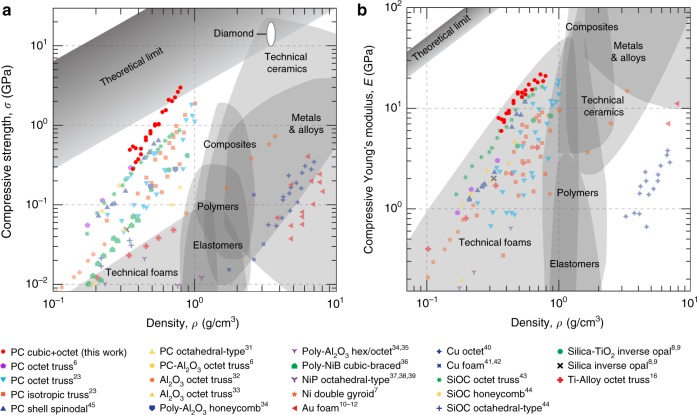
Though beam-based lattices have dominated mechanical metamaterials for the past two decades, low structural efficiency limits their performance to fractions of the Hashin-Shtrikman and Suquet upper bounds, i.e. the theoretical stiffness and strength limits of any isotropic cellular topology, respectively. While plate-based designs are predicted to reach the upper bounds, experimental verification has remained elusive due to significant manufacturing challenges. Here, we present a new class of nanolattices, constructed from closed-cell plate-architectures. Carbon plate-nanolattices are fabricated via two-photon lithography and pyrolysis and shown to reach the Hashin-Shtrikman and Suquet upper bounds, via in situ mechanical compression, nano-computed tomography and micro-Raman spectroscopy. Demonstrating specific strengths surpassing those of bulk diamond and average performance improvements up to 639% over the best beam-nanolattices, this study provides detailed experimental evidence of plate architectures as a superior mechanical metamaterial topology.
虽然基于梁的格子在过去二十年中主导了机械超材料,但低结构效率将其性能限制在哈欣-施特里克兰和苏奎特上限的几分之一,即各向同性多孔拓扑的理论刚度和强度极限。虽然板状设计预计将达到上限,但由于制造方面的重大挑战,实验验证仍难以实现。在这里,我们提出了一类新的纳米格子,由闭孔板结构构建。通过双光子光刻和热解制造的碳板纳米格子,并通过原位机械压缩、纳米计算机断层扫描和微拉曼光谱显示达到哈欣-施特里克兰和苏奎特上限。证明比块状金刚石的比强度更高,平均性能提高了 639%以上,优于最佳的梁纳米格子,这项研究提供了板结构作为优越机械超材料拓扑的详细实验证据。