Centre for Advanced Mechanics and Materials, Applied Mechanics Laboratory, Department of Engineering Mechanics, Tsinghua University, Beijing 100084, China.
INM - Leibniz Institute for New Materials, Saarbrücken 66123, Germany.
Proc Natl Acad Sci U S A. 2022 Aug 23;119(34):e2119536119. doi: 10.1073/pnas.2119536119. Epub 2022 Aug 15.
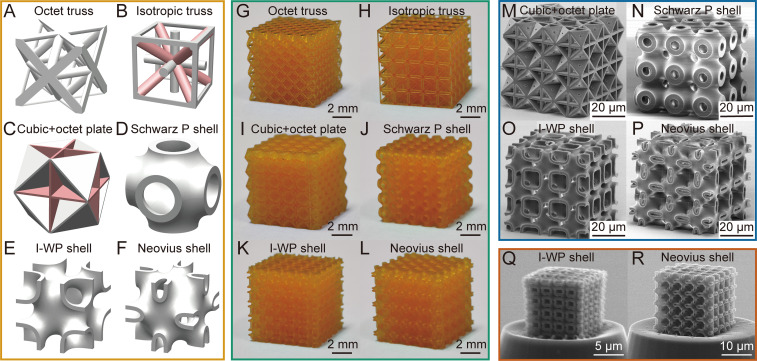
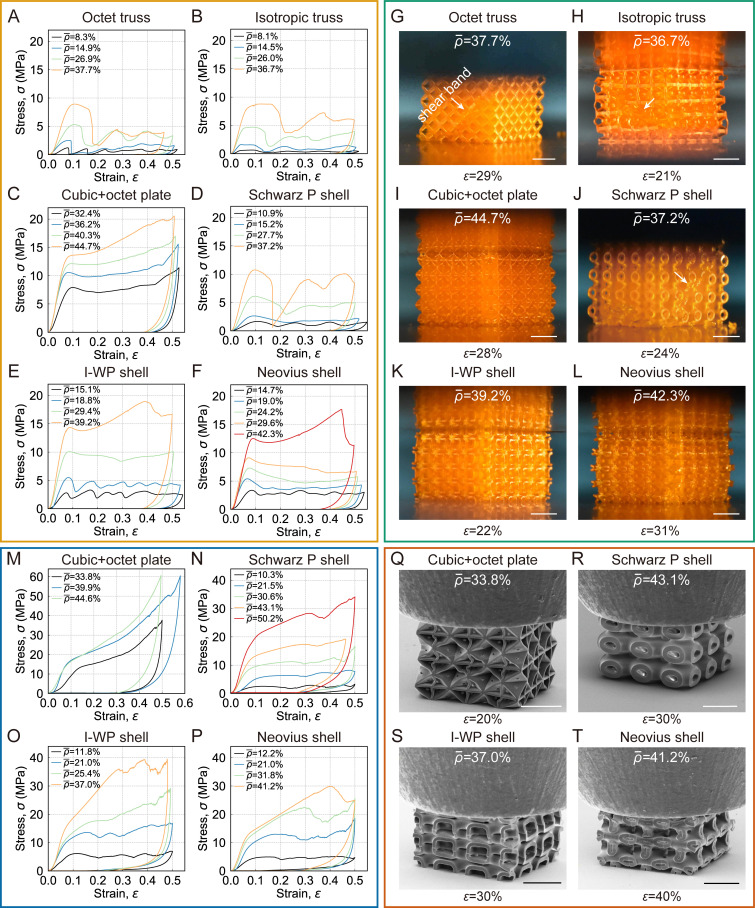
Recent developments in mechanical metamaterials exemplify a new paradigm shift called mechanomaterials, in which mechanical forces and designed geometries are proactively deployed to program material properties at multiple scales. Here, we designed shell-based micro-/nanolattices with I-WP (Schoen's I-graph-wrapped package) and Neovius minimal surface topologies. Following the designed topologies, polymeric microlattices were fabricated via projection microstereolithography or two-photon lithography, and pyrolytic carbon nanolattices were created through two-photon lithography and subsequent pyrolysis. The shell thickness of created lattice metamaterials varies over three orders of magnitude from a few hundred nanometers to a few hundred micrometers, covering a wider range of relative densities than most plate-based micro-/nanolattices. In situ compression tests showed that the measured modulus and strength of our shell-based micro-/nanolattices with I-WP topology are superior to those of the optimized plate-based lattices with cubic and octet plate unit cells and truss-based lattices. More strikingly, when the density is larger than 0.53 g cm, the strength of shell-based pyrolytic carbon nanolattices with I-WP topology was found to achieve its theoretical limit. In addition, our shell-based carbon nanolattices exhibited an ultrahigh strength of 3.52 GPa, an ultralarge fracture strain of 23%, and an ultrahigh specific strength of 4.42 GPa g cm, surpassing all previous micro-/nanolattices at comparable densities. These unprecedented properties can be attributed to the designed topologies inducing relatively uniform strain energy distributions and avoiding stress concentrations as well as the nanoscale feature size. Our study demonstrates a mechanomaterial route to design and synthesize micro-/nanoarchitected materials.
近期机械超材料的发展体现了一种新的范式转变,即力学材料,其中机械力和设计的几何形状被主动用来在多个尺度上编程材料性能。在这里,我们设计了基于壳的微/纳晶格,具有 I-WP(Schoen 的 I 图包裹包)和 Neovius 最小曲面拓扑结构。按照设计的拓扑结构,通过投影微立体光刻或双光子光刻制造聚合物微晶格,并通过双光子光刻和随后的热解制造热解碳纳晶格。所创建的晶格超材料的壳层厚度跨越三个数量级,从几百纳米到几百微米不等,比大多数基于板的微/纳晶格具有更宽的相对密度范围。原位压缩测试表明,我们的基于壳的微/纳晶格的 I-WP 拓扑结构的测量模量和强度优于具有立方和八面体板单元和基于桁架的晶格的优化板基晶格的测量模量和强度。更引人注目的是,当密度大于 0.53 g cm 时,发现具有 I-WP 拓扑结构的基于壳的热解碳纳晶格的强度达到了其理论极限。此外,我们的基于壳的碳纳晶格表现出超高强度 3.52 GPa、超大断裂应变 23%和超高比强度 4.42 GPa g cm,超过了所有以前在可比密度下的微/纳晶格。这些前所未有的特性可归因于设计的拓扑结构诱导相对均匀的应变能分布并避免应力集中以及纳米级特征尺寸。我们的研究展示了一种设计和合成微/纳结构材料的力学材料途径。